
Books
Making money work
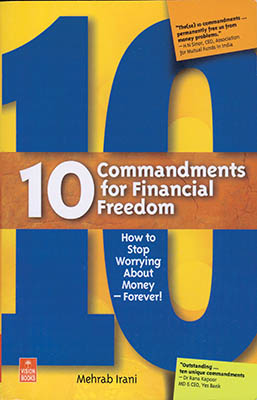
10 Commandments for Financial Freedom: How to Stop Worrying About Money — Forever! by Mehrab Irani. Published in 2013 by Vision Books Private Limited, 24 Feroze Gandhi Road, Lajpat Nagar 3, New Delhi 110024. Pp: 376. Price: Rs 395.
The subject is one which will interest a lot of people and most of us would like to stop worrying about money — forever. This is Mehrab Irani’s intention in his book 10 Commandments for Financial Freedom: How to Stop Worrying About Money — Forever! Looking at his school-going daughter, he realizes that a mere investment in excellent education will not liberate us from our day-to-day monetary problems. The introduction very clearly states that the book challenges conventional wisdom and thinking about money and what we should and should not expect from the book. Just as Moses received the Ten Commandments from Jesus Christ, we wait to receive Irani’s Ten Commandments which will free us from the constant worry of investing wisely so that we can harness our efforts to different and more constructive purposes.

Mehrab Irani: monetary advice
The first commandment deals with the importance of a rational allocation of assets and Irani quotes research which, contrary to popular belief, reveals that 90% of the return on an investment (ROI) portfolio depends on how an individual has allocated his funds under different categories of investments and only 10% depends on an individual’s ability to choose the right kind of stock and the correct moment to buy or sell. He proceeds to demolish the myth that gold never falls in value. If gold rose 23 times between 1971 and 1980, it fell by 70% during the next 20 years whereas stocks rose by 10 times over that period. He makes a very valid comment that the trick of asset allocation is not merely to diversify our investments per se but more importantly to try and ensure that the asset classes like government bonds, bank fixed deposits, equity shares, gold are not correlated to each other as far as possible. Useful summaries are provided at the end of each chapter entitled "Lessons From This Commandment.”
Irani similarly makes a very acute observation when he mentions that human beings generally spend more time and research while buying a share rather than selling it. He also draws our attention to the very pertinent fact that a salary increase cannot be seen as an end in itself but should be viewed with reference to inflation rates.
 Irani adopts the "You” attitude of directly addressing the reader and advising him on the future course of action. Whereas this technique does to a certain extent build up a sense of intimacy, it occasionally does make the reader feel he is a recalcitrant schoolboy being corrected by an all-knowing teacher. Also, the "Self-Understanding Questionnaire,” which summarizes the main concerns and attempts to make the reader think in the right direction, may seem to a few like an examination which is being held at regular intervals to assess the reader’s comprehension of the subject.
Occasionally Irani tends to labor the point. After clearly stating that 90% of the ROI depended on allocation of funds, he goes on to mention that asset allocation is nine times more important than an individual’s decision of what to buy and when. This is again repeated in the sentence when he mentions that individuals spend more time on the market timing rather than on asset allocation. Sometimes he leaves the reader wishing that there would be a bit more elaboration. Some more explanation on the various types of mutual funds and the benefits of an equity fund or a debt fund or a close ended or open ended fund could have helped the lay investor.
It is not clear for whom the book has been written. There is a class of investors which is more or less savvy with making their money work for them but a larger majority is quite clueless. If the book is being written for the lay reader, one wonders how easy it would be for him or her to understand the concept of discounted cash flows when Irani defines it as "estimating the future free cash flows of a company — and then assessing their present value by applying a proper discount rate.” Irani discusses with great clarity and length how different classes of assets perform under varying stages of a business cycle. However, how many readers would be conversant with the statement that "bond prices bottom out, and, conversely interest rates peak.” May be some more elucidation of why this happens would help the lay reader.
It is this class of investor who heeds help and guidance to rid himself or herself from worrying about money and to get freedom from the clutches of self-seeking bankers and brokers. Irani is unusually harsh with bankers. He terms them as being undercover predators and accuses them of selling products the customer does not need. However, is it correct to generalize that banks provide substandard services and charge high fees for this? Also, can one fault bankers for making money by borrowing from the individual at four persent on a savings bank account and lending it at higher rate? He is ready to differentiate between a good broker and a bad broker but surely the same would apply to banks and bankers as well as some do provide excellent service and advice.
Though the book is certainly a very valuable contribution on the subject of making money work, it would be even more valuable if Irani had kept the average investor more clearly in mind and had written the book in a language which would help him or her to maximize the ROI.
◆ ◆ ◆
From the archive