
Events & Personalities
Honoring Dr Homi Dastur
Senior neurosurgeon Dr Homi Dastur was felicitated at a live neurology workshop held jointly by the departments of neurology at the Tata Memorial and K. E. M. (King Edward Memorial) Hospitals on February 20-21, 2014 in the auditorium of the Tata Memorial Hospital. The event was the first in a series of orations set up in his name by admirers in the field. The reticent 87-year-old doctor had established the department of neurosurgery at the KEM Hospital in 1957 which he headed until 1974 following which he became consultant neurosurgeon at the Jaslok Hospital and Research Centre in Bombay where he still sees loyal patients who refuse to let him retire. Dr Sunil Pandya, distinguished neurosurgeon who has been with the Jaslok Hospital after retirement from KEM, paid tribute to his mentor through a Power Point presentation prepared jointly by himself and Dina Mehta, Dastur’s daughter who forwarded it to us at Parsiana’s request. It was based on two long personal interviews with Dastur along with archival material. A proposal was made on the occasion to rename the department at the KEM as "Homi Dastur Department of Neurosurgery” in his honor, as has been done in some cases abroad.
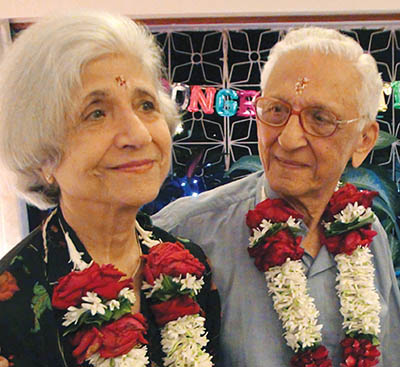
Drs Roshan and Homi Dastur
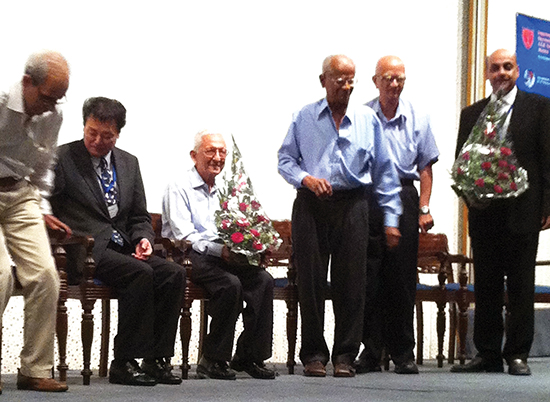
At the felicitation: Drs Takanori Fukushima and Dastur (seated) with others
"I was surprised at the whole thing,” Dastur admitted when Parsiana spoke to him over the telephone. The self-effacing surgeon felt "there was no need for such ceremonial recognition or acknowledgement.” People who had worked with him and his assistants who took charge of the department after he left seemed to think otherwise. He appreciated their continuing "joint effort to maintain the records and progress.” After his felicitation Dastur publicly thanked his wife of 50 years, Dr Roshan Dastur for her constant support: "None of this would have been possible without one person, my wife,” he acknowledged.
Another keynote speaker at the event was Dr Takanori Fukushima, professor of neurosurgery at Duke University Medical Center and Duke Raleigh Hospital at the Carolina Neuroscience Institute (CNI), USA. One of the top neurosurgeons in the world, Fukushima has specialized in his field for 35 years, being in the forefront of developing and teaching the most innovative surgical techniques, mentions the website of the CNI.
Pandya’s presentation reveals that Dastur, who was born in Karachi in 1926 and schooled there as well as in Lahore and Bangalore, attended Elphinstone College in Bombay. His medical education was at the Seth G. S. Medical College in Bombay where he obtained an MBBS degree in 1949 and Master of Surgery from the University of Bombay in 1952. In 1954 he became a Fellow of the Royal College of Surgeons, Edinburgh. Sir Wylie McKissock, a seminal figure in postwar British neurosurgery, wrote: "I can in all honesty say that Mr Dastur is the type and caliber of man whom I would be most happy to have as one of my own professional colleagues.” However, Dastur chose to return to India, where he implemented lessons learnt from McKissock and his team. These included introducing new procedures, streamlining operating techniques to shorten the time of each surgery, maintaining meticulous records on every patient and providing detailed reports to referring physicians, Pandya informed those present.
Working as the only consultant, in the early days Dastur attended to the daily outpatient clinics, performed operations and went on ward rounds until Dr Anil Desai joined the department. After some effort he managed to get the services of a stenographer-secretary, Warrier, who remained his faithful assistant for as long as he was with the KEM, doing the typing and maintaining the records. With just four beds scattered throughout the KEM Hospital, Dastur was permitted to start neurosurgical operations only around 4-6 p.m. after the general surgeons had finished for the day! Later, he was permitted to share the plastic surgery operation theater. The current operation theater complex, neurosurgery wards, office and outpatient clinic were provided much later, after Prof P. K. Sen saw him operate on a resident doctor in the middle of the night to remove a brain clot, Pandya revealed.
Dastur has always maintained high ethical standards, his priorities being care of patients, education of postgraduate and undergraduate students, and conducting research. Strict discipline was enforced regarding care of patients, almost all of whom were from the poorest strata of society. Molding the department into one of India’s finest, he was the first in Bombay to incorporate many innovations. Dastur’s treatment of patients and results of surgical procedures have been lauded throughout the city. Ever willing to share his knowledge and skills, he mentored several eminent neurosurgeons of today. He also conducted extensive research with his papers being read and published in India and abroad.
The quintessential family man, "Even at the busiest times in his department, he was always there for us,” acknowledges his wife Roshan. She earned her doctorate in medical and psychiatric social work and taught at Nirmala Niketan College of Social work and the Tata Institute of Social Sciences. At present she is honorary trustee at the J. J. Dharamshala at Nagpada in Bombay, mentions Dina. The three Dastur daughters are achievers in their own right, the eldest, Roshna Thapar being a senior director at DBS (Development Bank of Singapore); Dina is a market researcher having her own company, Convo.org; while the youngest, Sherna Dastur is a filmmaker and graphic designer.
◆ ◆ ◆
From the archive