
10WZC
The pluses and minuses
While the 10WZC dealt with the dwindling numbers and other problems, contentious matters like cremation and interfaith marriages were swept under the carpet
The 10th World Zoroastrian Congress (10WZC) has received mixed reviews. There has been much praise for the delicious food, the lovely entertainment performances and the enjoyable evening at the races. However, a common complaint of many Zoroastrians was the inability of the Congress to address and focus on key issues currently being faced by the community.
A contentious issue that wasn’t touched upon was whether Zoroastrian women should be ordained as priests. While I understand that from a traditional and doctrinal point of view women are not allowed to enter fire temples while they are menstruating, perhaps a provision can be made whereby older women are permitted to perform certain rituals. I would have loved to hear religious scholars and legal minds argue and give us their perspectives and tell us whether such an arrangement would be viable in India or not.
While on the subject of priesthood, the 10WZC failed to address even the non-contentious issue of dearth of male priests. Something must be done to improve the lot of mobeds. The work is back-breaking and the remuneration for priests is low. Why would a Zoroastrian boy give up a cushy white-collar job and opt for full-time mobedi in a fire temple? On one hand, people say that Zoroastrian women marry outside the faith because Zoroastrian men are "not up to the mark,” while on the other, the community is pressurizing men to go back to their roots and serve the community no matter how meager the stipend.
The 10WZC was the perfect platform to address the issue of disposal of the dead, bring in different viewpoints and ask members what they felt about matters like the proposed vulture aviary project at Doongerwadi. However, the topic wasn’t even touched upon.
Interfaith marriages and the consequences for children of such unions were also not discussed. If the children of Parsi men and their non-Parsi spouses may be admitted into our places of worship, why are those of Parsi women and non-Parsi men debarred? Can a Parsi woman enter an agiary if she hasn’t converted (to the religion of her husband) or has married under the Special Marriage Act? Can childless Parsi couples adopt children? Is it even legal? It would have been wonderful to hear legal luminaries explain where we stand in such matters. I’m sure discussion of such issues would have been maturely handled by most delegates and would not (as the organizers feared) have degenerated into heckling and name-calling.
A contentious issue that wasn’t touched upon was whether Zoroastrian women should be ordained as priests. While I understand that from a traditional and doctrinal point of view women are not allowed to enter fire temples while they are menstruating, perhaps a provision can be made whereby older women are permitted to perform certain rituals. I would have loved to hear religious scholars and legal minds argue and give us their perspectives and tell us whether such an arrangement would be viable in India or not.
While on the subject of priesthood, the 10WZC failed to address even the non-contentious issue of dearth of male priests. Something must be done to improve the lot of mobeds. The work is back-breaking and the remuneration for priests is low. Why would a Zoroastrian boy give up a cushy white-collar job and opt for full-time mobedi in a fire temple? On one hand, people say that Zoroastrian women marry outside the faith because Zoroastrian men are "not up to the mark,” while on the other, the community is pressurizing men to go back to their roots and serve the community no matter how meager the stipend.
The 10WZC was the perfect platform to address the issue of disposal of the dead, bring in different viewpoints and ask members what they felt about matters like the proposed vulture aviary project at Doongerwadi. However, the topic wasn’t even touched upon.
Interfaith marriages and the consequences for children of such unions were also not discussed. If the children of Parsi men and their non-Parsi spouses may be admitted into our places of worship, why are those of Parsi women and non-Parsi men debarred? Can a Parsi woman enter an agiary if she hasn’t converted (to the religion of her husband) or has married under the Special Marriage Act? Can childless Parsi couples adopt children? Is it even legal? It would have been wonderful to hear legal luminaries explain where we stand in such matters. I’m sure discussion of such issues would have been maturely handled by most delegates and would not (as the organizers feared) have degenerated into heckling and name-calling.
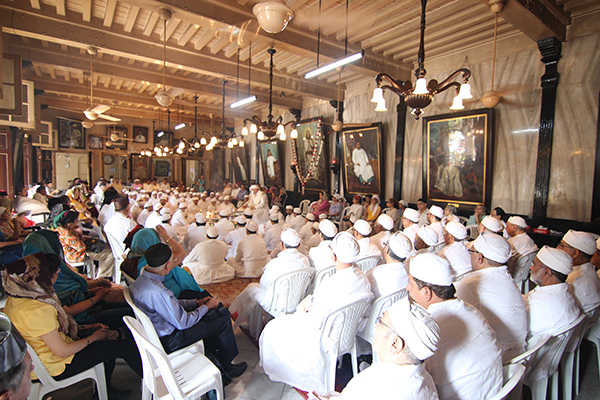
After the inaugural jashan of 10WZC at H. B. Wadia Atash Behram no
session focussed on priests Photo: Jasmine D. Driver
The session on late marriage and divorce (which was packed to capacity), was interesting as it raised important questions about why the age at marriage for Parsis is on the rise, and why so many women prefer to marry outside the community. The panellists not only spoke about the physical and emotional effects a divorce has on couples and their children (if any), but also about various legal problems that could occur. Tolerance and adjustment were declared the need of the hour and, as a young Zoroastrian woman I felt that the session did to a great extent make the youth aware of the various problems and worked toward suggesting concrete solutions. It was heartening to note that most of the youth present did want to marry within the community and expressed frustration at not being able to find suitable Zoroastrian partners.
The pressing issue of dwindling numbers was addressed, with several sessions devoted to the subject. Everyone is aware of the reasons for this state of affairs, but the 10WZC also put forward a kind of manifesto as to what was being planned to tackle it. The Jiyo Parsi scheme, for which the Government of India has sanctioned Rs 10 crores, is a step in the right direction, as is the treatment of infertility in young Zoroastrian couples. The organizers were prudent in including several different sessions to deal with this issue.
Dr Cyrus Poonawalla, 10WZC chairman said tardiness was a trait that irked him, but that did not seem to bother several of the speakers who insisted on usurping the stage for more than their allotted time slot, throwing the tight schedule into complete disarray. This led to cutting down on networking time and intermingling among delegates, which is an important part of any congress. However, at the various entertainment programs and dinners delegates were able to interact and make a few friends.
The signal success of the 10WZC was the amount of publicity it was able to garner in the national Press. Prominent newspapers provided generous coverage on all four days and I’m sure this must have created a buzz among other communities.
To conclude, most speakers dealt with what had happened in the past and on the present state of the community, but hardly anyone touched upon what could be done or how certain sticky situations could be tackled. Once again, fearing discussion on contentious issues, people preferred to stick to the tried and tested path of harping on our past laurels and glories.
That being said, I do think the 10WZC made several Zoroastrians ponder over pertinent issues affecting the community. It will take time, effort and money to sort out most of the problems plaguing our community, but the 10WZC made a start by helping indigenous (and overseas delegates) take off their blinkers and see the not-so-positive side. As Dr Nathaniel Branden, the American psychotherapist who worked in the field of self esteem said, "The first step toward change is awareness. The second step is acceptance.”
◆ ◆ ◆
From the archive