
Politics and Policy
The end of Camelot
Factions within the Bombay Parsi Punchayet board result in besmirching the name of the Punchayet
Many friends ask me about my involvement in the affairs of the community and particularly my experience as a trustee of the Bombay Parsi Punchayet (BPP) for 17 years. Though initially I was not inclined as I had a case against the BPP (pertaining to the so-called renegade priests), because of the recent shocking behavior of the trustees I feel the community needs to know what a drastic change has come about in the manner of functioning of the trustees. And I am using the opportunity to recount my experiences.
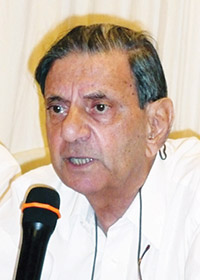
Jamsheed Kanga: "took bold decisions"
I was born and educated in Nagpur and my familiarity with Bombay was originally restricted to a few holidays spent with my aunt at Gowalia Tank. Only after I was selected for the Indian Administrative Service (IAS) and posted in Bombay and later Maharashtra state that I got to know and love Bombay. My first seven years in service were in postings outside Bombay. So my first connection with Parsi matters began with the participation in the World Zoroastrian Congress hosted by the BPP in 1978 at the Cowasjee Jehangir Hall where I participated from the floor in discussions. At that time the trustees were elected by the Anjuman Committee (AC) which consisted of all donors of Rs 5,000 and above (donor members) and an equal number of elected members from amongst those who paid Rs 5 to enrol. Those persons formed the AC which elected a trustee when a vacancy arose. I discovered that there was total ignorance in the community about the scheme. There were few ordinary members as a result a few power brokers who enrolled their friends to determine who was elected.
In order to increase the ordinary membership so that there was more involvement of the young, likeminded Parsis and I formed the Committee for Electoral Rights (CER) which organized a massive enrolment drive. As a result a fairly representative AC was elected in 1981. Soon thereafter when a vacancy arose on BPP chairman B. K. Boman-Behram’s retirement, I was elected unopposed as a trustee.
The other trustees at that time were cardiologist Dr Aspi Golwala, lawyer Eruch Desai, industrialist Jamshed Guzder, Justice Jal Vimadalal, general practitioner Dr Nelie Noble and businessman Manekji Hodivala. Golwalla as the senior most was elected chairman and Rustom Anklesaria, a retired IAS officer was the chief executive officer (CEO). I can state with honesty that I enjoyed the 17 years I spent as a trustee. We worked in a cordial fashion and for the good of the community. All the trustees were eminent persons who had succeeded in their own fields before they became trustees and did not require trusteeship to enhance their reputation. Nor did they have a different agenda as is the case today when persons spend huge amounts to entertain voters to get elected and gain fame. In fact no one spent a single pie for canvasing at that time. Anklesaria with his past experience as municipal commissioner of Ahmedabad and secretary to the chief minister of Gujarat ensured that before any matter came up for discussion the facts were properly presented along with his opinion, to help us decide. Though we often held differing views we discussed the issues in a reasonable manner and took decisions. Subsequently industrialist Naoroji Godrej and legal tax expert Homi Ranina were elected when vacancies arose.
During this period the trustees undertook the construction of flats at Godrej Baug, which resulted in the largest increase in our residential colonies since B. S. Panthaki and S. B. Bharucha baugs were built. The merit rating system of allotment was introduced and Justice Bakhtavar Lentin was appointed as ombudsman to hear applicants’ grievances. The system of doles was streamlined.
The most important achievement was the BPP rejoining the Federation of the Parsi Zoroastrian Anjumans of India (FPZAI). The all-India body was led by stalwarts like retired Indian Civil Service officer Shiavax Nargolwala, Golwalla, Guzder, Desai, Mani Clubwala of Madras and joint honorary secretary Keki Gandhi, besides others. With the assistance of Homi J. H. Taleyarkhan, a member of the National Minorities Commission, the FPZAI was a great boon to small anjumans in Gujarat and elsewhere. The Holiday Programme for Youth began which brought youth from all over India to Bombay. The trustees took bold decisions on issues such as permitting Parsi women married under the Special Marriage Act and continuing to profess Zoroastrianism, the use of the Doongerwadi. (This was after seeking the opinion of an eminent ex-Chief Justice of India.) What is most significant is that there was harmony among the trustees who respected each other’s views, discussed and debated matters in a civilized manner, and devoted themselves to serving the community with no self interest in mind. All trustees attended every meeting well in time from 6 to 9 p.m. even though many were busy professionals and businessmen. I was municipal commissioner of Bombay with a gruelling schedule, yet I always came in time for each meeting.
Some say that the caliber of the trustees has deteriorated on account of universal adult franchise (UAF) and that the earlier AC system was better. This is incorrect. Since the AC had the right to elect trustees as and when vacancies arose, any organization that controlled the AC elected trustees of their choice for seven years. This almost happened when the last AC election was to be held and the World Alliance of Parsi Irani Zarthoshtis (WAPIZ) (all fundamentalist groups are more zealous and better organized than others) almost captured the AC. If elected, WAPIZ would have had got all their supporters as trustees. That was why they moved the courts to prevent a change to UAF. Before the first election under UAF took place there were only two vacancies to be filled. But the entire board of trustees resigned. This was to prevent Dinshaw Mehta from becoming the next chairman by seniority. Though a panel of outstanding persons such as tax consultant Soli Dastur (who subsequently withdrew on account of his wife’s ill health), Keki Mistry (CEO, HDFC Bank), the late Dr Ketayun Dinshaw (director, Tata Memorial Hospital) and many others were fielded, the results were a disaster. As a result the majority of the trustees who were elected were from well-organized fundamentalist groups and some others including Mehta, were people who used money power to get themselves or their candidates elected by lavishly wooing the voters with dinners. There was little continuity as only one former trustee, Mehta, was elected. Very few had achieved eminence in any area. Of course there are a few who are sincere and have a good record of service but they are the exceptions.
Over the last three-four years we have witnessed the priorities of the trustees and their method of functioning. This board has the unique achievement of doing things never done before in the history of the BPP like the trustees trying to prevent the navjote of children of interfaith parents through threats of force, and the trustees going out of Bombay and physically threatening to rip the sudreh of a person to prevent what was considered wrong religious practice, of threatening and debarring certain priests for the same reason. Or humiliating an elected fellow trustee by denying him access to agenda papers and minutes because he had the gumption to disagree, of spending crores of community funds in litigation for issues outside their jurisdiction and preparing to spend even more. The question of taking money to allow the transfer of charity flats, meant for the really poor to persons who can pay crores, totally violates the object of the donors and is not only unethical, but allows scope for corruption which we are now witnessing. Statistics show three trustees Khojeste Mistree, Yazdi Desai and Jimmy Mistry missed as many as 14, 21, and 24 meetings respectively and also attending meetings after a delay of four hours (see attendance box on pg 28). It is evident that the work of the BPP is not their priority.
But the most shocking episode is where four trustees have filed a police complaint against the chairman for defalcation of funds and criminal breach of trust. As a consequence the normal functioning of this eminent and highly respected body has been derailed. Work is at a standstill. Clearly the two groups in the BPP are attacking each other without any concern about the reputation of this great body. Six ex-trustees, Minoo Shroff, myself, Dadi Engineer, Dinshaw Tamboly, Maneck Engineer and Burjor Antia had suggested that an independent enquiry should be held by a Parsi judge but the advice was not heeded. It is now learnt that the four trustees have approached the Charity Commissioner seeking the removal of the chairman. The future of the BPP is indeed bleak!
The community needs to introspect how things have come to such a pass, and the need to select good, sincere persons rather than who gives the best dinners before the election. If we do not heed the advice we will continue to get men of straw to represent us. The trustees behave as if they have a right to get their relatives on board. Yazdi Desai wants his wife Anahita elected and now Mehta wants his son to succeed him. We hope the community realizes the perils of dynastic rule.
I also feel that it is time that the elders of the community, eminent lawyers, doctors and businessmen take some interest and lead us. They are our true leaders and have brought glory to our community as versus this bunch of trustees. If such an incident had occurred say in the Catholic community the Archbishop would have intervened and sorted out the dispute. Unfortunately our High Priests are not able to do so which is a great pity. We are truly rudderless today.
I can only conclude with the hope expressed by Rabindranath Tagore for our country:
"Where the mind is without fear…/where the world has not been broken up into fragments/By narrow domestic walls/…Where the clear stream of reason has not lost its way/Into the dreary desert sand of dead habit/… Into the heaven of freedom may our (community) awake.”
◆ ◆ ◆
From the archive