
Readers' Forum
Devoid of devotees
We have been hearing a legitimate refrain, virtually a lament, that many of our agiaries remain empty — devoid of devotees. This is a socio demographic religious malaise with very evident reasons but with little attention paid to possible remedies.
There are many reasons such as migration from south Bombay to north Bombay. Agiaries in other cities and towns also suffer this fate. Migration from India is another reason.
However, neglect of prayers is a bigger worry than empty agiaries. Many women and quite a few men do not wear the sudreh and kusti. This practice is not just confined to the young. Those in their 60s, 70s and 80s are equally guilty. If at random you ask a Parsi what roz or mah it is, 50% will not be able to answer!
Some agiaries, in Bombay and in smaller places are in such a pathetic state that the devotees are put off. What can one expect when a panthaky is paid just Rs 3,500 per month and asked to fend for himself?
The High Priests have done next to nothing to inspire confidence and motivate Parsis to first seek solace in prayers, to analyze and appreciate our rituals or to enthuse them to visit fire temples. Nor have they done anything to help people to marry within the community choosing to merely criticize inter-faith marriages. Inter-faith marriages have come to stay, with 39% occurring in Bombay, 80% in Calcutta and 15-20% in Gujarat. (There are no statistics available on Gujarat interfaith marriages — editors.) When the priests’ own children have married out of the fold, how can they carry conviction?
Yet another reason why Parsis have stopped going to the agiaries is the very illogical practice of agiaries not performing post-funerary rites for the first four days for those who opt to be cremated. Which scripture sanctions this?
The dullest among Parsis take up priesthood (for economic reasons). They inspire no confidence in the laity to look up to them for any guidance. Consider the continuing anachronistic practice of ara antar (when the bride and groom are separated by a white cloth at the beginning of the wedding ceremony). This is a non-Zoroastrian practice which no priest has had the gumption to do away with.
With the rigid birth control practiced by community members causing our numbers to decline, this will prove the last straw on the camel’s back. Unless we wake up and act collectively, our agiaries will continue to remain empty.
There are many reasons such as migration from south Bombay to north Bombay. Agiaries in other cities and towns also suffer this fate. Migration from India is another reason.
However, neglect of prayers is a bigger worry than empty agiaries. Many women and quite a few men do not wear the sudreh and kusti. This practice is not just confined to the young. Those in their 60s, 70s and 80s are equally guilty. If at random you ask a Parsi what roz or mah it is, 50% will not be able to answer!
Some agiaries, in Bombay and in smaller places are in such a pathetic state that the devotees are put off. What can one expect when a panthaky is paid just Rs 3,500 per month and asked to fend for himself?
The High Priests have done next to nothing to inspire confidence and motivate Parsis to first seek solace in prayers, to analyze and appreciate our rituals or to enthuse them to visit fire temples. Nor have they done anything to help people to marry within the community choosing to merely criticize inter-faith marriages. Inter-faith marriages have come to stay, with 39% occurring in Bombay, 80% in Calcutta and 15-20% in Gujarat. (There are no statistics available on Gujarat interfaith marriages — editors.) When the priests’ own children have married out of the fold, how can they carry conviction?
Yet another reason why Parsis have stopped going to the agiaries is the very illogical practice of agiaries not performing post-funerary rites for the first four days for those who opt to be cremated. Which scripture sanctions this?
The dullest among Parsis take up priesthood (for economic reasons). They inspire no confidence in the laity to look up to them for any guidance. Consider the continuing anachronistic practice of ara antar (when the bride and groom are separated by a white cloth at the beginning of the wedding ceremony). This is a non-Zoroastrian practice which no priest has had the gumption to do away with.
With the rigid birth control practiced by community members causing our numbers to decline, this will prove the last straw on the camel’s back. Unless we wake up and act collectively, our agiaries will continue to remain empty.
B. T. DASTUR
At Parsiana’s request London based Zoroastrian scholar Farrokh Vajifdar explains:
What with chucking rice grains, busting coconuts and smashing eggs, after safe removal of the sinisterly perceived white sheet, we are now gunning for "excised customs.” By inference, this should extend to the fading out of other Hindu-acquired wedding traditions — no more tilis for rice-sticking, no more gorgeous (and gaudy) saris, no kors, no garas, no more pseudo-Sanskrit pasandes ("I dos.”)
What with chucking rice grains, busting coconuts and smashing eggs, after safe removal of the sinisterly perceived white sheet, we are now gunning for "excised customs.” By inference, this should extend to the fading out of other Hindu-acquired wedding traditions — no more tilis for rice-sticking, no more gorgeous (and gaudy) saris, no kors, no garas, no more pseudo-Sanskrit pasandes ("I dos.”)
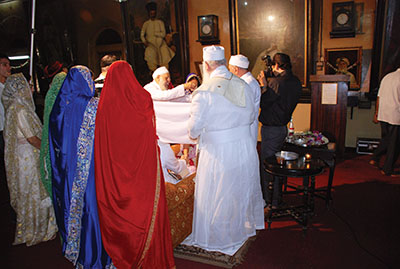
The ara antar at a wedding ceremony
The white sheet separator goes far beyond India, Iran and other nations with ancient precedents. For Parsis — shun "(non)-Zoroastrian” in these contexts! — as for others the significance is virginal, to put it delicately. To be impolite, in another setting (best left unnamed) the white sheet was then spread across the conjugal bed on the wedding night, and after consummation, it was proudly displayed as its proof to the seniors of both families. The tilis, both dot and dash, should further explain this custom. We Parsis, being vastly superior in every way to all lesser races (!) have, without realizing its full import, restricted this nauseating habit to the pre-ceremonial slot. The happy-to-be pair are both considered to have been prim and proper in sexual abstinence (oh yes?) before the actual ceremony, and supposedly not even having had sight of one another until the removal of the ara antar sheet. Now, try telling this to our priests for whom these traits, and even the dual language of the wedding ritual is wholly unintelligible. Ask also whatever happened to the eki-beki (the guessing of whether coins held by the couple are odd or even in number); will it be replaced with the credit limit on plastic cards? And the chhera-chheri (fastening the couple’s garments together with a knot)?
◆ ◆ ◆
From the archive