
Books
Memorial to a city
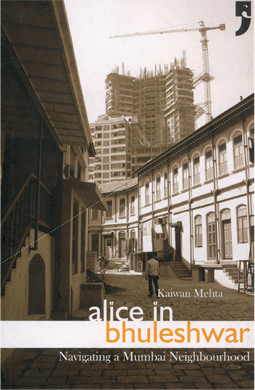
Alice in Bhuleshwar: Navigating a Mumbai Neighbourhood by Kaiwan Mehta. Published in 2009 by Yoda Press, 268 A/C, Vasant Kunj, New Delhi 110070. Pp: xix + 187. Price: Rs 295.
When Lewis Carroll wrote Alice in Wonderland he created a young girl, extremely curious about the wonders all around which delight her and prompt her to raise several unanswerable questions. Ever thereafter, Alice has become a symbol of joy in a wondrous world. Hence, Kaiwan Mehta’s Alice in Bhuleshwar: from one wonderland to another. Mehta is sympathetic to Alice’s perplexity: "I’m searching my cities. I search inside and around buildings. Do I search for what is lost, or do I search for that I do not wish to lose? Or do I simply search to find what I do not know? How can I search that which I do not know?”
The appropriateness of the book’s title becomes increasingly relevant as one goes through page after page. In the curiosity of rediscovering Bombay, the author resembles Alice, grown older and wiser, fortified by his anxiety to rediscover the city that continues to mystify him. A student of architecture, literature, Indian aesthetics and cultural studies, Mehta is currently pursuing a doctorate at the Centre for the Study of Culture and Society at Bangalore. He has been associated with many institutions like the KRV Institute for Architecture, Bombay; Jnanapravala, Bombay and Akademie Schloss Solitude, Stuttgart.
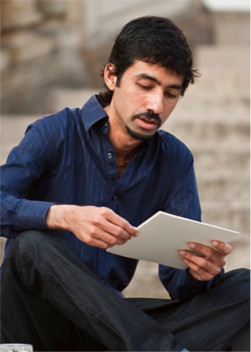
Author Kaiwan Mehta: Bringing Bombay alive
The knowledge gained thereby is reflected in Alice in Bhuleshwar where he takes his readers for a walk through the streets and past the buildings of the "native town” of colonial Bombay which remains a residential and religious hub as before and continues to thrive in Bhuleshwar, the city’s essential commercial marketplace. The buildings, to Mehta, are literally registers of history, maps defining the past, yet singularly relevant and alive in today’s changed times. "Every gali (lane) belongs to a sweeper, and he proudly owns the burden, as much as he curses the stench in his life... As I see and enjoy the map that shows me my buildings of fantastical imagination, from days gone by, I miss, unapologetic, the maps of garbage, the heritage of dust.”
The city’s diversity he ascribes to a cohesion of integrity. To experience a city one needs to recall the desires, symbols, metaphors and fantasies through which we ascribe meaning to the modern experience of urban living. History, to him, is to understand humanity as a constantly dynamic set of objects, collections and constellations. "The urge to view cities is the urge to comprehension, is the urge to believe for that fraction of a moment that ‘I know the city.’”
In travelling across the city, Mehta feels that many have romanticised the trains in Bombay. Personally, he refers to them as "boxes of steel that are pure nothingness, like coffins of steel. Transferring the city from here to there, they mix up the city like the milkman churning milk in Bhuleshwar.” Some comparison, that!
Fortunately, his attention turns to the hospital opposite the Charni Road station which bears on its facade: "When I fall ill, it is He who cures.” As the old, long, one-storied building was considered a "heritage site,” it could not be touched. But the multiplying numbers of patients desperate for beds solved the problem. The old building was broken down to be replaced by a new, three-storied, much bigger one which is believed to have drawn its design elements from the geometric proportions and correctness of other examples of Islamic architecture. "Today the building stands tall with domes and glass facades,” writes Mehta, "trying to look ancient and strong, and ending up as a marquee, once the sun sets, with green and purple lights flickering on it!”
Alice in Bhuleshwar takes the reader through the usual tourist attractions abounding in the city. His architectural background, his personal knowledge of every item of tourist interest and his abounding love for the city make his presentation more "alive” than it would be if left to the so-called "guides” who recite by rote what little they know. Constrained by space, I have to confine myself to just one or two of these items. A major landmark, the Rajabai Tower was built by the merchant prince Premchand Roychand in memory of his mother. Designed on the lines of Big Ben in London, "This Tower continues to stand as an anthropological document of colonialism in stone.” The Tower shows 16 men, each dressed in the particular clothing of his community. The sculpture showing eight men is repeated in two rows, one at mid-level and one at the top at lantern level. If one were walking around the Oval Maidan on a full moon night, surrounded by darkness, one would be able to see two moons, the moon itself and the clock.
Mehta mentions a tragic incident that outraged the entire city. Two girls out on an evening stroll, ventured to climb to the top of the Tower to have a better view of the entire city around them. They were alarmed to be chased by a suspicious looking man. In panic, to save their honor and that of their families, both girls jumped to their death. One of the girls, pet-named Bachu, had been married less than a month earlier to Ardeshir Godrej, founder-pioneer of the Godrej enterprise. Many monuments were raised in honor of the girls.
The historic Dandi March by Mahatma Gandhi which brought freedom for India several steps closer was launched at the Servants of India building, just down the road from Bal Wadi and Charni Road and opposite the Harkisandas Hospital.
The author mentions the conservative notions concerning women of 19th century Bombay "which in many ways have not changed even after 100 years.” He recalls the days of Pandita Ramabai, Dadabhai Naoroji and Maneckji Khurshedji Shroff who became famous through the Khada Parsi statue at Byculla today. Moving out of the Fort precinct or Malabar Hill to Bhuleshwar and Girgaon that were a part of the once "native town” of colonial Bombay: "We refer to this entire area very fondly and collectively as Bhuleshwar — a place where one can simply get lost (bhulaiya) in the entwined streets, and even more narrowly entwined histories, or rather stories that die yet unfold here every moment.” As the author argues, is not the idea of getting lost, if accompanied with imagination and curiosity, also a very creative action? This labyrinth is actually the journey of his book. Bhuleshwar is for the author "a wonderland for the many questions I needed to ask of architecture, history and politics, basically the city...
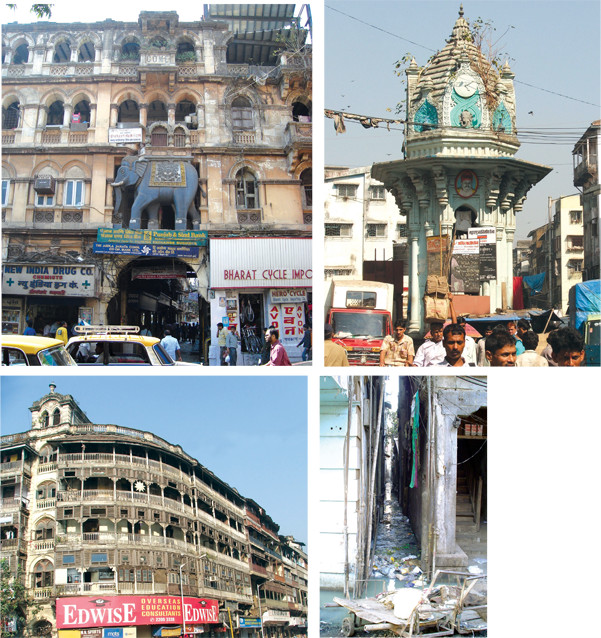
Clockwise from top left: Bhangwadi elephant; a water fountain in the city; an alley inbetween two buildings and Jer Mahal at Dhobi Talao with Goan clubs
"The same areas of Bhuleshwar and Kalbadevi with their cluster of wadas and wadis (colonies) developed into the intellectual capital of Gujaratis. The culture of Parsi Gujarati theater which came to be known as ‘Rangabhoomi’ developed in Ahmedabad in 1847-48 and saw its first performance in Bombay in Narsopant Wada in 1853.” It also was shown in cities like Surat and Baroda. The Parsis first performed Shakespeare’s Taming of the Shrew in Surat in 1801. In the same year, a Kolhapur-based Marathi theater company visited Baroda and toured Gujarat where their themes from history and chronicles set the trend for future Gujarati plays. From 1858 to 1867 Bombay saw the rise of theater clubs. The Royal Theatre was set up at Horniman Circle for the entertainment of the native elite. This was followed by the Royal Theatre at Grant Road. A regular play would begin with a prayer, the narrator would introduce each of the characters, colorful clowns and dancers would entertain the audience before the play commenced.
In all these plays, women’s roles would be performed by men. Even the progressive Parsis opposed women acting on the stage with men. The first woman to appear on the stage was at the Bori Bunder Theatre, later known as Capitol Cinema.
In this context, Mehta speaks of the well-known actor Jayashankar who impersonated Sundari on the stage, but retained his male identity off it. He had a Parsi girlfriend who visited him in her car on the pretext of wanting to procure theater scripts and song booklets. Another friend of his was Fazal Hussein, who also was friendly with the owner of the theater company for which Jayashankar performed. These two relationships, with the Parsi lady and Hussein, offer "insights into the liminal character and identity Jayashankar had come to possess.”
In the lanes of Thakurdwar and CP Tank also lived the famous Premchand, who tried to fathom the human mind and Saroj Pathak who stated: "My sensibility has always been an odd one. I have really never been as interested in the external world and its everyday events as in the working of the mind, which fascinates me.”
Individuals like Cornelia Sorabjee, the first Parsi woman scholar, and Pandita Ramabai posed challenges to the notion of "home” that rested in the imagination of the nationalists. Ramabai’s Sharada Sadan, a home for widows, brought the home into the public sphere and, much like Katherine Mayo’s Mother India, highlighted the suffering of women in India and its homes. So did Sorabjee. "Both were described as traitors or betrayers,” writes Mehta sarcastically. "While in the apparent warmth of the home, the male negotiated between the public space of westernisation and the home space of tradition, where the wife was ‘educated’ to be a ‘good wife’ and ‘companion.’”
To sum up, Alice in Bhuleshwar is written with profound knowledge and deep sensitivity. There is about it a certain resonance which gives it density. I would like to express my admiration for the superb photographs by the author himself, assisted by Anuj Rao and Nuno Grancho; the impressive designing of the book by Asha Sairam, the printing at Paul’s Press and publishing by Arpita Das for Yoda Press; and the high publishing values by Arushi Sen and Supriya Nayak. The book "feels” good in your hands as you read it!
Having myself lived in Bombay for over 80 years, reading this book is like accompanying the author on his travels through the city. So vividly is it written, all memories of seeing it grow under my eyes, through childhood, youth and old age, memories of successes and failures, were revived and revitalised. Even in my travels abroad, Bombay has always remained my favorite city.
Deep inside me, self-exiled as I am in Poona, with memories crying out for a final return to the city of my past, I believe that somehow this city will survive. It has an almost extraordinary survival strength. It has survived communal riots, natural disasters, bandhs (closures), Shiv Sena antics and much else besides.
Why is the city endangered today? What is this new terrible danger it faces? It’s numbers — mere numbers. This grave omission needs to be pointed out in Mehta’s book.
Surely this much-scarred city that has survived major disasters can overcome and control the number of its people. Isn’t it the patriotic duty of each and every citizen — that means you and me — to help in whatever way each of us can?
That is the least we can do to live up to the underlying hopes and expectations of this striking memorial to a beloved city, penned with such devotion by Mehta.
◆ ◆ ◆
From the archive