
Books
A Balcony view
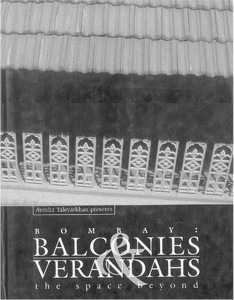
Bombay: Balconies and Verandahs — the space beyond by Ayesha Taleyarkhan. Published in 2002 by Neeru Nanda, Crossover Media and Design Private Limited, A-15, Deeplakshmi, Prabhadevi, Bombay 400025, Tel: 24381689. Pp: 125. Price: Rs 1,000.
"Balconies seemed to be beckoning... Some were exquisite and had clearly been well maintained. Others seemed to have barely weathered years of pollution and neglect. And then I would often catch a glimpse of the crowded and colorful kind; pieces of cluttered households overflowing onto the cityscape... As a photographer I passionately felt the need to capture this concept on film, integrating the images with the changing lifestyles and the ever-changing scenarios of a metropolis like Bombay,” writes Ayesha Taleyarkhan to explain the genesis of the book, Bombay: Balconies and Verandahs — the space beyond.

Taleyarkhan: "integrating images”
"Many books have been written about Bombay and its various facets. None to my knowledge has ever been written about the balconies of Bombay. And so Bombay: Balconies and Verandahs becomes the first of its kind,” the message of the municipal commissioner of Bombay K. C. Srivastava is carried in the book. "Beautifully presented this book is a perfect fusion of text and design and will give you the opportunity to understand Bombay’s history — social, cultural and architectural — through its buildings and in particular, its balconies. This volume is a must-have addition to the book collection of anyone who loves Bombay,” he adds.
"First Ayesha and her idea were dropped in my lap. What a great idea! It appealed. Then Ayesha dropped some 5,000 pictures in my lap. Great pictures. What a challenge!” writes project director Neeru Nanda who, as credits Taleyarkahan, "put her formidable creative and organizational expertise behind the concept (to) demystify the whole process of transforming my idea into a book.”
"Instead of taking the conventional ‘research-the-subject’ route, I let the pictures tell me a story,” Nanda explains her rationale for dividing the book into five sections: "How the megalopolis can be viewed from a balcony; how the balconies serve as the architects’ muse; how the balconies become a metaphor for the character and mood of the people; how the balconies are a medley of stories and memories for the people; how the balcony has gone through a metamorphosis illustrative of the changes in peoples’ lives.”
The text accompanying Taleyarkhan’s incisive visuals in separate sections is contributed by different writers — Mini Chandran-Kurian, Rahul Mehrotra, Madhulika Varma, Meenakshi Agrawal and Brinda Somaya. Lest there be confusion, the reader is told that while a verandah is an entire wrap around space that covers a large portion of the facade of the building, the balcony’s limited projection is localized to a room. Balconies and verandahs in Bombay are found in four distinct architectural styles — the classical or the neo-classical like the Royal Institute of Science and the Cowasji Jehangir Hall, the neo-Gothic like the Bombay University Library and the High Court, vernacular or traditional like Khotachi Wadi and the villages of Bandra, and the art deco buildings alongside the Oval Maidan or on Marine Drive.
While some of the balconies or scenes as seen from a balcony are ‘oh so familiar,’ there are many which may have escaped the reader’s eye. Captions on every page would thus have been welcome to familiarize the reader with the different nooks and corners, or beams and pillars of Bombay.
The functional purposes of a balcony/verandah are differently explained: as practical responses to the tropical climate or as spaces designated for ‘hanging out’ beyond the threshold of the homes without stepping onto the street, a place to dry your clothes and gossip with the neighbors, a space to satisfy the basic instinct of curiosity, a cozy den for the wife, a playroom for the kids, a leisure room for the entire family, a hothouse of plants. With the increasing shortage of space in Bombay, dust, noise and pollution force people to enclose their balconies. Also the affluent prefer to shut the world outside with giant glass panes. The higher the status, the darker the panes.
Institutes are making innovative uses of their balconies. At the Cowasji Jehangir Hall, now the National Gallery of Modern Art, the balconies and verandahs are being used for a coffee shop and a meeting place as the airconditioned interiors have ceased to be interactive. At the INHS Asvini and the B. D. Petit Parsee General Hospital (PGH) too the verandahs permit patients to interact with visiting family and friends. The verandahs play an important part in the healing process. In this context Taleyarkhan told Parsiana how disappointed she was when she was not given permission to shoot at the PGH, an institution and architecture that she much admires.
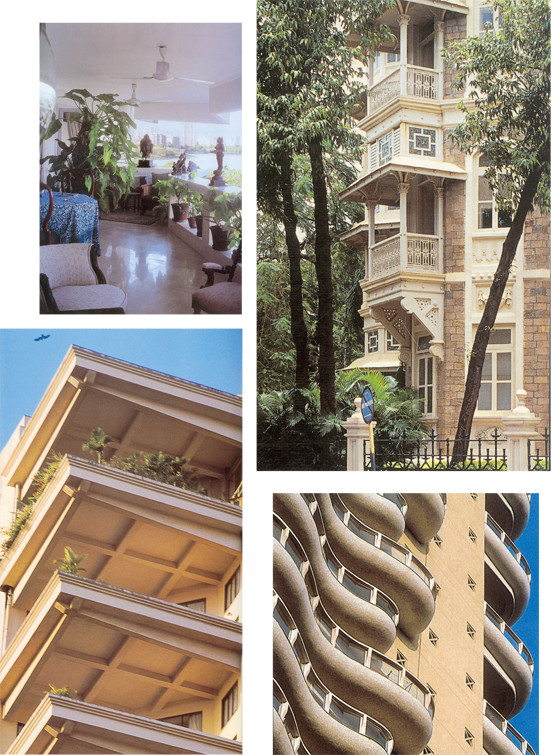
Facing page: Balconies serve a purpose while offering a view beyond
Over the months that she shot the different architectural facades of Bombay, sometimes with prior introduction, sometimes unannounced, in most cases "people were unfailingly supportive and helpful,” Taleyarkhan acknowledges in her book. "I was literally rediscovering my beloved city and seeing it with fresh eyes...in certain parts of Bombay I was almost a tourist,” writes the photographer confessing how at times she would spot "the perfect balcony, tantalizingly hidden behind dense foliage, just out of my camera’s reach. Other times I had to do absolutely nothing. The photograph was waiting for me — with the most perfect composition and lighting.”
Having evolved as a photographer, Taleyarkhan had started off in the black and white era of editorial photography when she was with Business India. She then moved on to the glitzy world of advertising photography of the late ’80s and ’90s. "Insightful yet contemporary would aptly describe Ayesha’s style,” notes an introduction to the photographer on the inside back jacket of the coffee table book. "A photographer’s best work is done for herself,” she believes.
There were many people whose "input, encouragement and support” Taleyarkhan valued for the success of this project: close friend Phiroze Nagarvala, Nanda, creative director Seema Shroff-Zaveri, Jayashree Menon who "kept the text lively yet relevant” and all the assistants. While Zarir Cama of Hongkong and Shanghai Banking Corporation guided her on the financial aspects, the project was made viable thanks to the sponsorship of HDFC and The Indian Hotels Company Limited. Among members of the community who pledged their support to her mission were Pheroza Godrej, Cyrus and Jamshed Guzder. "I would like to dedicate this book to my parents, Jini and Zal Taleyarkhan who recognized me for the free spirit that I am and were enlightened enough to encourage and nurture my creative talents,” mentions Taleyarkhan while also thanking her son Kabir, and sisters Lyla Gazder and Dinah Jain for putting up with her "obsession with this work and bad moods when deadlines approached.”
Taleyarkhan embarked on this, "her maiden venture,” for the Bombay born and raised lady felt the need to give back to the metropolis "in some small way, a part of the joy she experienced growing up in this city.”
Parinaz M. Gandhi
◆ ◆ ◆
From the archive