
Books
Ode to the city
Above Bombay by Jehangir Sorabjee. Second edition published in 2011 by Eminence Designs Private Limited, C/o Shree Krishna Packaging, 424, Parekh Market, 39, Kennedy Bridge, Opera House, Bombay 400004. Pp: 183. Price: Rs 2,500.
The second edition of Jehangir Sorabjee’s Above Bombay is another ode to this city and updates us on the changes that have taken place since the first edition which was published in 2005. It is more concise as the number of pages have been reduced, but the quality of the photographs has been enhanced due to superior processing.
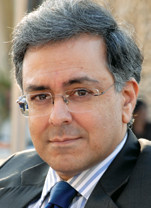
Jehangir Sorabjee;
Unfortunately, the city has become even more congested over the last few years with high-rises springing up randomly, wherever some open space may exist. Construction at the cost of trees and even mangroves is not surprising in any way today. Since foresight does not enter into the equation, tree cover is gradually decreasing instead of increasing. The lungs of Bombay are shrinking and the consequences have to be borne by the citizens. The Bandra-Worli Sea Link is the major change in the Bombay skyline, connecting the island city to the western suburbs and adds an appealing dimension to the book. But the mouth of the Mithi River at Mahim Causeway was narrowed to reclaim land, causing the Mithi to flood which took a high toll of life and property.
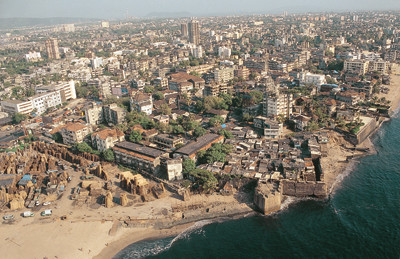
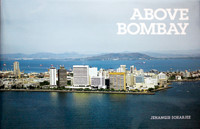
Right: cover of book; left: aerial view of Mahim with the Mahim Fort in the foreground.
Sorabjee was keen to produce Above Bombay because it brought a lot of pleasure to residents of the city who were able to see it in all its splendor and often displayed the book to their friends, colleagues, etc with pride in order to show them different aspects of Bombay from those encountered at ground level. He is a doctor by profession and qualified from the Grant Medical College with his MBBS and his MD in internal medicine. Thereafter he obtained his MRCP (UK) and his DTM&H (London). At present he works at the Bombay Hospital as an honorary consultant physician.
Shooting the photographs was not a straightforward matter for Sorabjee since most of the photography was done from a helicopter. Each outing lasted about half an hour, and there were no second chances if he didn’t manage to get a certain photograph the first time! The next time, it was another flight route. The best time of the year to shoot was after the monsoons, when the chances of a clear day and good light are far better. However, some of the images were obtained from the top of buildings, so there was more flexibility and time to plan the composition and exposure of the picture. He used a digital camera and a 28 mm lens to create a panoramic effect of the city below.
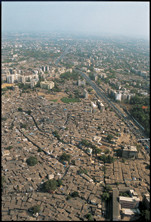
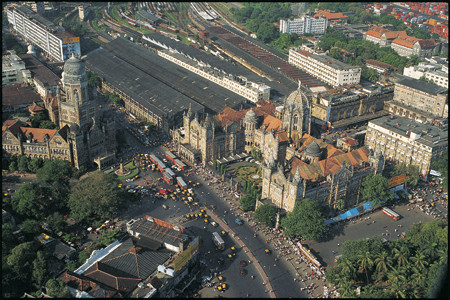
A bird’s eye view of the Western Express Highway (left) and the Chhatrapati Shivaji Terminus
One of my favorite images is on page 40, which is a view of the Kala Ghoda area of the Elphinstone College building, the David Sasoon Library, the Army and Navy building which are quintessentially from the British period, with a wall of high rises in the background. The other is on page 30, of the area around Mantralaya incorporating art deco buildings of the 1950s built in a semicircle with a semicircular garden as well. It’s the kind of symmetry you welcome seeing in a by and large unplanned city like Bombay. The picture on page 63 taken from top of Bombay Hospital is an endearing image of Bombay in the monsoons that everyone can relate to. Page 116, Mazagaon Hill is a spot where poets and writers could soak up inspiration from all the natural beauty surrounding them: a picture that could melt away all the cares of the world. The expanse of red Mangalore-tiled low-rise on page 112 of Mohammed Ali Road, shot from the J. J. Flyover takes us back to the Bombay of old, when traffic jams didn’t exist! The vista on pages 180 and 181 reminds us of the origins of Bombay — a group of fishing villages with a substantial cover of mangroves.
So as the author says, "Bombay, is a city that changes relentlessly, its borders amalgamating chunks of the sea, spreading outwards like protoplasm to occupy new latitudes and longitudes.” Above Bombay shows Bombay’s often obscured beauty, but when Sorabjee’s feet touch the ground he comes face to face with the real Bombay.
AYESHA TALEYARKHAN
◆ ◆ ◆
From the archive