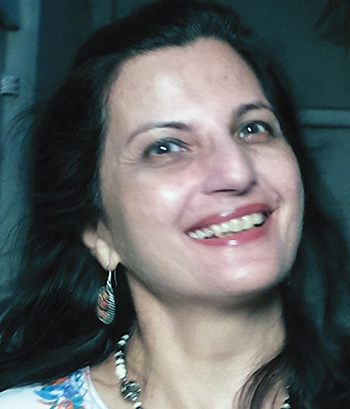
“Ladies and gentlemen”
About 460 disadvantaged children receive free education and food at the Samarpan Foundation school run by Sherna Wadia
"I run a school now,” she had said. "Believe it or not.” If she had said this to me 32 years ago, I might have laughed. It was the last thing anyone would have believed Sherna would do. Educated at the University of London and the University of Poona, for nearly four decades the science graduate worked with prestigious firms like Tata Consultancy Services, Tanzania Posts and Telecommunications Corporation, Computers and Telecoms Systems (Tanzania) Limited as a computer programer, systems analyst, project leader and branch manager between 1970-90. From 1999 she has been doing editorial freelancing for Penguin Books, HarperCollins Publishers, Westland Books, Bibliophile South Asia as also assisting organizations like UNESCO, UNIDO, Commonwealth Human Rights Initiative, Centre for Women’s Development Studies, Ministry of Panchayati Raj and Foundation for Universal Responsibility of HH The Dalai Lama.
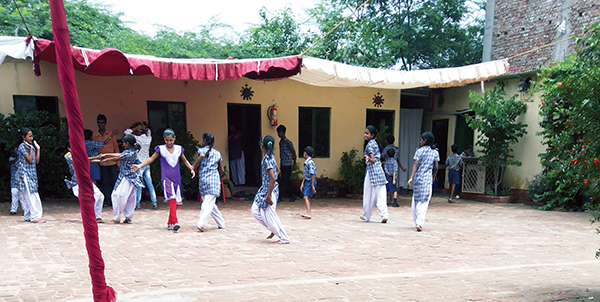
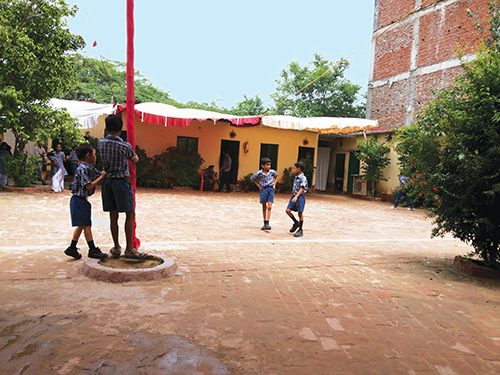
Samarpan Foundation school children, who come from underpriviledged backgrounds, at play
My friend was away at a meeting "negotiating for certificates for my children” but I knew I was in for a treat the minute I had stepped through the gates. Almost every one of the 150 children there and some seven teachers left whatever they were doing and walked up to wish me a very "good morning” without a shuffle, jostle or elbowing out. Why did it not surprise me that their Sherna Madam did not have an office? Sherna’s spot consisted of two plastic seats, a low coffee table, a stand-up fan (that we were to share with some of the other children and teachers at lunch later) in the compound and the remains of an old wedding shamiana to protect her from the punishing Delhi heat.
"Our Samarpan Foundation was started in 2006 by Dr Patrick Sanfrancesco, a healer from Goa,” states Sherna. The Foundation’s activities include free education, food distribution, healthcare, management and support of orphanages and homes for the aged, disaster management and rehabilitation, rural and urban development. The Foundation commenced with a small school in Kishangarh Village, an urban Delhi slum, imparting informal education to about 40 underprivileged children. Today, they have a truly inclusive educational institution catering to 460 underprivileged children aged five to 17 years of parents from all walks of life, be they ragpickers, rickshaw drivers or delivery boys. Their morning shift following the CBSE (Central Board of Secondary Education) syllabus serves as a regular school from Nursery to Grade V and the afternoon shift offers coaching assistance to students up to Grade XII.
The children in the morning shift are smartly turned out in beautifully tailored uniforms, bright backpacks and even brighter faces that could light up a football stadium and those beady eyes reflect an insatiable hunger for learning. Tiny feet run towards the basins to wash their hands before their bowls are filled with a freshly cooked meal of daal, rice, vegetables and roti, with some fresh salad thrown in for good measure. All the Samarpan teachers serve their wards with a generous amount of food and unconditional love. Children are permitted several helpings "as long as they do not waste the food.” The Samarpan Foundation takes pride in reporting that at a health camp conducted in January 2011, not a single child from their School was anemic.
Cultivating trained minds
It was "a series of accidents” that brought Sherna to the Samarpan Foundation. Tracing her sojourn with Samarpan, Sherna mentioned, "In 2009, I was requested to start an activity during the afternoons. A friend suggested that a tuition center was the need of the hour and offered to set it up. So we walked out into the Village and received a surprisingly positive response.” The mothers of girls, in particular, were determined that their daughters should not lead the wretched lives they did.
The tuition center thus started with three teachers supervising about 60 children from government schools between 3 p.m. and 4.30 p.m. "It was tough work, as even children in Class IV could not sit at their desks or concentrate for more than 15 minutes at a time; but heartening that after one year, several of them achieved top positions at their schools. I gave them a snack on their way out — banana, chocolate, biscuit, peanuts – and simultaneously inculcated a new lesson: no littering” by teaching them to put skins/wrappers in the garbage bin.
By the time they had shifted to new premises at the end of a ragpickers’ lane in July 2009 the onus was on Sherna, for some volunteers had left by then. "I could not understand why such a godforsaken place was chosen for a school, till I realized that Patrick always sends us to such places for a reason, and my reason was to bring the ragpickers’ children to school,” Sherna recalled, adding, "They live in what is euphemistically called godowns. In fact, our household garbage comprises their gardens. A rude shock awaited us when we went to the godowns and stood in the midst of the stench, filth and flies: ‘We will never send our children to your schools,’ declared the ragpickers who knew that their kids were ill-treated and mocked for their parents’ profession by the children and teachers of regular schools. Ultimately, a thekadarni (local leader) took our side and convinced a few parents to allow their children to attend school from 2 p.m. to 3 p.m. I promised to return the next day to fetch them.
"There was total disbelief when I arrived — they did not expect me to keep my word. And total chaos of children, half dressed, part excited, part terrified. After 20 minutes I put out a finger, told a passing child to hold it and walked out. Four children followed and as we passed each godown, the group increased — laughing, skipping, so happy —30 children arrived at school. (Did I feel like the Pied Piper!) By the third day, we had 120 children and I took homeopathic medicine Kali Phos before going to school and Rescue Remedy on my return home!”
Since these children settled down so well, they were made to follow a regular academic program in the morning shift and the 2 p.m. shift was converted to an additional tuition center. They still retain one class though for those who cannot attend school for sundry reasons. Even though "education is so pathetic in India, there is still a difference between the trained and untrained mind in going ahead with life at a later stage. Every child should have a school education; after that, let them choose what they want to do,” stresses Sherna.
Within a year Sherna started running the morning school when the volunteer in charge had an accident and could not return. So she is effectively there from 8.30 a.m. to 4.30 p.m. every day. Both shifts are given a similar afternoon meal at 3 p.m.
"On Saturday afternoons we have fun — dancing, singing, arts and crafts,” states Sherna. To further add to the overall development of the children a self-defense course for girls was conducted in association with the Delhi Police, and their first Sports Day was introduced three years ago. Sherna also referred to the computer center at Samarpan that was set up with 10 computers.
"We recently enrolled adult women, mothers of our children, in literacy classes for one hour per day. We were touched by the children’s pride: ‘My mummy will also learn to read’; and the women’s delight: ‘I can now read the prices in the shops,’” states Sherna. There are two vocational classes at 3 p.m. for embroidery and fabric painting/mehendi. Whilst mothers or elder siblings are at class they have an option to leave their young ones, aged two to four years in the crèche run by the Foundation.
The school is totally free and runs solely on private donations (The Monsoon Accessorize Trust, London, UK; Tides Foundation, USA; Col Siri Ram Nanda Charitable Trust, Delhi; Chand Parkash Santosh Mehra Public Charitable Trust, Delhi are the major donors). Textbooks and uniforms are provided to the children in the morning shift. All the children receive stationery and notebooks. Additionally, they try to provide a sweater, blanket, schoolbag, a pair of shoes and two pairs of socks to each child once a year. To emphasize physical hygiene children are also given soap, toothbrushes, toothpaste, combs and shampoo periodically and de-licing treatment with neem oil once a week.
Yes, money for salaries to the teachers was hard to come by and every uniform, shoe and ribbon was a struggle but life was not without its funny moments. "I used to address the kids as ‘Ladies and Gentlemen’ of the Samarpan School until one day it dawned on me that they hadn’t a clue! Arms across their little chests they would all sit up straight, knowing it was something important but not knowing exactly what ladies and gentlemen actually meant!”
The children at the Samarpan School come from different religious backgrounds. To Sherna who is the lone Zoroastrian in their midst, the Zoroastrian religion is "not about who can enter a fire temple and how one’s dead body should be disposed. It is about living life to the best of your ability, fighting injustice and helping those who have less than you in any aspect — physical, mental or emotional. This is something I learnt from observing my parents and both sets of grandparents.” She often wonders: "Is this religion teaching us anything different from other religions?”
At peace with a world of her making, Sherna observes, "Today when I walk into the Village, I am overwhelmed with the love and respect I receive, and filled with a deep feeling of wonder and gratitude at the turn my life has taken. I know that I would not exchange my life, tough as it is, for any other.”
Donations to Samarpan Foundation are entitled to 50 percent tax exemption under Section 80G of the Income tax Act. For further details contact Samarpan Foundation, D9/150 Kishangarh, Vasant Kunj, New Delhi 110070, email:delhi@samarpanfoundation.org www.samarpanfoundation.org
Heta Pandit is the author of seven books on Goan architecture and has been interested in conservation and environmental issues since 1981. Currently she is chairman, India’s Oldest Maritime Museum in New Bombay.
wonders: "Is this religion teaching us anything different from other religions?”
At peace with a world of her making, Sherna observes, "Today when I walk into the Village, I am overwhelmed with the love and respect I receive, and filled with a deep feeling of wonder and gratitude at the turn my life has taken. I know that I would not exchange my life, tough as it is, for any other.”