
Business
Woman’s worth
Resolving differences and diversities, managing conflicts is her forte. Dr Nayreen Daruwalla is program director at SNEHA (Society for Nutrition, Education and Health Action) for the prevention of violence against women and children. "The issue of violence against women and children is pervasive and cuts across all class and cultures,” she says. With a doctorate in social psychology, Daruwalla has seen life in all its nuances.
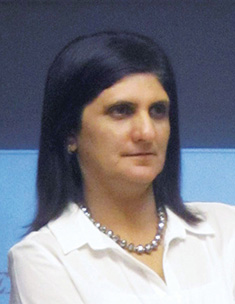
Dr Nayreen Daruwalla
Daruwalla was one of the main speakers at an interactive workshop hosted by the Women Entrepreneurs (WE) wing of the World Zarathushti Chamber of Commerce (WZCC) on July 6, 2013 at Della Tower in Bombay. Women entrepreneurs from different fields – fashion, image makeover, healthcare, herbal life, catering, interior designing and life insurance — made the most of the sagacious suggestions put forth by the speakers. Introducing Daruwalla, WE secretary Villie Daruwalla stated that Nayreen has 22 years experience in training, research, counseling and community development in the social sector.
Speaking on "Personal growth and managing conflicts at the workplace,” Nayreen stated that people have within themselves the creative power to solve problems and become more self-directed. With relationships floundering due to work and peer pressure, she acquainted the audience with "self awareness exercises.” People need to be "in relationship with at least one other significant person (spouse, friend, coach, therapist) who treats him or her with empathy and unconditional positive regard.” The "person of tomorrow” is adaptable, open to experience, self-trusting, existential (living fully in the moment) and harmonious/authentic with others. One needs to "take on enhancement activities such as learning new things, making friends and facing pain and threat to fulfill the innate tendency for self-actualization.”
"Either you evolve or you disappear,” stated WE chairperson Dolly Dhamodiwala. "If you don’t go after what you want, you can spend your entire life settling for what you get.” Homai Mehta, vice chairperson of WE, emphasized that WE is a platform for entrepreneurs as well as professionals. She outlined the various programs that would be organized to empower women to realize their full potential and move up the economic value chain.
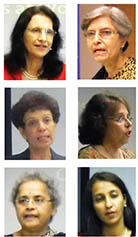
Clockwise from top left) Dolly Dhamodiwala, Homai Mehta, Behroze Daruwalla,
Zankhana Kaur, Sulbha Pande, Villie Daruwalla (Below) S. Ganga
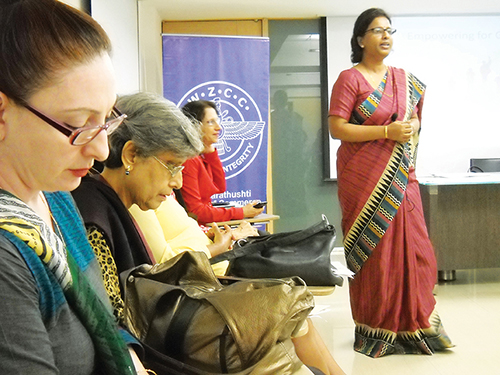
Sulbha Pande, deputy general manager, in-charge, Women Entrepreneur Cell, Central Bank of India, noted that the Government of India is planning to start a women’s bank. The Central Bank of India has many financing options for women, including the CentKalyani scheme, which covers services and industries — health, medical and financial services, food processing, handlooms, garments, fashion designing, beauty parlors, transportation, etc.
Behroze Daruwalla, corporate secretary and director on WZCC’s international board, delineated the organization’s broad reach across continents. The WZCC is like a family, helping the individual to grow through support and networking, she said. The WZCC has collaborated with TiE, The Indus Entrepreneurs for organizing programs jointly, stated Dhamodiwala. She welcomed Zankhana Kaur, program director — mentoring and TiE Stree Shakti (TSS), the women’s wing of TiE, which is the world’s largest non-profit organization for entrepreneurs. Kaur observed that TSS encompasses women from all social strata and their on-ground activities and programs encourage entrepreneurship globally.
Innovation, research and development and creativity are major growth factors, said S. Ganga, adjunct faculty in the Centre for Entrepreneurship, S. P. Jain Institute of Management and Research. Ganga has 15 years of experience at ICICI Bank in appraisals of credit proposals of SMEs (Small and Medium Enterprises), sanctioning of loans and framing the Bank’s financing policies for SMEs. The animated session between speakers and participants ended with WE committee member Veera Mundroina proposing a vote of thanks.
"When I see women confident and empowered to deal with their life situations in a positive manner it gives me a lot of satisfaction,” Nayreen told Parsiana later in response to queries about her work with SNEHA, a secular, Bombay-based non-profit organization that targets four large public health areas — maternal and newborn health, child health and nutrition, sexual and reproductive health and prevention of violence against women and children, particularly in urban slum communities. World Bank data states that every third woman in India suffers from some form of violence. "As compared to say a decade ago there is certainly more awareness of the issue as a human rights violation. Forms of violence have undergone a change from very apparent forms like physical and sexual abuse to more insidious forms of emotional violence,” explains Nayreen who has been associated with SNEHA since its foundation in the 1990s.
Though she used to deal with cases directly for many years, she now has a team of 10 counselors who handle cases at the counseling centers in Dharavi, Parel, Santacruz, Govandi and Kurla. "My office is in Dharavi in an Urban Health Centre, an extension of the Lokmanya Tilak Municipal General Hospital. I mentor them and provide them guidance and if there is a need then I intervene directly. I oversee all the different strands of the program and have to continuously try for funding to sustain the work which is very challenging,” she asserts. "I speak Marathi reasonably well as we also do a lot of training with the Bombay police to sensitize them on issues of gender and violence.” Nayreen also manages large teams and collaborations, including grants from the Sir Dorabji Tata Trust and CREA (a feminist human rights organization based in New Delhi which works towards advancing the rights of women and girls). The goal is also to contribute towards modifying health and legal policies for women and children facing violence and to bring about changes in mindset.
"This work is particularly quite distressful because tangible rewards are hard to see. Since we need to network with the health system, the police and the legal authorities, it is sometimes very frustrating to carry out interventions since it is not in our control. Hearing and seeing cases of abuse is depressing and challenging to deal with. But today we have a large community base of women, youth and men helping us in identifying cases of violence, providing initial crisis intervention and bringing up violence as a human rights issue and this gives me a lot of satisfaction,” says the intrepid lady who is originally from Ahmedabad and whose husband Mozam works in Vietnam. The couple has a 20-year old daughter Zenaika. "I am a self-driven person who desires to bring about a change in women’s status wherever possible,” says Nayreen.
◆ ◆ ◆
From the archive