
The Captains’ contribution
Gosi and Perin Captain were torchbearers of the 70-year-old Hindustani Prachar Sabha founded at the initiative of Mahatma Gandhi
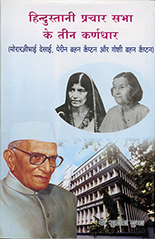
"At a party given by Jamsetji Tata on the Thames river in UK in honor of Mohandas Karamchand Gandhi, Gosalp (Gosi) and Perin Captain (both née Naoroji) saw Gandhi for the first time. Perin turned to her older sister Gosi to say ‘look at that gentleman, his eyes are so catching and (he) conducts himself so well.’” This is recorded in Hindustani Prachar Sabha (HPS) ké teen karnadhar (The Three Torchbearers of the HPS) written in Hindi by Dr Sushila Gupta — the three torchbearers being Gosi and Perin Captain and Morarji Desai. Honorary research director of the HPS, Gupta states "the sisters poked fun at his western outfit of coat, pant and tie at that meeting,” as they probably expected Gandhi to don Indian attire. "Gandhi realized their gaze and went up to chat with them,” she continues.
 The material for the book is derived from the archives of HPS, the 70-year-old institute which was founded at the initiative of Gandhi to popularize Hindustani. HPS operates from The Mahatma Gandhi Memorial Building which stands on a 2,000 sq yd plot at Marine Drive. The building was erected after the demise of pioneer Perin who was confident that her older sister, by four years, would make her dreams come true.
Perin was secretary of the Hindi Prachar Sabha but was convinced, as she wrote to Gandhi, "that Sanskritized Hindi and Arabic-Persian based Urdu would not be useful for the unity and integrity of India.” Thus was formed a separate Hindustani Prachar Sabha. This is quoted from one of the 100 volumes of Sampurna Gandhi Vangmay of the Ministry of Information, Government of India which is a comprehensive compilation of speeches, articles, letters, thoughts, etc. by and on Gandhi. The simplified form of Hindi and Urdu constitutes Hindustani. "Hindustani is such a language which is used by Hindus and Muslims of urban and rural areas of India, which is written both in Devnagari (the Hindi script) and Persian,” states Gupta.
HPS ké teen karnadhar, among 14 books published under the auspices of the institute, was meant to commemorate HPS’s diamond jubilee in January 2003. This was done on Gupta’s recommendation to the trustees, that HPS should "nurse something concrete rather than spend lakhs of rupees on celebrations and amusement,” she asserts.
On the warpath
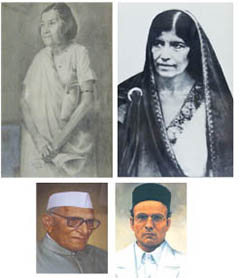
 Gosi and Perin were the granddaughters of the Grand Old Man of India, Dadabhai Naoroji, who had three children — a son and two daughters. His son Ardeshir married Virbai Dadina and they had eight children — Gosi was the second daughter (born 1884) and Perin the fourth (born 1888). As Ardeshir died young, Dadabhai looked after the grandchildren. Gosi was sent to Cheltenham School, London at age nine, going onto Oxford for further studies, whilst Perin studied at the Cathedral Girls’ High School and spent a year at Elphinstone College, where their grandfather was professor of mathematics and natural philosophy. Perin later went to the Sorbonne University in Paris, befriending Madame Bhikhaiji Cama and other revolutionaries.
The Naoroji sisters believed the way to independence was through violence. Paris was the center of revolutionaries in those days. Along with Mme Cama, they attended the Egyptian National Party convention in Brussels, Belgium where the Egyptians were agitating for their independence. Perin is reported to have sung a song on Indian national sentiment in keeping with the spirit of the conference. They also built up contacts with Polish refugees. At 22, Perin learnt to make a bomb from the émigré Polish engineer W. Browjevsky. She wanted independence for India at any cost, the HPS ké teen karnadhar enlightens us.
Cama requested Perin to accompany freedom fighter Vinayak Damodar (Veer) Savarkar from Paris to London in March 1910. (Ironically, Savarkar was one of the persons charged with the assassination of Gandhi but was later acquitted on a technicality.) When Savarkar stepped off the train as it steamed into Victoria Terminus, he separated his luggage from Perin’s as he suspected he would be arrested in London. When apprehended, he declared, "I do not know this lady.” Left to her own devices on the platform, Perin had no option but to go to Oxford, where Gosi was a student. Interestingly, in those days women were allowed to appear for examinations but were given no degree at Oxford. Perin is known to have visited Savarkar in jail several times and also played a part in the plan to free him.
On another occasion they had a brush with authority when in 1910 they were returning to India through Sri Lanka and onward by train. Gupta details, "At Madras station, five European ladies did not allow both the sisters to board the compartment. They passed a remark that being black they could not sit with the white in the first class. There was a heated argument and ultimately the station master intervened and allowed both the sisters to board the train,” though it is not clear whether they were allowed to enter the first class or not. This incident was a first for both and firmed their belief in Gandhi and the discrimination he must have endured at Pietermaritzburg in South Africa where he was thrown out of the first class compartment because he was colored.
The volte face from violence to non-violence came in 1915 at a party held by industrialist Jehangir B. Petit at which the Naoroji sisters and Gandhi were present. The Father of the Nation recognized the ladies whom he had met nine years earlier. He had an enduring effect on them. From silk to khadi; from Oxford and the Sorbonne to jail; from bombs to satyagrah (non-cooperation) was the shift for the duo.
Still, the sisters were not convinced that they should wear khadi and asked Gandhi why he insisted on it as a means to obtain swaraj (independence). Gandhi related the story of a village woman in whose household lived four women with one sari. The woman who had to step out wore the sari. By weaving and selling khadi the disadvantaged could supplement their income. From then on, the two affluent Naoroji ladies wore khadi.
Under the banner of the Rashtriya Stree Sabha (RSS — national ladies’ organization), the sisters spurred the use of khadi and collected funds for the independence movement. As volunteers of Desh Sevika Sangh (DSS — association of lady workers of the nation) an offshoot of RSS, they also wore saffron saris with white blouses. They picketed and also participated in the Dandi salt march, against Gandhi’s wishes; he did not want women joining the protest. When the British Government rendered the RSS and DSS illegal, the determined ladies constituted a new organization — Gandhi Seva Sena (army in service of Gandhi). Perin is known to have courted arrest on at least three separate occasions — twice being incarcerated at the Arthur Road Jail. Needless to say, both were active members of the Indian National Congress, founded by their paternal grandfather. Gosi continued to work for national causes till her death in 1976 at the age of 92. She was a member of the Akhil Bharatiya Gramodyog Sangh (national cottage industry association), president of Bombay Provincial Gramodyog Sangh and also managing trustee of Kamla Nehru Memorial Hospital.
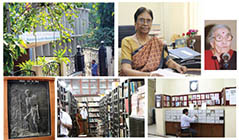
Others Parsis who served HPS are Aloo Dastur and Feroze Patch. Dastur was a managing committee member, trustee and ultimately president. For 45 years Dastur contributed her ideas and worked without accepting even conveyance expenses or even a citation at her resignation as president in 2008, two years before her death at 96. Patch is trustee and HPS’s honorary secretary. Other long serving members are trustee Francis Matthew and committee member, Sudhakar Gupta, having served the Sabha for 30 and 35 years respectively.
The Sabha continues to publish books, teach Hindi — their course is recognized by the Ministry of Human Resource Development — and hold essay competitions across the country. "We intend to bring out a Hindi-English dictionary of common Hindi usage,” Gupta animatedly explains her next project. "First give the Hindi word, the correct pronunciation in roman script, the word’s easy meaning and then the English equivalent.” She gives the example of the usage of the word ‘room.’ "In the room in English would read kamré mein in Hindi, which has a post-position preposition where the preposition is after the noun.”
On asking whether HPS is still true to the ideals of Gandhi, Gupta states, "Gandhi is recognized as the best leader in the world but his ideas are not accepted and followed by us… because of vested interest. His ideas don’t suit us. Gandhiji said going on the easy path is very difficult. ‘Be honest...’ ‘Speak the truth...’ These are simple imperatives but so difficult to follow. So I am a believer, but I can’t claim to follow. I am not a Gandhian,” says the 82-year-old quoting Gandhi: "Main kabar mein maujood rahoonga” (I will be vigilant from the grave). …We neglect him. He continues guiding us in his ideas. He has become a decoration. People love to see him on the wall but what about our behavior? We make a show. We should be honest to the nation, to this Sabha founded by him.”