Building on benevolence
The Godrej Housing Colony has sheltered its company’s employees for over 60 years
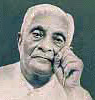 "I am a Godrej product," says Ramesh Bhandarkar, a third generation inhabitant of the Godrej Housing Colony in Vikhroli. "From childhood to now, I owe a lot to Godrej." A manual worker at Godrej and Boyce Manufacturing Company Limited (G&B), he echoes the views of several employees for whom the Colony insulates them from the hardships and rigors of Bombay life.
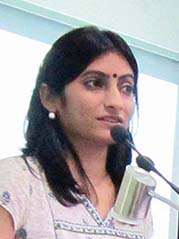
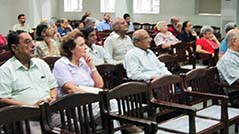
Sanghamitra Sen, a Research Fellow 2009 of the Avabai Wadia Research Fellowship, endowed by Wadia in 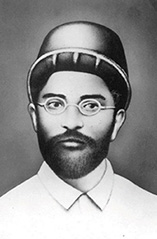 memory of her brother Phiroz Mehta, delivered her findings on "Private Enterprise and Labour Housing in the 20th Century with Special Reference to Godrej Housing Colony" at the K. R. Cama Oriental Institute (KRCOI) on September 6, 2012. The president of KRCOI Muncherji Cama welcomed the audience and Dr Nawaz Mody, chairperson of the research committee, mentioned in her vote of thanks that Sen was the second Fellow at KRCOI to complete a project — the first was on a women’s journal of the 19th century (see "On ‘women’s wisdom,’" Parsiana, November 21, 2012).
 Sen’s research of two years highlights how agrarian labor migration from the north of India in the early 1900s necessitated housing colonies in Bombay, Calcutta and Madras. Housing was a must in far flung areas of mines, jute mills, etc. Jamsetji N. Tata, Laxman Kirloskar and Walchand Hirachand were some industrialists "who went beyond providing a mere roof, but built a microcosm where every conceivable need of employees was catered to," amplified Sen. Chawls were constructed in abundance in the early 1900s to house the people migrating to Bombay because of its booming cotton mills and strong economy, the net informs us. A chawl (from Marathi chāl) is a building which has four to five stories with about 10 to 20 tenements.
Mill owners in Ahmedabad such as the Lalbhai group built housing to the east of the Sabarmati river. In Kanpur too wool and cotton mills had housing units as did TISCO (now Tata Steel), TELCO (now Tata Motors) in Jamshedpur, Tata Chemicals in Mithapur and the Empress and Swadeshi Mills in Nagpur, Tata Mills’ chawls were on Bombay’s Elphinstone Road. Each had 30 to 80 units. Sen informs "15 acres was leased by the Indore Darbar (belonging to Sir Currimbhoy Ebrahim who owned several mills) for the purpose of erecting chawls for work-people of Indore-Malwa United Mills Limited."
This building activity led to congestion in all cities and by 1940s "suburbs" started developing. The Indian Government stepped in to bar any new factories or expansion in cities. Only light industry such as bakeries, laundries, etc were permitted, all heavy industry being banned.
In 1921, of the 84 percent immigrants in Bombay, 70 percent lived in chawls with 97 percent inhabiting single rooms in Parel, stated Sen. In 1949, statistics showed 17 lakh single room tenements; by 1967, boarding was 27 sq ft per person. The British had "black or native towns" for the poorest of the poor.
Visioning Vikhroli village
"Legend has it that Pirojsha Godrej, one of two founder brothers of G&B, when visiting a sick worker, was deeply affected by the employee’s accommodation. Pirojsha decided to uplift the dwellings," Sen revealed. In 1951, the Pirojsha Godrej Colony was envisioned and encouraged by government as Prime Minister Jawaharlal Nehru was persistent about accommodation for employees, especially after the famine of 1955.
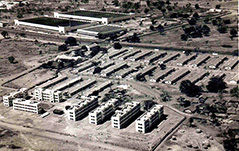
Godrej learnt of land in Vikhroli village, within three miles of already known Andheri. The additional bait was the presence of wells. The doyen purchased this land in the name of his youngest son Naoroji in 1943. Five colonies were put up as per the railway layout of the time between the Great Indian Peninsula Railway, predecessor to Central Railway and Bombay Baroda and Central India, predecessor to Western Railway. By 1953, the project was ready for habitation.
Godrej submitted plans for 552 settlements called ‘baithi (squat) chawls,’ the layout of which was the concept of an English garden city. "The housing space of the larger chawls was 500 sq ft whilst the smaller ones measured 422 sq ft. The engineers asked for a swap of plans between kitchen and lavatory because of ease of laying pipes. Ventilation was made as per the recommendation of the municipality. Constructed in the late 1950s, the chawls were built with superior materials, fireproof, of brick and mortar on hard soil. Sewage and flushing systems which have stood the test of time as also running water, gas and electricity were provided. Employees paid Rs 2 to 12 per month as rent, then.
 As occupation started, G&B furnished each house with two steel almirahs (cupboards). Each home had a front and back yard to encourage social interaction. "Leafy avenues so the return home would be soothing. Coconut and gulmohur trees were all planned by Pirojsha himself," says Sen. The researcher clarified that this land is still held by G&B. She also referred to Sohrab Godrej, eldest son of Pirojsha, who retained interest and directed "hedges should be planted to demarcate each house." Cultivation of bhendi (ladies’ fingers), papaya and banana was encouraged. In fact during famine the township also supplied fresh vegetables to the residents of Vikhroli. Gardener Vinod, as the roster names him, was specially mentioned as an enthusiastic
  resource in planting banyan trees, chikoo and other fruit trees.
A report on the township given by a team comprising Dr M. V. Moorthy and N. F. Kaikobad from the Tata Institute of Social Sciences, enumerated a playground, library and a prize given for the best kept garden and house to encourage maintenance. This report was commissioned by Sohrab for expert comments on the budding township in 1955. Suggestions were welcomed so long as they did not interfere with structure or design; when laborer M. L. Kadam asked for replacement of asbestos at his own cost, Sen supposes "it was safe to assume that he was not allowed to do so."
The industrialist intended to build 100 chawls but stopped at 30. As a growing labor force necessitated accommodating as many workmen as possible, from 1957 onwards, nine-unit baithi chawls gave way to multi-storeyed structures, Sen informed us. She added that in those days water recycling for gardening and sewage was a novelty.
The layout and planning is as per the terrain. Godrej did not want employees to have to walk for more than 15 minutes to reach their place of work. Sen pointed out that Godrej housing has uniformity in design and color. Other Indian business houses gave housing as per grade or band or family need. Modern facilities of stilt parking, utility areas for drying and washing machines are also incorporated in the layout. The baithi chawl and continuous factory construction, except between the years 1975 and ’85, gave building expertise to the industrial house.
Life in baithi
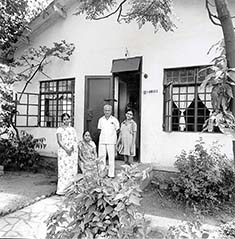
The academic claimed the culture of baithi chawls was unique. As per Sen’s research when the employees were asked whether the baithi chawls be demolished to make way for multi-storey buildings, the answer was an unequivocal ‘no.’ She found the sense of community feeling strong; the living space was designed as per climate and local needs. Ganesh pandals with a theme each year were encouraged. G&B runs a welfare center — Pragati Kendra — from 1955. At the Udyachal School all categories of employees’ children study together. The complex has a flour mill, adult literacy classes, tailoring, batik printing, clinics for pre and post natal care and vaccination campaigns. In the 1960s and ’80s a 700 sq ft house was rented out to the employees for Rs 18 as the lowest and Rs 85 per month as the highest rent. Formerly, sons, widows and children of deceased employees were allowed to continue living at the premises, now they have to vacate in seven days upon retirement or leaving employment.
The Central Labour Institute conducted a study on housing. Sen threw light as she said that "paternalism created a citizenry which was passive in India… Someone else had taken care of everything." During calamities like floods, famine and epidemics, the municipality made limited intervention in and around G&B so that "Vikhroli was left high and dry" in the belief that Godrej took care of safety and crises. During labor strife the senior administration needs to be vigilant to maintain law and order in the complex.