
Cover Story
Recognition for restoration
Opting for restoration, rather than redevelopment, the buildings of the Garib Zarthostiona Rehethan Fund built over 100 years ago earn the UNESCO Asia-Pacific Awards for Cultural Heritage Conservation
Amidst the fast developing, high rise properties at Bombay Central stand apart five, two-storeyed buildings that constitute the heritage precincts of Murzban Colony. In this secluded oasis, any intruder is subject to scrutiny. When Parsiana was surveying the buildings in the complex with camera in hand on April 23, a vigilant occupant from the first floor wanted to ascertain whether prior permission for photography had been obtained. The sound of her queries was sufficient to bring concerned neighbors to the balconies of the building facing hers. Once she was told that we were in the company of Muncherji Cama, trustee and honorary secretary of the Garib Zarthostiona Rehethan Fund (GZRF) that owns the property, there was respectful silence.
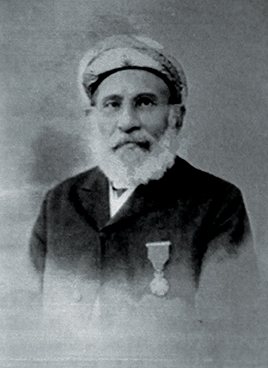
Khanbahadur Mancherji Murzban
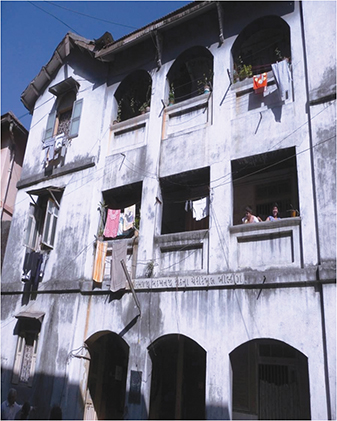
The phased repair and restoration work of the over 100-year-old GZRF buildings has earned international recognition for two successive years. In 2013, one of the buildings at Murzban Colony (also known as the Lal Chimney Compound, although there is no longer any Red Chimney in the vicinity) was among the winners of the UNESCO Asia-Pacific Awards for Cultural Heritage Conservation. Out of 47 entries from 16 countries, the Lal Chimney Compound was selected for an Award of Distinction. As noted the citation, "By keeping the original function of the buildings, the historic continuity of the community has been ensured...The conservation of the buildings…is highly laudable for its achievement in safeguarding a distinctive typology of late 19th century and early 20th century urban community housing that had been left in ruinous condition and slated for demolition. Responding sensitively to each of the structures’ unique architectural elements, the decision to reuse and conserve original materials and ornamental details helped retain the compound’s authenticity.” Other monuments to be conferred this Award last year were The Great Serai, Kabul, Afghanistan and Khaplu Palace, Baltistan, Pakistan.
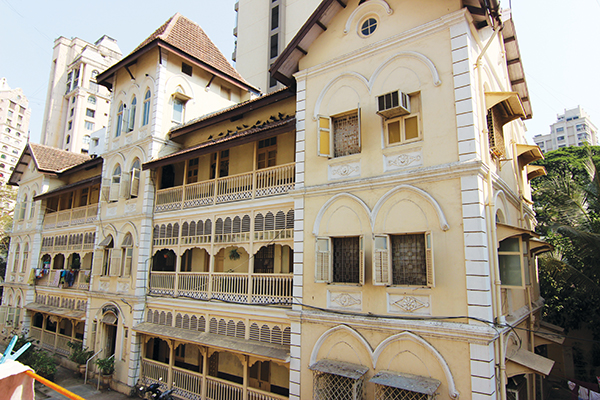
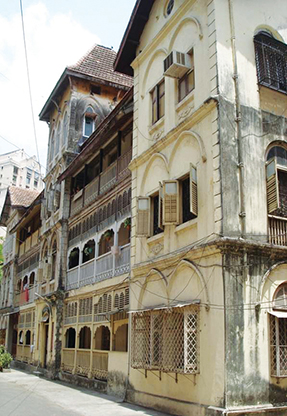
Wadia Building at Murzban Colony, after and before conservation
The previous year when the Sethna Buildings on Wadia Street in Tardeo, also under the purview of GZRF, were restored, they earned the 2012 UNESCO Asia-Pacific Award for Cultural Heritage Conservation. The citation lauded the restoration project for representing "an outstanding model for protecting and extending the use and life of historically significant and social housing under threat of demolition from urban renewal and development...The project is a celebration of an often unloved and under-appreciated yet socially significant part of a nation’s heritage and should be seen as an exemplar to encourage and stimulate a continuation of the rehabilitation of social housing projects across the Asia-Pacific region.”
"Tamé majanaa towers kai nathi baandhtaa (Why aren’t you building fancy towers)?” well-meaning members of the community would frequently suggest to the trustees who chose not to pursue that option. Their rationale was simple: if the property goes under redevelopment, "there would be a hell of a lot of monthly outgoings,” explained Cama. As against a paltry monthly contribution of Rs 200-300 for their tenements admeasuring less than 500 sq ft, the revised municipal taxes, if calculated at the rate of Rs 16 per sq ft, would work out to Rs 8,000 each month. Presently, for those who cannot afford, the trust charges a monthly contribution of as low as one rupee, and in certain cases even exempts them from payment.
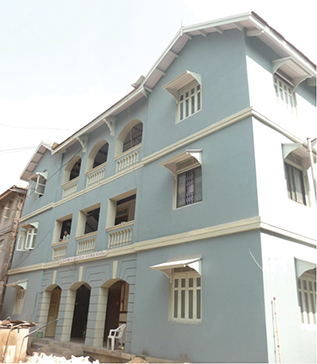
Sethna Building on Wadia Street, post and pre restoration
"Some of our occupants are really below the breadline, some are hovering around the breadline and some are comfortably placed,” Cama summed up the financial profile of the Zoroastrian residents living in around 50 buildings owned by the GZRF. Besides their Lal Chimney premises, they oversee close to 500 flats on their property in Gilder Lane that includes another Murzban Colony, two widows’ chawls, as also some estates on Wadia Street and Avabai Cassinath Street in Tardeo, plus buildings in Dadar. The Albless Dispensary and the Bai Ratanbai F. D. Panday Girls High School are additionally run by the Trust.
All tenements are given on leave and licence to Parsis for their trust deed clearly states in Gujarati that occupants can continue to stay at the pleasure of the honorary secretary. "We are very strict in certain things,” states Cama. Since every flat is allotted on merit without accepting any monetary reimbursement, no one can sell or demand compensation when they hand over vacant possession after the death of the occupants "otherwise charity is not going to be served,” emphasizes Cama.
When the trustees have to repair and restore the heritage buildings in their possession, they do not expect any contribution from the residents, "only cooperation,” especially if they are required to temporarily relocate. Barring a "few oddballs” who may be ungrateful, "by and large the occupants have been cooperative.” Looking at the nature of complaints that come to him, Cama observes, "Parsis are hilarious.” The tolerance levels in the community are really low, believes Cama, and repeats a grievance he heard from one of the residents who was not willing to brook any inconvenience saying, "Maanaso bau aawaaj karéch (the workmen make a lot of noise).” However, he felt their efforts were rewarded when some of the residents of Sethna Building voluntarily raised funds and gifted the trustees a cheque of one lakh rupees in appreciation of the repairs to their building. Considering that the trustees had spent over a crore towards this restoration, more than the money it was the gesture that touched them. "By the grace of God, we are able to generate funds,” Cama reveals.
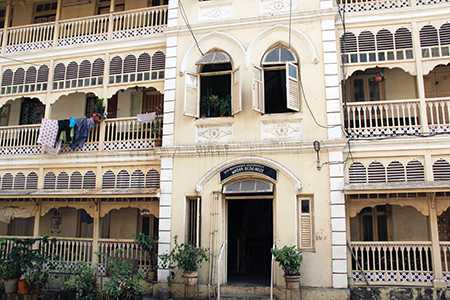
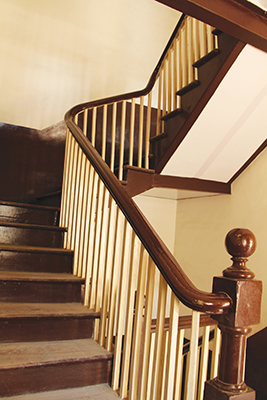
Entrance to Wadia Building and a stairway at Lal Chimney Compound Photos by Jasmine D. Driver
Referring to the commitment of award winning conservation architect Vikas Dilawari and contractor Cyrus Unwalla of Premier Construction, Cama mentioned that they both had "an excellent working relationship with the trustees... Despite facing great personal problems, they never let that affect their professional life.” Their working style appealed to Cama who candidly describes himself as "not the bribing sort; I am the fighting sort.”
On his part, Dilawari considered himself "very fortunate to enjoy the trust of such good clients.” He shared his elation at "transforming rundown, inconspicuous buildings into something so beautiful” and drew an analogy with "a doctor who after treating a patient in a fairly critical condition experiences joy and satisfaction on the recovery of the patient.” Whilst some buildings needed internal restrengthening, for others, only the exteriors and roofs had to be attended to. Referring to these buildings as "artistically modest yet ornate,” Dilawari specified that "good Mangalore tiles and superior quality wood contributed to the unique characteristics and design of these buildings.” Before starting on the restoration work he was required to prepare a report delineating "what is wrong, where, and how it can be rectified.” Whilst occupants may prefer to extend their living space by cementing the open balconies he chose to restore the wooden, perforated balconies with railings to facilitate inflow of breeze. Having commenced work at the Lal Chimney Colony in October 2009, it was in December 2012 that it was largely completed, at a cost of Rs 2.8 crores, working out to around Rs 850 per sq ft, he says.
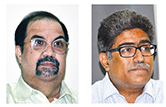
Muncherji Cama and Vikas Dilawari
In a city that is facing a space crunch and the consequent escalation in real estate values, Dilawari feels that we need to remind ourselves "to have a balance of development and restoration.” He is more keen to safeguard the "essence of a community place so that neighbors don’t lose their relationships, buildings don’t lose their character and alleys don’t turn into car parks.” Dealing with these "dream clients” reinforced his belief that the Parsi "community cares for its heritage.”
Besides Cama who has been honorary secretary for over a decade and trustee for the last six years, the other custodial trustees of GZRF are his mother Banoo who is the president, Keti Mehta, Sam Jijina, Rohinton Padder and Kersi Treasurywala. They are assisted by a managing committee comprising Sir Dinshaw Petit, Jehangir Wadia, Ayesha Jejeebhoy, Dr Villy Cama and Dr Nawaz Mody. "The managing committee is a hunting ground and grooming ground for future trustees,” believes Muncherji. Although "the trustees are not ‘yes men,’” Muncherji is of the view that they are able to do constructive work because they are not plagued by "the election nonsense.”
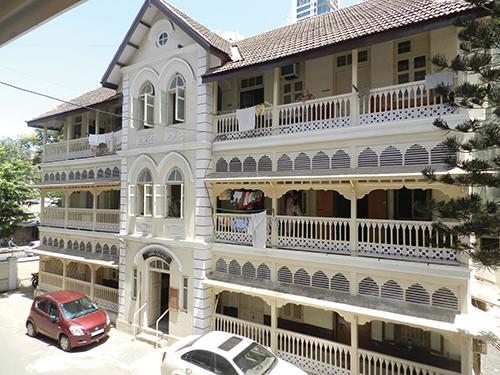
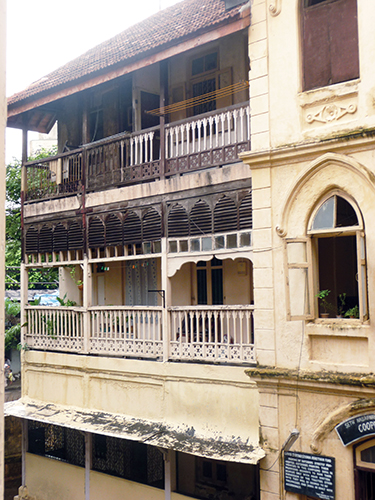
Conservation undertaken at Murzban Colony
Whilst the buildings that have been restored should remain in good shape for the next 40-50 years, currently the trustees are in endless correspondence with the municipality on the subject of renewing their Murzban Colony lease. If the lease is not renewed, the trustees are worried that according to the new guidelines the cost of monthly outgoings per tenement would increase to double what they have been paying for all five buildings for a year.
When Mancherji Murzban, the renowned executive engineer of the 19th century, built Murzban Colony, he had been granted land on lease by the Bombay Land Improvement Trust. For the Murzban Colony on Gilder Lane, some land had been donated by Sir Dinshaw Petit and his son Framji. Explaining the family connection between the Petits and the Camas, Muncherji Cama reveals that his grandfather’s grandfather, Cawasjee Petit was the eldest son of Sir Dinshaw Petit, first baronet. With more than 50% of the GZRF buildings donated by the Cama family, their family members continue to have representation on the trust board.
According to Muncherji Cama, it behooves on trustees "to be more sensitive to the needs of the less fortunate. We have to appreciate and accept the fact that there are people who would like to contribute but are genuinely unable to. We have to subsidize them in a sensible manner, not to make them feel deprived or different from their co-occupants.”
Speaking on behalf of his colleagues, he asserts, "Trusteeship is a sacred duty; a contract between us and our maker. Our aim is to leave the property in a better shape than what we received whilst giving the residents a happier life.”
◆ ◆ ◆
From the archive