
Cover Story
Good, green and growing
Godrej Group chairman Adi Godrej is awarded the Padma Bhushan for his many services to trade and industry
For him, life is more about moments than milestones! "I was 17 when I went to America to study at the Massachusetts Institute of Technology (MIT). I returned to India when I was 21 and joined Godrej in 1963, the first management graduate to join the business. There were no management schools in India at that time,” says 71-year-old Adi Godrej, chairman of the Godrej Group, a multi-faceted man, strong in the art and heart of business!
.jpg) At MIT he learnt many important lessons of life. "As an undergraduate I lived in a fraternity. You had to manage everything on your own, keep body and soul together on the frugal foreign exchange available to Indians at that time!” he continues. An American education meant more than just focusing on science and maths. "I studied economics, literature, philosophy… all this added a lot of value. I travelled, took on part-time work, including research with Franco Modigliani (then a professor at MIT), who later won the Nobel Prize in Economics.”
At MIT he learnt many important lessons of life. "As an undergraduate I lived in a fraternity. You had to manage everything on your own, keep body and soul together on the frugal foreign exchange available to Indians at that time!” he continues. An American education meant more than just focusing on science and maths. "I studied economics, literature, philosophy… all this added a lot of value. I travelled, took on part-time work, including research with Franco Modigliani (then a professor at MIT), who later won the Nobel Prize in Economics.”
The young man joined Godrej at a time when their factories at Lalbaug and Delisle Road were still the safe depositories of production, though manufacturing at Vikhroli had also started. "Godrej’s sales turnover at that time was Rs 10 crore and there were two main companies — Godrej and Boyce and Godrej Soaps,” he says. "With seven major companies with interests in real estate, FMCG (fast moving consumer goods), industrial engineering, appliances, furniture, security and agri care — to name a few — our turnover crosses $ 3.3 billion (Rs 18,150 crores as of March 31, 2012),” notes the Godrej website.
On April 20, 2013, Godrej received the Padma Bhushan from the President of India Pranab Mukherjee at Rashtrapati Bhavan in New Delhi. "The ceremony was conducted extremely well, quick and efficiently,” he remarks. Four days earlier Godrej was at The Grosvenor House at Park Lane in London, being honored as "Entrepreneur of the Year” at The Asian Awards 2013, which recognize the weighty contributions of Asians to the world, judged by some of the UK’s leading figures. His action-packed one-year tenure as CII (Confederation of Indian Industry) president ended at the annual CII meet on April 4, where Rahul Gandhi addressed India Incorporated for the first time with his interactive "India is a beehive” speech and Godrej delivered the welcome address.
At MIT he learnt many important lessons of life. "As an undergraduate I lived in a fraternity. You had to manage everything on your own, keep body and soul together on the frugal foreign exchange available to Indians at that time!” he continues. An American education meant more than just focusing on science and maths. "I studied economics, literature, philosophy… all this added a lot of value. I travelled, took on part-time work, including research with Franco Modigliani (then a professor at MIT), who later won the Nobel Prize in Economics.”The young man joined Godrej at a time when their factories at Lalbaug and Delisle Road were still the safe depositories of production, though manufacturing at Vikhroli had also started. "Godrej’s sales turnover at that time was Rs 10 crore and there were two main companies — Godrej and Boyce and Godrej Soaps,” he says. "With seven major companies with interests in real estate, FMCG (fast moving consumer goods), industrial engineering, appliances, furniture, security and agri care — to name a few — our turnover crosses $ 3.3 billion (Rs 18,150 crores as of March 31, 2012),” notes the Godrej website.
On April 20, 2013, Godrej received the Padma Bhushan from the President of India Pranab Mukherjee at Rashtrapati Bhavan in New Delhi. "The ceremony was conducted extremely well, quick and efficiently,” he remarks. Four days earlier Godrej was at The Grosvenor House at Park Lane in London, being honored as "Entrepreneur of the Year” at The Asian Awards 2013, which recognize the weighty contributions of Asians to the world, judged by some of the UK’s leading figures. His action-packed one-year tenure as CII (Confederation of Indian Industry) president ended at the annual CII meet on April 4, where Rahul Gandhi addressed India Incorporated for the first time with his interactive "India is a beehive” speech and Godrej delivered the welcome address.

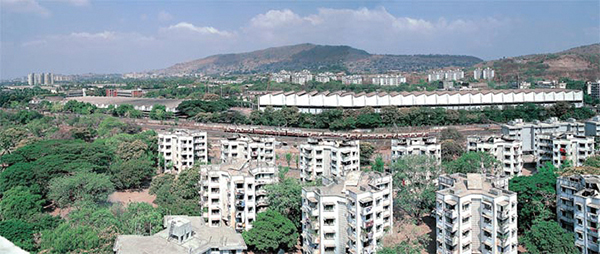
The new headquarters being built at Vikhroli (above), overview of factory, flats and foliage
"Sixty percent of my time during that one year was spent in CII work. We took 12 delegations to 12 countries! I also travelled extensively within the country, meeting people at very high level,” he describes. "We went to Pakistan, Bangladesh, Sri Lanka, the US … The trip to Pakistan went off very well. We met the chief minister of Punjab, the foreign minister, Imran Khan and Nawaz Sharif… Business and political leaders said they want greater trade and investment between our two countries. It was a good start. Unfortunately some untoward incident or other crops up and derails fully taking the process forward.” Having met Prime Minister Manmohan Singh many times, as well as finance minister P. Chidambaram, Commerce Minister Anand Sharma and several others, Godrej says he has found them "extremely responsive.”
The chairman is clearly a man who believes in ‘motivate, not mandate!’ In an hour-long interview, Godrej spoke to Parsiana about how the Group has built on the past, repositioned the present and envisages the future. We arrived at the green and good Godrej campus named Pirojshanagar at Vikhroli and well-mannered, well-trained attendants ushered us efficiently to a waiting room, though it was only 8.30 in the morning and most of the staff was yet to arrive! Adi Godrej himself was courtesy personified, solicitously enquiring whether we would like tea or coffee and, on being answered in the negative, asking whether we minded if he had some coffee! The chairman’s office is unostentatious, family pictures on the shelves behind his desk lend it warmth. "We will soon be having a new headquarters. You must have seen the construction going on as you came in. There is a lot of development and redevelopment going on. Over the years, we want to make Vikhroli an iconic, green, industrial, commercial and residential township. It is already green, but we want to see more of residential space. Some factories will move (to Ambernath where they have bought some land).” For the Group, chlorophyll is as important as concrete! "Our mangroves (a dense, green, 1,500-acre nature’s basket of flora and fauna including reptiles and jackals) are among the best in the world. They are the lung of a crowded city and add a lot to Bombay’s health platform. Students and visitors are brought in to inculcate a sense of environmental protection. People’s perceptions are clearly changing.”

Godrej One
Ability and fidelity
Brand Godrej was founded in a small way in 1897 by Adi’s granduncle Ardeshir Godrej with the making of locks, which soon became renowned for strength and reliability. Ardeshir’s brother Pirojsha consolidated the business, expanding it in the 1940s by buying virgin land at Vikhroli, a suburb which soon became synonymous with the name Godrej. Pirojsha’s sons Sohrab, Burjor and Naoroji (Naval) grew the enterprise. "My grandfather (Pirojsha) was over 80 when I joined but he would still come to office and wanted to know everything. I used to discuss with him. My uncle Sohrab was not so actively involved in the day-to-day running — his special interest was the protection of the environment and wildlife and he worked a lot with international associations,” Adi narrates. "With my uncle Naval I worked closely on family finance planning, how to tackle the negative impact of the enormously high taxation of that time, etc.”
Brand Godrej was founded in a small way in 1897 by Adi’s granduncle Ardeshir Godrej with the making of locks, which soon became renowned for strength and reliability. Ardeshir’s brother Pirojsha consolidated the business, expanding it in the 1940s by buying virgin land at Vikhroli, a suburb which soon became synonymous with the name Godrej. Pirojsha’s sons Sohrab, Burjor and Naoroji (Naval) grew the enterprise. "My grandfather (Pirojsha) was over 80 when I joined but he would still come to office and wanted to know everything. I used to discuss with him. My uncle Sohrab was not so actively involved in the day-to-day running — his special interest was the protection of the environment and wildlife and he worked a lot with international associations,” Adi narrates. "With my uncle Naval I worked closely on family finance planning, how to tackle the negative impact of the enormously high taxation of that time, etc.”
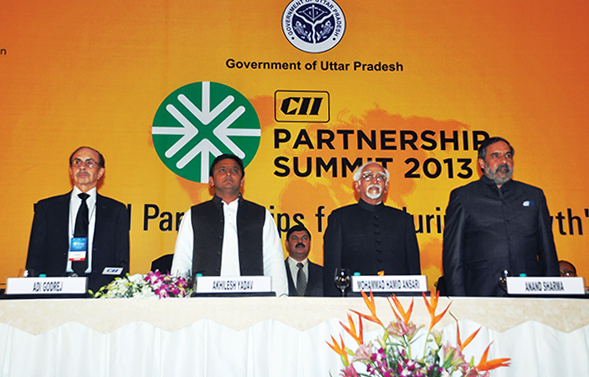
At Agra meet (above , from left) Adi Godrej, UP chief minister Akhilesh Yadav,
vice president Hamid Ansari, commerce minister Anand Sharma,
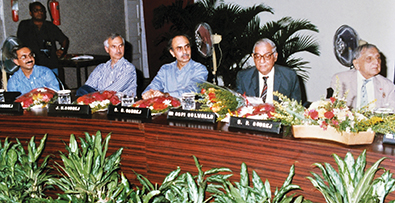
(below, l to r) Nadir, Jamshyd and Adi Godrej, Dr Aspi Golwalla and Sohrab Godrej
From his father Burjor, who had a doctorate from Germany in technical chemistry, he imbibed the importance of technology. "He was passionate about research and technology. From my elders I learnt about business formats. I introduced HRD (human resource development), marketing… They gave me a free hand when they saw what I was doing yielded results. I am grateful to them for their faith in me,” Adi acknowledges. "My mother Jai was a tremendous influence, right from an early age. She was a teacher all her life, including many years at our Udayachal School here. She had some very good education ideas and implemented many of them on me. At age four, I could cross a road on my own, walk from our home at Walkeshwar all the way up to Hanging Gardens. At age 10, I was given an allowance of Rs 75 per month — which was not too frugal or too liberal. From that I had to meet all my expenses — fees, books, travel, sports… This gave me a great sense of budgeting and planning and was extremely useful. My mother was a remarkable person, liberal in outlook. She would suggest, but abide by my decisions.”
The family has remained united for 116 years in the business, Adi says with pride. "In my generation I am the oldest. My cousin Jamshyd (Naval’s son) is seven years younger and is the chairman and managing director (MD) of Godrej and Boyce Manufacturing Company Limited. My brother Nadir is nine years my junior and is the MD of Godrej Industries and chairman, Godrej Agrovet. I am very proud of my children Tanya Dubash (executive director and president, marketing), Nisa (president, human capital and innovation for Godrej Industries and associate companies) and Pirojsha [MD and CEO (chief executive officer), Godrej Properties]. They have studied in the US, in Ivy League colleges. They have brought in fresh new ideas and repositioned the Godrej brand making it more youthful and contemporary. I have been very liberal with my children, not interfering in their lives, guiding them but allowing them to take their own decisions. Be it reorganizing the companies, developing strategy, making the logo more colorful, managing HR or initiating our international forays, they have contributed tremendously,” Adi remarks. Acknowledging his wife Parmeshwar’s contribution he smilingly says: "We were both very young when we married. I was 24, she was 21. She is artistic, very good at designing — restaurants, homes, etc and has extremely good taste.” In the early years she was involved with Godrej Soaps’ advertising. A non-executive director of Godrej Properties, she is a lady known for her stylish dressing, her work towards AIDS awareness and other social causes and her interaction with national and international celebrities.
Other family members associated with the business are Jamshyd’s son Navroze, director at Godrej and Boyce, who is presently doing further studies in the US. Jamshyd’s brother-in-law Vijay Crishna (sister Smita’s husband) is executive director of Godrej and Boyce. Nadir’s three sons, Burjis (20), Sohrab (18) and Hormuz (16), are in the process of completing their studies.
The Godrej Group is largely privately held and the family figures in the Forbes annual list of billionaires. Certain companies like Godrej Consumer Products Limited, Godrej Properties Limited and Godrej Industries Limited are listed on the stock exchange and provide robust share value.

Range of Group products
Challenge and change
"Think the future backwards, not the present forward,” the Group chairman advises. Work your goals out first and then strategize towards achieving them. "We call our goal 10 x 10, which means we want to grow 10 times the present size in 10 years. This will mean a compounded annual growth rate of 26 percent. Some companies will grow faster than others. Ours is a consumer-oriented business,” he notes, pointing out that around 500 million Indians use a Godrej product daily in some form or the other — bathing with a Godrej soap, opening a fridge door (Godrej launched its low-cost refrigerator called ChotuKool for rural households in 2010 in addition to its premium brands), relishing Real Good chicken or products from Nature’s Basket, using an insecticide, a Godrej lock or living in a Godrej apartment… Other groups, for example the Tatas, are much larger but they are more B to B (business to business) oriented. "We are at the top with regard to having the largest number of consumers among companies headquartered in the developing world. The only company I know which has more consumers is China Mobile. HUL (Hindustan Unilever Limited, a strong competitor in the FMCG space in India) is a multinational, not an Indian company.”
"Think the future backwards, not the present forward,” the Group chairman advises. Work your goals out first and then strategize towards achieving them. "We call our goal 10 x 10, which means we want to grow 10 times the present size in 10 years. This will mean a compounded annual growth rate of 26 percent. Some companies will grow faster than others. Ours is a consumer-oriented business,” he notes, pointing out that around 500 million Indians use a Godrej product daily in some form or the other — bathing with a Godrej soap, opening a fridge door (Godrej launched its low-cost refrigerator called ChotuKool for rural households in 2010 in addition to its premium brands), relishing Real Good chicken or products from Nature’s Basket, using an insecticide, a Godrej lock or living in a Godrej apartment… Other groups, for example the Tatas, are much larger but they are more B to B (business to business) oriented. "We are at the top with regard to having the largest number of consumers among companies headquartered in the developing world. The only company I know which has more consumers is China Mobile. HUL (Hindustan Unilever Limited, a strong competitor in the FMCG space in India) is a multinational, not an Indian company.”
Moving the milestones
From launching in 1918 the first soap in the world to be made with vegetable oils (without animal fat), to building the steely growth of the Storwel (steel almirah or cupboard), to participating in the program to launch Chandrayaan-1 (India’s first unmanned lunar probe), to being India’s largest animal feed business, to constructing large townships in different parts of India, Group milestones have been many.
Godrej has gone global in a big way in recent years, with acquisitions adding to their portfolio of products in the hair, home and personal care segments. "We have a higher per capita sale in countries like Indonesia, South Africa, Argentina, Chile, Uruguay and the UK than in India. We see faster growth in the developing world. Our strength is our ability to take on products designed for low and middle income groups.”
From launching in 1918 the first soap in the world to be made with vegetable oils (without animal fat), to building the steely growth of the Storwel (steel almirah or cupboard), to participating in the program to launch Chandrayaan-1 (India’s first unmanned lunar probe), to being India’s largest animal feed business, to constructing large townships in different parts of India, Group milestones have been many.
Godrej has gone global in a big way in recent years, with acquisitions adding to their portfolio of products in the hair, home and personal care segments. "We have a higher per capita sale in countries like Indonesia, South Africa, Argentina, Chile, Uruguay and the UK than in India. We see faster growth in the developing world. Our strength is our ability to take on products designed for low and middle income groups.”
Strong and sustainable
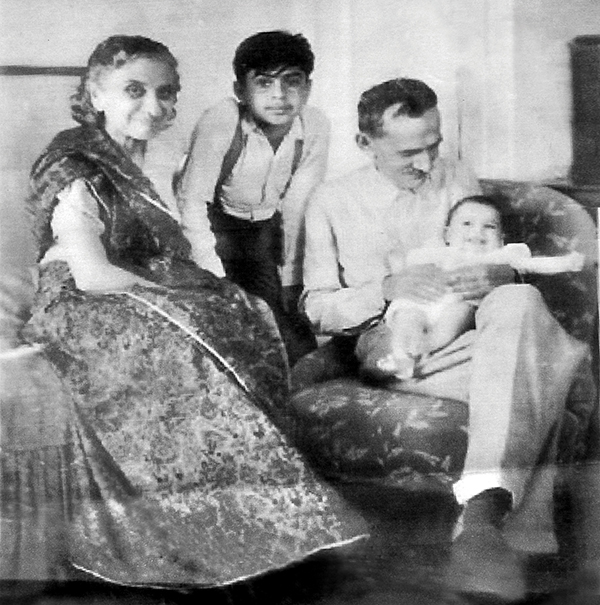
Adi with maternal grandparents
"Good and Green” is a CSR (corporate social responsibility) initiative. "In 10 years we aim to teach one million youth specialized skills to make them employable and to fit in with our kind of work — hair salons, poultry farming, construction work, sales, etc,” he elaborates. Working towards zero waste, carbon neutrality, positive water balance and 30 percent renewable energy use are among companies’ goals.
Management education is a subject close to Godrej’s heart. "Young managers imbibe leadership traits early,” he notes. He is the chairman of the board at the prestigious Indian School of Business in Hyderabad and was a member of the Dean’s Advisory Council of the MIT Sloan School of Management and the Wharton Asian Executive Board. He has chaired the board of governors of the Narsee Monjee Institute of Management Studies and been president of several Indian trade and industry bodies.
Management education is a subject close to Godrej’s heart. "Young managers imbibe leadership traits early,” he notes. He is the chairman of the board at the prestigious Indian School of Business in Hyderabad and was a member of the Dean’s Advisory Council of the MIT Sloan School of Management and the Wharton Asian Executive Board. He has chaired the board of governors of the Narsee Monjee Institute of Management Studies and been president of several Indian trade and industry bodies.
Bullish on a billion!
By the year 2050, Godrej tells us, India will be the largest economy in the world. "China will overtake the US in the next five to 10 years, but it will become an aging country (because of its one-child policy), as will other countries in the world. We have the advantage of both democracy and demography. We should leverage our youth, which is passionate about our country. There are many young ministers at the center and states, as well as young business leaders who are doing very well.” The government must continue with the reform momentum and promote the ease of doing business by reducing the plethora of permissions required at every stage. "The fewer restrictions there are the better. A very important step is the introduction of the Goods and Services Tax (GST) which has been debated for long. Difficult to say when it will come, but the earlier the better.” The Direct Tax Code, the new Companies Bill, fast tracking of large infrastructure projects, particularly in highways and power, a balanced land acquisition policy, inclusive growth for all sections of society in all parts of India, improving health, education and sanitation are among the issues the government needs to address more urgently, believes the experienced businessman, who has worked hard to impress upon leaders of all shades that the economic agenda should take precedence over political pursuits.
It is a big mistake to go on hounding tax payers. "Tax administration should be clear. The tax department should look on people as customers, not as something to be attacked,” he tells us. Corruption levels will come down if more governance is done through internet connectivity (thereby reducing personal interface with government officials) and states like Madhya Pradesh and Punjab have done well on this score. "It is ridiculous that we import coal. From being a big exporter we may become an importer of iron ore (due to illegal mining, etc). Environmental protection can be done by greater use of science and technology, not by stopping development. We need much more technology in agriculture. In some parts of the country, the crop yield is much less than in others. If we can increase crop yield to the same levels as the best in India, and I’m not saying the best in the world, we can double the total agricultural output.” If you take the average of the last decade, we have seen eight percent growth and India has done extremely well in many fields, he says, drawing the big picture.
It is a big mistake to go on hounding tax payers. "Tax administration should be clear. The tax department should look on people as customers, not as something to be attacked,” he tells us. Corruption levels will come down if more governance is done through internet connectivity (thereby reducing personal interface with government officials) and states like Madhya Pradesh and Punjab have done well on this score. "It is ridiculous that we import coal. From being a big exporter we may become an importer of iron ore (due to illegal mining, etc). Environmental protection can be done by greater use of science and technology, not by stopping development. We need much more technology in agriculture. In some parts of the country, the crop yield is much less than in others. If we can increase crop yield to the same levels as the best in India, and I’m not saying the best in the world, we can double the total agricultural output.” If you take the average of the last decade, we have seen eight percent growth and India has done extremely well in many fields, he says, drawing the big picture.

The water sports enthusiast
Fitness is fun
"I used to play cricket in school. It was my mother’s brother Nari Dastur who encouraged me to learn riding at the Amateur Riders Club at the Mahalaxmi Race Course. Uncle Naval introduced me to sailing and wind surfing,” the sports enthusiast tells us. Godrej swivels his chair to point with pride at the pictures of his grandsons Aryaan and Azaar, now 14 and 12 respectively, water skiing with their grandfather! The septuagenarian still swims in the sea and enjoys jet skiing (a jet ski is a kind of motor bike on water). "I walk a lot and do at least 10 hours of exercise a week. I have never lost a day at work due to flu or upset tummy or anything like that! Operations, yes, but not sicknesses,” he says, proud of his fitness.
For him, mountains are pure magic! Mount Kailash is a peak which lies in a remote and inhospitable area of the Tibetan Himalayas, near Lake Mansarovar. "You can circumambulate (go around) Mt Kailash on foot. It is a 44 km trek which usually takes three days. We (Godrej, industrialist Anil Ambani who regularly runs the marathon and another friend) did it in 16 hours! I was 59 at that time; Ambani is 17 years younger than I am. The altitude ranged from 16,000 to 19,000 ft!” The memories of adventure remain evergreen!
"I used to play cricket in school. It was my mother’s brother Nari Dastur who encouraged me to learn riding at the Amateur Riders Club at the Mahalaxmi Race Course. Uncle Naval introduced me to sailing and wind surfing,” the sports enthusiast tells us. Godrej swivels his chair to point with pride at the pictures of his grandsons Aryaan and Azaar, now 14 and 12 respectively, water skiing with their grandfather! The septuagenarian still swims in the sea and enjoys jet skiing (a jet ski is a kind of motor bike on water). "I walk a lot and do at least 10 hours of exercise a week. I have never lost a day at work due to flu or upset tummy or anything like that! Operations, yes, but not sicknesses,” he says, proud of his fitness.
For him, mountains are pure magic! Mount Kailash is a peak which lies in a remote and inhospitable area of the Tibetan Himalayas, near Lake Mansarovar. "You can circumambulate (go around) Mt Kailash on foot. It is a 44 km trek which usually takes three days. We (Godrej, industrialist Anil Ambani who regularly runs the marathon and another friend) did it in 16 hours! I was 59 at that time; Ambani is 17 years younger than I am. The altitude ranged from 16,000 to 19,000 ft!” The memories of adventure remain evergreen!
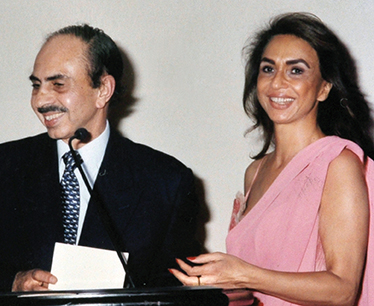
Adi with wife Parmeshwar
Open mind
Zoroastrian by birth and belief, Godrej says he is dismayed by moves from certain sections of the community to be restrictive and controlling. "Religion survives best by being liberal and open,” he asserts. "We have to be receptive to modern thinking.” Disposal of the dead in dakhmas may have been possible millennia ago, when population densities were different, the geography of Iran completely different. "I believe cremation to be the most sensible and hygienic method,” he says with his customary forthrightness. On the other issues plaguing the community, Godrej says with candour: "I haven’t studied this sufficiently to comment.”
We ask why many renowned Parsi businesses of yore have diminished substantially, moving away from entrepreneurship. "This is normal in businesses across the world. Survival of business over generations is not the rule, it is the exception. The inherent interest or motivation may vary. In Indian businesses, we have noticed that families may splinter because there are too many family members in the same business.” He smilingly agrees when we suggest that having many members may be an advantage if there are enough businesses to run!
After 50 years on the job, the chairman still looks forward to Monday mornings! "We have a strong and professional leadership, both family and non-family,” he declares. The Group will continue to grow; work will remain involving, evolving and energizing!
Zoroastrian by birth and belief, Godrej says he is dismayed by moves from certain sections of the community to be restrictive and controlling. "Religion survives best by being liberal and open,” he asserts. "We have to be receptive to modern thinking.” Disposal of the dead in dakhmas may have been possible millennia ago, when population densities were different, the geography of Iran completely different. "I believe cremation to be the most sensible and hygienic method,” he says with his customary forthrightness. On the other issues plaguing the community, Godrej says with candour: "I haven’t studied this sufficiently to comment.”
We ask why many renowned Parsi businesses of yore have diminished substantially, moving away from entrepreneurship. "This is normal in businesses across the world. Survival of business over generations is not the rule, it is the exception. The inherent interest or motivation may vary. In Indian businesses, we have noticed that families may splinter because there are too many family members in the same business.” He smilingly agrees when we suggest that having many members may be an advantage if there are enough businesses to run!
After 50 years on the job, the chairman still looks forward to Monday mornings! "We have a strong and professional leadership, both family and non-family,” he declares. The Group will continue to grow; work will remain involving, evolving and energizing!
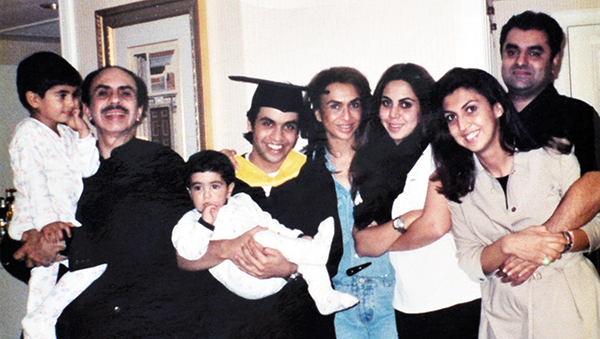
Adi with Aryaan, Azaar, Pirojsha, Parmeshwar, Nisa, Tanya and Arvind Dubash
◆ ◆ ◆
From the archive