
Books
Dark deeds in Dahanu
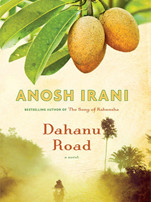
Dahanu Road by Anosh Irani. Published in 2010 by HarperCollins Publishers, a joint venture with the India Today Group, A-53, Sector 57, Noida 201301. Pp: 304. Price: Rs 299.
Dahanu Road is Anosh Irani’s third novel. It is surprising that an author of his caliber has remained relatively unknown in India in spite of his achievements. Though born and brought up in Bombay, he moved to Vancouver in 1998. He has authored two novels, The Cripple and His Talismans and The Song of Kahunsha, both of which were extremely well received. He is also a playwright and his play Bombay Black won the Dora Award for an Outstanding New Play. He has been nominated for the Governor General’s Award for Drama for his anthology The Bombay Plays: The Matka King and Bombay Black.
In Dahanu Road we encounter a mature novelist who presents a convincing portrait of life on a chikoo farm in the sleepy town of Dahanu and the relationship between the land owning Iranis and the Warlis, the original settlers. The novel begins in Iran in 1920 where Shapur, a young and excited boy, is being taken by his father, Vamog, to Yazd where he has been promised a feast at Aflatoon of Esfahan, the most famous confectioner not only in Yazd but in all of Persia. At the crucial moment Vamog drops the coin he is carrying and while bending down to retrieve it causes his shadow to fall on a Muslim royal. So badly is he thrashed that he decides to leave his native land and seek his fortune in India.

Anosh Irani: mature novelist
The novel alternates between two periods, the 1940s when Shapur is a young man who has just married Banu and 2000-01 when his grandson, the hot blooded Zairos courts Kusum, the daugher of Ganpat who commits suicide early in the novel by hanging himself from a tree. Over the years, Shapur has established himself as a rich farmer owning acres of chikoo tree plantations. Like the other Zoroastrians in the novel, he has quickly forgotten the oppression and the high-handed behavior of the Muslim ruling class he suffered in Iran; the oppressed have now become oppressors in their turn and have no hesitation in depriving the Warlis of their land, employing them as slaves to do their farming and usurping rights like the droit de seigneur which was practised before the French Revolution where the nobles had the right to lay their claim on the new brides in their fiefdom.
As one lacks the knowledge, one really is not in a position to comment on how authentic the portrayal of the Warlis is though one certainly feels that Irani does idealize them to a certain extent. Though they are treated like chattels, the Warlis generally behave in a dignified manner and only resort to violence when they have been provoked. The Iranis, on the other hand, mouth the sacred words of "good thoughts, good words and good deeds” while merely paying lip service to these precepts as no kindness or charity is shown to the Warlis. The good deed that Shapur does by employing the Pathan, Ejaz, on a whim and his good intention of blithely promising the latter that Ejaz’s son would be treated like his own has dramatic repercussions later in the novel and is the cause of Shapur’s eventual undoing.
Once again, in the relationship between Zairos and Kusum, Irani shows that good thoughts, words and deeds alone are not enough. Zairos falls in love with Kusum the first time he sets eyes on her when she comes to claim her father Ganpat’s body. He goes beyond the call of duty by attending her father’s funeral and even giving her a job at the farm. When he learns about her husband Laxman’s ill-treatment of her, he interferes and ineffectually gets him beaten up. Zairos goes to the extent of paying Laxman a sum of Rs 3,000, the bride price he had paid for Kusum. But he does not manage to save Kusum from her fate. Laxman continues to physically attack her very violently and even files a case against Zairos. Irani clearly makes a point that manashni, gavashni and kunashni are ineffectual if they are inadequately thought out and feebly implemented.
One of the strengths of the novels is that the author does not flinch from portraying the Iranis, warts and all. When Shapur moots the plan of meeting the striking Warlis with a view to negotiate their demands, the other Iranis use this as a ploy to get the Warlis to gather at one place on Dahanu beach where the police can start firing on them; the Iranis have no hesitation in having the Warli houses ransacked and their defenceless women raped. On one occasion Shapur himself stands by and watches as Vithal, Ganpat’s father, is mercilessly beaten up because he is accused of robbing a paltry sum of Rs 10 from the house. It is obviously a society which believed that "subjugation was as natural as a sunset.” On yet another occasion Pestonji and Noshir Irani, returning after a wedding at which they had too much to drink, come across some Warlis who had robbed a few coconuts. One of them is caught and beaten with a cricket bat, his ribs broken and eventually an iron parai (rod) is brought and shoved into his body.
It is the women characters who are memorably etched. They are the ones who are eventually sacrificed at the altar of male ego. Whether it is Banu, Shapur’s wife or Mithoo, his son Aspi’s wife and Zairos’ mother, both are unhappy about living in a small village like Dahanu; both hanker after the bright lights of the metropolis. Whereas Mithoo manages to maintain her mental equilibrium, Banu loses hers and withdraws into a world of books and suffers from the delusion that the characters she comes across in the novels are her only friends. Kusum is another finely drawn woman. (One never learns why she is digging a grave for her father as Ganpat is later cremated and it is unlikely that his ashes would be buried.) She is earthy and in spite of being uneducated is aware that her relationship with "Jairos” as she calls him, is doomed from the very start. He just does not have the required strength to overturn the social and moral order. If Zairos abandons her in her hour of need he behaves no better than Laxman who constantly abuses her and even pulls out a mass of her hair leaving her with a bald patch.
It would not be correct to say that the novel is bleak in its outlook. There is a great deal of humor which comes through a colorful assortment of minor characters where the eccentricity of the Iranis is presented in a lighthearted manner. Aspi hunts mosquitoes with a vengeance. His full-time occupation seems to be of combing the streets of Dahanu with a catapult and aiming at those defecating in the open air and polluting the beautiful countryside. The entire contingent at the Anna Purna chai (tea) stall is painted in a few words with great affection: Anna himself with his "old Hollywood charm,” his dusky wife, Merwan Mota, the fattest man in Dahanu, Keki, the ‘Italian,’ who reads intellectual stuff like Camus, Zairos’ cousin Bumble who is introduced riding his motorcycle wearing a Santa suit, Xerxes, the dentist, flying a glider above the populace which assembles each evening on the beach. They have minor roles to play in the novel but Irani shows great skill in portraying them with such loving care and perfection that they remain in the memory long after one has read the book.
◆ ◆ ◆
From the archive