
Books
Chevalier’s chase
The Tower of Silence by Phiroshaw Jamsetjee Chevalier ‘Chaiwala.’ Published in 2013 by HarperCollins Publishers, A-53, Sector 57, Noida 201301. Pp: 240. Price: Rs 299.
In 2001, Gyan Prakash, a professor of history at Princeton University, USA, stumbled upon an incomplete manuscript of a detective novel written by the curiously named Phiroshaw Jamsetjee Chevalier ‘Chaiwala’ at the British Library in London. With personal interest in Bombay and particularly the Parsi community, he was intrigued enough to know the end of the story. Prakash spent the next three years searching world-wide for a complete manuscript and for information on the mysterious Parsi with a name like Chevalier. We should be forever grateful to Prakash for his tenacity, for while he could not dig up much about the author who lived most of his life in seclusion, he found the manuscript and had it published this year. In his introduction, Prakash writes about how he found it. This account is as interesting as the book itself.
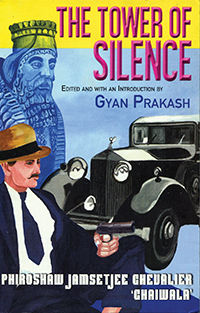
After scouring several Bombay libraries, he found the missing pages in the Asiatic Library at Horniman Circle. Perhaps the book’s revival from oblivion presents for a better story than the book itself. However, the importance of the book lies in the colorful picture it presents of the ways and idiosyncrasies of the Parsis in Poona and Bombay in the 1920s. The plot has the fictitious detective Sexton Blake (who also appears in many novels written by different authors), his assistant Tinker, the almost invincible super villain Beram, and the fast-moving inter continental action makes this Indian English pulp fiction of the Raj era an interesting read for Parsis and non-Parsis alike.
The Tower of Silence, penned by the author in 1927, is an unintentionally amusing novel which begins in Poona with the "click” of a camera shutter. This is largely due to all the cheerleading Chevalier does on behalf of Zoroastrians, and his language, which is the sort of severely correct English of anglicized Indians that might remind one of the way one’s grandparents wrote. The book is peppered with praises of Parsis such as their great love for animals, their chivalry at not causing harm to helpless ladies, their sense of justice and fair-play, and their fanatical devotion to the Zoroastrian religion. "Along with their psychological powers (sic), deep learning and noble disposition… the Parsees had a mine of wealth. For how else could so small a number hold its own against 300 million (the then population of India) in this land of mystery and mighty upheavals?” writes Chevalier.
The author had even tried his hand at poetry with rather poor success before he turned his attention to this fictional work. In fact, the book is an angry response to a real life incident that took place in 1923 that outraged the Parsis of Bombay. It was the attempt by a British aviator to photograph the innards of the Towers of Silence.
As per the story in the book, photographs of the tower of silence in Poona showing corpses piled up in the dakhma waiting to be picked clean by hovering vultures were published in a British weekly called The Graphic. Chevalier spins this crime into a revenge drama that hops from London to Burma to Bombay and hinges on the rivalry between two antagonists: Beram (the name Behram was anglicized to Beram by the author mainly for British readers, I suppose), a Parsi vigilante bent on teaching a lesson to those involved in taking the photographs of the dakhma from the air and thus destroying the sanctity of the towers of silence, and Blake, an ace British private eye who tries to foil Beram’s plans with the help of his sidekick Tinker and a dog named Pedro.
Chevalier paints Beram as a sort of superhero. He has highly developed telepathic powers that he uses to communicate with his own sidekick Rustom across rooms; he can hypnotize people; kill with just the power of his thoughts; and has powers of deduction that rival the great detective that preceded him, Sherlock Holmes. But he is also chivalrous, has a "loving familiarity with birds and animals, however savage or timid they may be” and a fondness for "the most exquisitely salted Indian tamarind and delicate strips of raw Bombay mangoes.” Blake, his only intellectual equal, tries to stop Beram from hurting the photographer, a Mr Young, and the editor of The Graphic. In the process, the two pursue each other across continents, in various disguises; somehow Blake the British detective can speak Gujarati and Hindi; they are always just missing running into each other, obviously, in order to keep the story running. Strangely enough, the chase involves a lot of reptiles including a fight between a cobra and a mongoose; human sacrifice in Burma; and, of course, the tower of silence.
As far as detective novels go, The Tower of Silence is just about average. The story, although fast paced, is rather simple and the twists in the plot are often confusing as characters constantly second-guess their opponents, taking action even though there are no clues for the reader to follow. But it keeps one hooked thanks to the fantastically quirky character that is Beram and the way the book captures the sentiments of the Parsi community at the time of the clandestine photography. It speaks volumes about the lives of the Parsis during the days of the British Raj. However, it must be said here that editor Prakash, in his effort to keep the book short, may have deleted many parts from the original manuscript which could have made the story a little less confusing. The ending is as intriguing as it is dramatic. No Indian author, leave aside a Parsi, has used the towers of silence as a scene location. But with the recent hulabaloo about the unintentional use of the Doongerwadi estate for hosting a film crew, I have very serious doubts if The Tower of Silence by Phiroshaw Jamsetjee Chevalier ‘Chaiwala” will ever be made into a film. What happens to Young in the end? Did the Parsis have their revenge and dispose of him? You will have to read this novel to find out!
ARDESHIR DAMANIA
◆ ◆ ◆
From the archive