
Education
Enlightened educationist
The New High School, which Jalbhai Dorabji Bharda started 121 years ago, became one of the leading educational institutions of its time because of progressive teaching methods
For not paying attention in class and causing a disturbance, a wealthy Parsi student of the Fort High School was reprimanded by his tutor Dhunjibhai Gilder. During the lunch recess, the boy came from behind and gave a tapli (rap) to the master. After a brief chase the boy was caught and brought before the principal, Maneckji Bejanjee Cooper. All the teachers asked for his rustication but Cooper believed, "The good name of the school will be spoiled and other parents may withdraw their own children.” When Cooper refused to reconsider, Jalbhai Dorabji Bharda with five other teachers resigned on the spot.
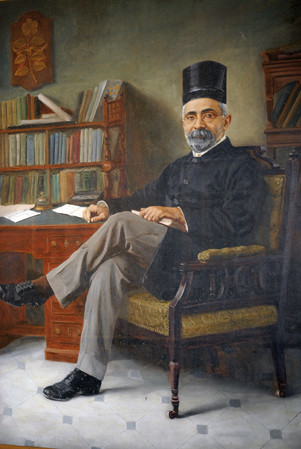
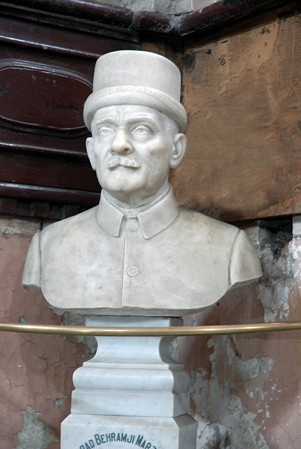
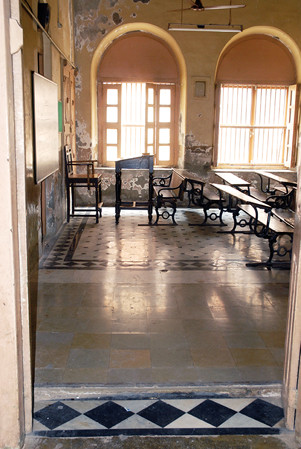
(From left): Jalbhai Bharda’s portrait by Manchershaw Pithawala; marble bust of Kaikobad Marzban; classroom
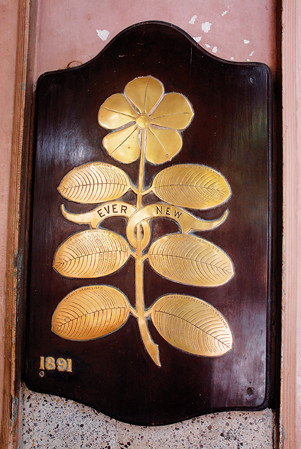
Within six months Bharda moved on to start the New High School that he set up conjointly with his cousin Kaikobad Behramji Marzban in 1891. Starting with an initial enrolment of 400 students, by the end of the year the students numbered 901. It was the first school in India that employed only graduate teachers for the higher classes and whose principals, Bharda and Marzban, were themselves graduates of Bombay University which had been established in 1857. In fact it was only five years prior to the founding of the School that Bharda had stood first in his BA examination.
Whilst the proprietors of Fort High School, Dadabhai Pestonjee and Cooper dissolved their partnership over a disagreement and closed down their School the New High School prospered as a result of radical changes made in the curriculum by Bharda and Marzban who introduced their own selection of text books and the latest teaching methods. Bharda embraced the holistic approach for training a child’s mind, observing, "The method of examination (in our school) has changed. In the old days the questions asked were generally such that the student learnt the answers by heart. Now, he is thrown more on his own wits as good teachers do not consider it a part of their duty to guess likely questions and give him ready-made answers that he can learn by rote.” The school became well-known not only in the entire Bombay State, it was noticed by educators in England and America as well.
Bharda was totally against the demand that the school teach in vernacular languages. "If we allow students who are going up to college level the option of answering all the subjects except English in their vernacular, we may be reasonably sure that the students will not be able to derive all possible benefit from their college teaching.”
Marzban and Bharda complemented each other perfectly. The former taught English and correct pronunciation, dramatics, elocution, debating and sports, while Bharda took science, mathematics, first aid, in the higher classes, encouraging them to observe everything carefully and discuss their findings with colleagues. He also lectured on astronomy (his favorite subject), using lanterns, predecessors of the slide projector. He made the subject so interesting that pupils from the entire school thronged the lecture room. To boys who showed any special interest in science and astronomy, Bharda would unhesitatingly loan his telescope and other apparatus so that they could further their knowledge. He would tell stories of his travels and visits abroad and make his young listeners repeat them to test whether they had grasped every detail.
Subjects like drawing, physical training, wrestling and drill, and lectures given with the aid of magic lanterns which were made compulsory by the British Government in 1915, had already been included in the curriculum of the New High School from day one! The other schools had just begun to start school libraries, but New High School had a library when it was opened. The school even boasted a modest museum, reading room, and special library only for teachers.
The New High School was the first in Bombay to start Road Safety Patrol. It has given India several cricketers and Bombay many mayors. The school was extremely sought after due to the good results at the matriculation exams; it enjoyed cent percent passing results and in 1914 the two top students came from the New High School. Bhulabhai Desai, one of Indian’s great freedom fighters and an eminent Bombay lawyer, was a pupil of the New High School and observed, "From the program of work, it can be seen that our principals have not cared for monetary gains, but by their selfless services have provided for the whole province an excellent example to be copied by all.”
Taking a personal interest in all his pupils, Bharda would often escort them on outings to various places of interest around Bombay. On one such trip to the Kanheri Caves, Ardeshir Behramji Homavazir and Nusserwanji Eduljee Udwadia were invited to lead the group of students and some ladies from the Fort area, including Bharda’s college-going daughter Khorshed. In those days the area was thickly wooded with no motorable road or clear path from Borivli station to the Caves. A guide was hired, but proved useless as even after two hours of walking the Caves could not be found. That was one of the few times that the pupils saw "Bharda Master” lose his temper. When they finally reached the Caves everyone was treated to a lesson on their origins and history as Bharda believed in mixing practical knowledge with book learning.
An amusing incident was narrated by Homavazir who started his teaching career at the New High School. One Sunday Udwadia and three other teachers including Homavazir took the students on an early morning botanical excursion to the Victoria Gardens. Without informing them, Bharda casually turned up at 7 am on his bicycle. He spent more than an hour with the students explaining the names and characteristics of the plants and animals till it was lunch time. By now exhausted and hungry, everyone just flopped on the grass and opened their lunch boxes. Just then the principal of Elphinstone High School, Eduljee Talati, who happened to come by began discussing with Bharda the lotus flowers in the pond and the amount of weight the round thali like leaves could carry without sinking. More than 30 minutes passed by, and students were left chagrined about whether they should start lunch without Bharda. After some time the two teachers approached the two principals who realized their error in keeping the students waiting for so long and at once joined the picnic. All had a hearty laugh before doing proper justice to the food. Homavazir made a note of a Hindi saying "Gyani sé gyani milé, tau ho gyan ki lootaloot (when two knowledgeable persons meet, they gain knowledge from each other).”
On returning from a trip to Europe in 1907, Bharda gave a lecture to the Parsi Writers Association on the educational systems of England and Germany. He incorporated some of these aspects in his own school. During the 30 plus years under his guidance the New High School grew from strength to strength not just in academics but also in sports. His pupils, if they are still alive, would now be in their 90s and may recall his genial wit, tolerant and understanding nature, devotion to duty, and above all his love and concern for all his pupils even after they left the school and were well-settled in life. Lord Lamington, the Governor of Bombay (1903-1907) observed in a letter, "Some of the private schools reach a high standard of efficiency. One of these is in Bombay city, under the control of Messrs Bharda and Marzban and is the largest (school) in the Indian Empire, and possibly in the British Empire, and is maintained entirely out of fees collected from its pupils…”
By the time the School celebrated its silver jubilee it had reached a student strength of 2,271 of whom nearly half were non-Parsis. The turbulent period for the School was during the time the great plague epidemic hit Bombay and almost all families left for the towns and villages of Gujarat. By 1901 nearly 40,000 people, many of them Parsis, had fled. Since fees were not forthcoming and expenses of the school were mounting, Bharda asked for a temporary loan from his mentor Sorabji Muncherji Billimoria of Dharampor. After the danger receded the School once again began to progress and the loan was repaid with interest. All the money earned by Bharda was ploughed back into the school by purchasing books from M/s Taraporewala and Company and also Thacker Spink and Company, the leading booksellers of the day.
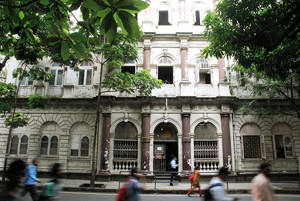
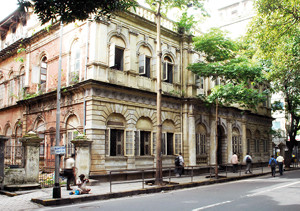
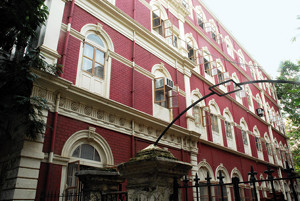
Facades of Bharda New High School’s buildings from different angles
Bharda dressed simply in a soft silk long black coat and grey trousers and wore a soft, black mukhmal (velvet) Parsi skull cap. He sported a small goatee and was ever smiling. Although a strict disciplinarian, Bharda was neither severe nor vindictive in inflicting punishment to erring pupils. He had the uncanny knack of understanding the adolescent mind and the cases that came to him for adjudication were treated with fairness, winning him great popularity, much love, affection and admiration.
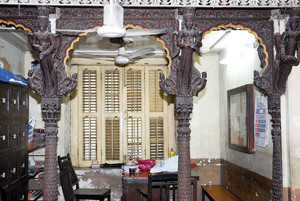
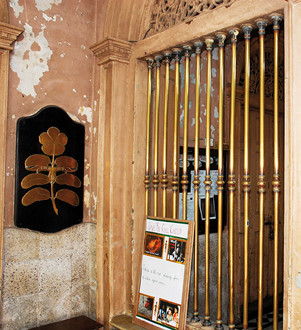

Interior views of school building; (far right) part of telescope from Baliwala and Homi
Academic aspirations
There were different individuals who had influenced Bharda who was born in Udvada on February 16, 1864. His father Ervad Dorabji performed religious ceremonies and rituals at the Iranshah Atash Bahram along with his elder brother Cawasji. A very diligent student, Bharda lost no opportunity to further his knowledge. On the recommendation of Billimoria who had home schooled him, Bharda was sent to the Surat High School. But after a year or so he realized that the real center for learning was in Bombay. He passed his matriculation exam with flying colors in 1882 and bagged the coveted Ellis Gold Medal accompanied by a prize of books worth Rs 60 to be awarded each year to the student who scored the highest marks in any Oriental language. Billimoria, who was very pleased with Bharda’s performance, presented him a pocket watch and chain which he used with pride all his life.
Bharda completed his BA studies from the Elphinstone College in Bombay. He loved the poems of Alfred Lord Tennyson and William Scott and on several occasions roused the interest of his class by quoting some of the finest lines of English verse. He studied French under Jehangirji Kaikhusrow Kabraji and German from a teacher at St Xavier’s College. He even learnt Farsi. He began studying for an MA degree, but due to his failing health was advised by Dr Khushru Nusserwanji Bahadurji to discontinue higher studies which disappointed him greatly.
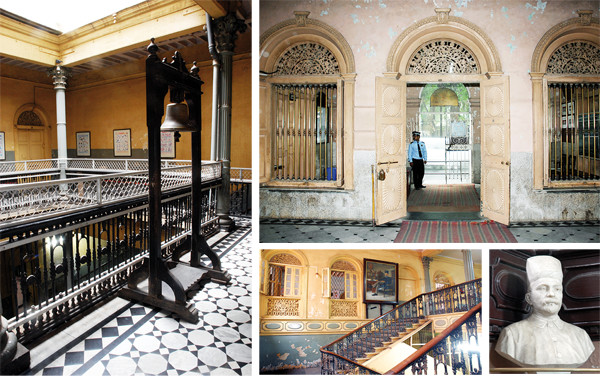
(Clockwise
from top l): Corridor;
lobby; bust
of Bharda; staircase
of school
Devoting most of his adult years to the progress of the New High School, Bharda made maximum use of his time before he succumbed to typhoid on August 13, 1921 at the age of 57. His body was carried on foot from his residence at Gowalia Tank to Doongerwadi by pallbearers followed by a large number of mourners that included prominent Parsi citizens and their families, students and ex-students, principals of other schools as well as people from Grant Road and other areas. The congregation at the funeral exceeded 3,000 men and women of all communities. At a memorial meeting held on August 14, 1921 Marzban declared, "From this day our school shall be called The Bharda New High School.” A few years later Marzban too passed away.
Among Bharda’s many honors were membership of the David Sassoon Reformatory, and trusteeship of the Udvada, Bombay and the Deccan Parsi Anjumans, He also took care of the education of the sons and daughters of all the mobeds in Udvada. He left behind his wife, Cooverbai, the daughter of Seth Maneckji Cawasji Damanwalla who had supported him in his endeavors and additionally assisted the poor in the Parsi community. Although the Bhardas had only one child, Khorshed, at the time of his death he had left behind thousands of sons — the pupils at his school. As ex-student Sir Rustomji Pestonji Masani had commented at Bharda’s birth centenary celebrations, "Jalbhai and Kaikobad are gone, alas! But their work survives and their influence lives.”
[The school is located close to the Victoria Terminus on Waudby Road (now renamed Hazarilal Somani Marg) and has 700 students — editor.]
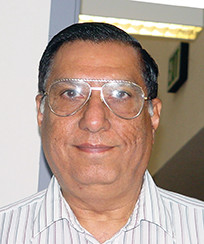
Associate research geneticist at the University of California, Dr Ardeshir B. Damania’s area of interest includes biodiversity conservation issues, early agriculture, crop domestication and plants of economic and medicinal values. His early career was with the Food and Agriculture Organization of the United Nations and he subsequently worked with the International Center for Agricultural Research in the Dry Areas.
◆ ◆ ◆
From the archive