
Institutions
The end of an Era
The erstwhile New Era School imparted an all-round education to its students
Why New Era?” was a question my parents, Dr Kaikhushru and Pareen Lalkaka, were repeatedly asked by puzzled well-wishers when they chose this predominantly Gujarati school for me, their only daughter. "Your daughter will never learn English. She will remain illiterate.”
 My parents, educators themselves, were impressed by the School’s ideology based on the vision of Mahatma Gandhi and Rabindranath Tagore, and its emphasis on first imparting education through the mother tongue. Gujarati was taught initially and then gradually English and Hindi were introduced as second and third languages, (plus Sanskrit or French as the optional language). By the time students came to the eighth standard they were proficient enough to switch to English as the medium of instruction. This unique, rational, multilingual approach, coupled with a curriculum that laid a lot of emphasis on the arts — making dance, music and art an integral part of the education that was based on the rich cultural heritage of India — convinced my parents of its importance.
The Republic of India was only a year old when I was born. The vision of its founding fathers was lofty and profound. India would show the world how different castes and communities could live in peace and harmony — a cultural blend of many colors united under a benevolent Constitution. They wanted an India rooted in her traditions, yet international in outlook, eager to accept and incorporate the best from all cultures and creeds. It was this vision that Maganbhai Vyas (known as MT), his wife Sarojben and brother Chandulal wished to enshrine in the institutions they founded at the height of the freedom movement: the Fellowship School in 1927, and the New Era School in 1930.
My parents, educators themselves, were impressed by the School’s ideology based on the vision of Mahatma Gandhi and Rabindranath Tagore, and its emphasis on first imparting education through the mother tongue. Gujarati was taught initially and then gradually English and Hindi were introduced as second and third languages, (plus Sanskrit or French as the optional language). By the time students came to the eighth standard they were proficient enough to switch to English as the medium of instruction. This unique, rational, multilingual approach, coupled with a curriculum that laid a lot of emphasis on the arts — making dance, music and art an integral part of the education that was based on the rich cultural heritage of India — convinced my parents of its importance. The Republic of India was only a year old when I was born. The vision of its founding fathers was lofty and profound. India would show the world how different castes and communities could live in peace and harmony — a cultural blend of many colors united under a benevolent Constitution. They wanted an India rooted in her traditions, yet international in outlook, eager to accept and incorporate the best from all cultures and creeds. It was this vision that Maganbhai Vyas (known as MT), his wife Sarojben and brother Chandulal wished to enshrine in the institutions they founded at the height of the freedom movement: the Fellowship School in 1927, and the New Era School in 1930.
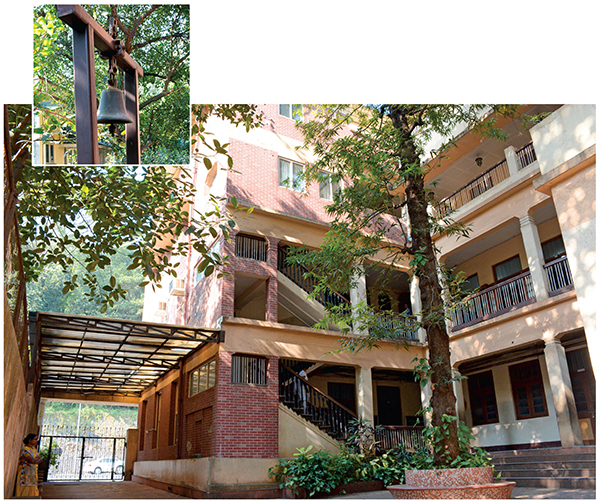
The New Era School premises; inset: old School bell;
above: School badge Photos: Courtesy The New Era School Odyssey and Aban Mukherji
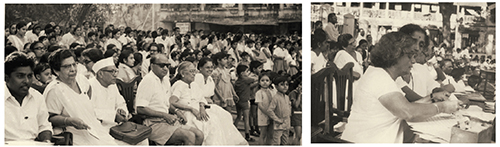
Above: Jerben Gyara (2nd from l) and Dr K. C. Vyas (4th from l) with Mehroo Dastur (r) at a School gathering
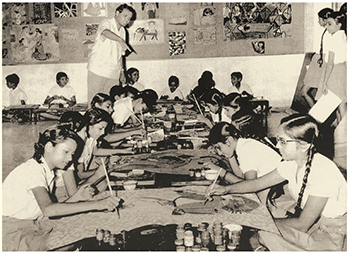
Dinesh Shah conducting the art class
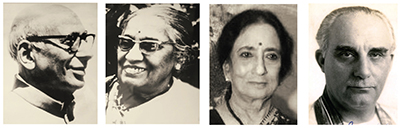
From l: M. T. and Sarojben Vyas and daughter Ila Pal; Dr George Arundale

A portion of the mural on the School wall created by Dinesh Shah
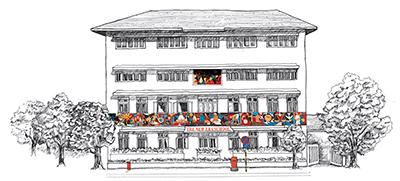
Sketch of the School building
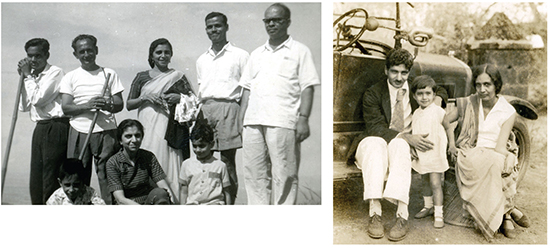
Above: Nargish Shroff (in sari) and Pareen Lalkaka (seated) with other teachers and students;
(r) Mithi Choksi with husband Prof Rustum and daughter Shirin
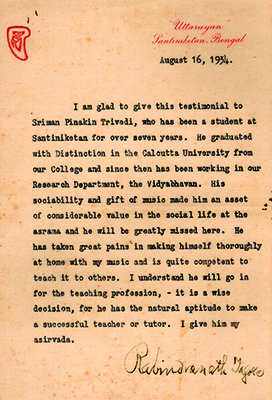
Testimonial by Rabindranath Tagore for Pinakin Trivedi
The Vyas brothers, hailing from the Rajpipla division of Bharuch district and graduating from Ahmedabad, had come under the spell of the Theosophical Society headed by Dr Annie Besant, and the principles of progressive education. After training under Dr George Arundale at Adyar, Madras, they opened an ashram school on the banks of the Narmada in Shuklatirth in 1922. In 1924, encouraged by Arundale, MT went to the London School of Education for further training. On his return, inspired by Gandhi’s ideas of New Education (Nai Talim), Tagore’s all-encompassing vision, and incorporating Maria Montessori’s ideas of child education, the family founded these two co-educational schools in the vicinity of the Maidan. By the time I joined New Era in 1956, the E-shaped building stretched from the Gowalia Tank Maidan to the Hughes Road entrance that faced the Hanging Gardens of Malabar Hill.
New Era, though a predominantly Gujarati school, had a sprinkling of Parsi and Bohri students from progressive families and quite a few Parsi teachers who left their imprint on the institution.
Mithi Rustum Choksi was the head of the English department. Her son Jal, and daughter Shirin (Kudchedkar) studied at New Era; and Kudchedkar later headed the S. N. D. T. University’s English department. Mithi was the author of numerous "Rapid Readers” published by Macmillan Press. Thorough and with an impeccable command of the English language, she was an inspiration for the teachers working under her. One of whom was Meher Patuck, née Lalkaka. Amongst her students was the late ophthalmologist Dr Homi Dordi who retained very fond memories of her.
Jerben Gyara, the plump and commanding headmistress of the Primary School was loved for her heart of gold as much as she was feared for her legendary strictness. "A lady with stainless steel vocal chords” she could freeze us into obedience, and then reprimand us with affectionate understanding. "Jau dikra, beeji vaar aavi bhul naa karto (Look dear, don’t make the same mistake again). You are a good boy.” I can never forget the day she caught me reading an Enid Blyton story, the book hidden under the desk. Her booming voice brought the Sea of Adventure tumbling to the floor as she pinned me with a piercing look. But she never reported this to my mother who was by then also a teacher at the school, for which I was eternally grateful. And from that day on she saw to it that some of us were given more challenging tasks to do while the rest of the class grappled with English grammar. Remembering her sterling qualities, our social studies teacher, Dineshbhai Buch, aptly summed up her character in a single quote: Vajraadapi kathoraani, mriduni kusumaadapi — harder than adamantine (possessing the hardness or luster of a diamond), softer than a flower.
We had the tall and slender sariwala (sari wearing) Dhunben who taught English and the frockwala (dress wearing) Dhunben who taught us embroidery and was in charge of girl guides. Nergish Shroff, Mehroo Dastur, and my mother, Pareen, all three petite, with a commanding presence, taught English and French.
New Era was a school where both teachers and students were encouraged and expected to think differently. Teachers were given the freedom to experiment with different methodologies and innovative teaching techniques to make learning as enjoyable and personalized as possible. And students were never discouraged from questioning their teachers or freely expressing their thoughts and feelings.
I remember my mother starting an English Club where music, songs and games were employed to enhance the students’ grasp of English. Games and music were two great de-inhibitors. Without realizing it, children forgot they were speaking in a foreign language and spontaneously started conversing in English. She taught them European folk dances, playing the music on her mini piano accordion. She prepared students for the elocution competitions held at The K. R. Cama Oriental Institute where they would have to compete with students from English medium schools, thereby motivating them to improve their pronunciation and diction.
In the spirit of Shantiniketan, the school founded by Tagore about 180 km from Calcutta, our School encouraged the flowering of the arts and a close rapport with nature and the rural countryside. Music, art and dance flowed effortlessly into our lives. Pulin Bihari Dutt from Shantiniketan was the first to head the arts department, introducing the concept of freedom of expression to encourage creativity. When I began my schooling, Dineshbhai Shah had taken over as the head. I can never be grateful enough to him for his role in opening up the world of painting for me. We drew the world around us with abandon on large sheets of paper. And when our drawings burst the boundaries of the paper and meandered over the classroom floor, no restraining hand stopped us.
Our pre-school was blessed with music teachers like Khandubhai, who made the world of fields and forests, animals and birds, rivers and oceans come alive through song and abhinaya (gestures). Looking back in wonder I realize that it was not merely the Hanging Gardens and Gowalia Tank Maidan with their stately trees and twittering birdsongs that brought us close to nature but also the nursery rhymes and children’s songs so full of love for all living creatures that sensitized us to all forms of life. There were no blind mice whose tails were chopped off, or goosey ganders thrown down the stairs or pigs on railway tracks getting their bones crushed. Instead, there were peacocks and peahens dancing in ecstasy, shy spotted deer gambolling in the woods, playful streams bubbling over rocks, sparrows being entreated to play without the fear of being scolded by ba or bapu (mother or father), pretty green parakeets welcomed at the windowsill. From the age of three we were dancing to these tunes, keeping time to the dhol and the tabla.
As we grew older, we graduated from folk melodies to Hindustani classical music, ably simplified by our music teacher, Narayan Joglekar, who hailed from the Gwalior Gharana. Pinakin Trivedi, fresh from Shantiniketan, introduced Rabindra Sangeet (songs written and composed by Tagore) and composed our school anthem based on a Tagore melody as well as numerous dance-dramas.
In 1936, inspired by Rabindra Sangeet and dance, dancing was introduced as an activity and Navkumar Sinha became our first Manipuri dance teacher. The famous Jhaveri Sisters, who pioneered the revival of Manipuri, were also New Eraites and familiar figures in our School.
With the coming of Namdev Lahote, theater took center stage in our lives and students and teachers participated in every step of the production of school plays and dramas. And not a single child was left out. The shyest ones had a role to play on stage even if it meant just standing still, as a tree or a flower.
Three things that stand out in my memory about my School are Friday assembly periods, the school library and the teaching of social studies
Every Friday we gathered in the Assembly Hall facing the frieze of the Himalayan range on the wall behind the stage. Some of us were chosen to recite prayers from the various religions of India. I remember reciting the Ashem Vohu and the Ahunavar prayers while others recited the Jain, Christian, Sikh and Muslim ones ending with the Buddhist chant Buddham Sharanam Gacchaami [I take refuge in Buddha, I take refuge in dharma and I take refuge in sangha (the community of monks and hermits where dharma is imparted)]... which was echoed by all the students present.
Then the whole Assembly chanted the beautiful verse from the Brihadaranyaka Upanishad, Asato Ma Sadgamaya. "Lead me from untruth to truth, from darkness to light, from death to immortality.” We ended with singing Vinoba Bhave’s lovely Sarvadharma Prarthana (In Praise of All Religions) – Om Tat Sat (Supreme Absolute Truth).
MT, and later his nephew Dr Kantibhai Vyas, my principal, had a way of bringing the world to our doorstep. We heard many eminent personalities share their views and experiences. Freedom fighter and Gandhian Usha Mehta brought the Quit India Movement to life, narrating how she had been tortured in jail by being made to sleep on slabs of ice. Incidentally, during the Quit India Movement Mehta and Rohit Dave operated a clandestine Radio Station from the New Era School premises. The Gandhian Ravishankar Maharaj spoke on Vinoba Bhave’s Bhoodan Movement; Nawang Gombu, Everest hero Tenzing Namgyal’s nephew, spoke on mountaineering and kindled a love for the Himalayas in my heart. Atomic scientist and religious scholar Dr Minocher Karkhanawala, whose children studied in New Era, would be invited to speak on Zoroastrianism. On our stage with their wandering repertory theater, the English Kendalls Geoffrey and Laura, daughters Jennifer and Felicity together with actor Shashi Kapoor, performed scenes from Shakespeare, and actor Naseeruddin Shah and his troupe performed Anton Chekhov’s plays. Renowned Gujarati poets, novelists and educationists also graced our assemblies as well as Anuradha Pal, the famous tabla player and granddaughter of MT. Her mother Ila was an artist in her own right whose studio was located next to our school library. Painter Maqbool Fida Husain was a frequent visitor.
The School library was con-sidered to be one of the finest in Bombay for its collection of Gujarati books. It also had a vast collection of Western and Bengali classics translated into Gujarati. We really ‘gained in translation.’ To my surprise I realized I had read authors like Jules Verne, Victor Hugo, Leo Tolstoy, etc first in Gujarati, then in abridged form in English and finally the unabridged version. In the same way, we devoured Bengali novels and wept copiously over Sarat Chandra’s tragic tales. At 12, I was confident enough to embark on a major project of rewriting Pride and Prejudice in verse, and to the credit of my teachers and parents, spelling mistakes were not allowed to dampen my ardor!
Our teachers were encouraged to use methods that employed all five senses to enhance the students’ ability to grasp the subject. Daulatbhai Desai, one of our best loved teachers, could transform a history lesson into a "virtual experience” that remained with us for life. I clearly recall how our class was taken to the Assembly Hall where he narrated the events of the Freedom Movement so vividly that we were literally transported into that period — becoming part of the Salt March, one with the revolutionaries, unfurling the first flag of Independence with Madame Bhikaiji Cama, standing in the shadow of Prime Minister Jawaharlal Nehru as he delivered his "Tryst with Destiny” speech on August 14-15, 1947.
After this lesson we were allowed to express our feelings through art and given huge sheets of paper to draw whatever had moved us deeply. I was fired by the courage of the revolutionaries and distinctly remembered how perplexed I had been realizing that our march towards freedom had churned up many streams of thought leading to diametrically opposite actions. Should I draw the Dandi March or Madame Cama unfurling the flag? Which was the right path to achieve Independence — Ahimsa (non-violence) or violence?
I also remember the dismay I felt when I realized that our family hero, Dr Cawas Lalcaca of Shanghai had lost his life in 1909 trying to save the hated Sir Curzon Wylie from the bullets of the Indian revolutionary Madanlal Dhingra. To me it appeared that he had lost his life needlessly on the wrong side of history!
The seeds of independent thinking were sown in my mind and I began to view my family, my Parsi community and my schoolmates in a more critical light. I began to observe how Parsis were viewed by other communities. It was quite a shock to realize that we were not looked upon as ‘God’s gift to India’ but as good natured, eccentric kaagraakhau (crow eater) bawas and my ‘Lalkaka’ (red uncle) surname did not help! On the other hand, I began to notice the overtly racist, ‘Colonel Blimp’ attitude of some members of my community, which made my blood boil. And when one eccentric relative proudly remarked that he had sent money to Prime Minister Ian Smith of Rhodesia to carry on the good work of apartheid, my 13-year-old soul was ready to shoot him dead in the spirit of the revolutionary Chapekar Brothers (who were involved in the assassination of W. C. Rand, the British plague commissioner of Poona).
Then again, on Saturdays, at the morning Sangh-Geet assemblies where we lustily sang many beautiful patriotic songs of Tagore and Mohammad Iqbal, of Khabardar and the poet Kavi Kaant, my heart would swell with pride. In the song O Hind Dev Bhoomi Kaant mentions various communities, but only qualifies the Parsi community with the adjective vishvaasi (trustworthy). What wonderful songs they were, so all embracing and full of love for the Motherland, so devoid of narrow, jingoistic nationalism.
We were never allowed to forget our relationship with the countryside and our wonderful social studies camps took us to many a rural area where we lived with the villagers, attended panchayat meetings and took part in their daily activities. I have still preserved my Std VII diary of Chinchan no Pravaas (A Trip to Chinchan). I had filled a 100page book with my observations and drawings.
I cannot end this piece without mentioning the wonderful monsoon picnics. It was exhilarating to cast aside our raincoats and feel the rain on our skin, the earth wet and squishy under our feet, roaring waterfalls and verdant trees. We wished the outings would never end.
But all too soon these magical days were over. Now the curtain will finally come down on this wonderful institution which will close its doors in 2018. Only the collective memory of its students and teachers will remain to keep the flame burning.
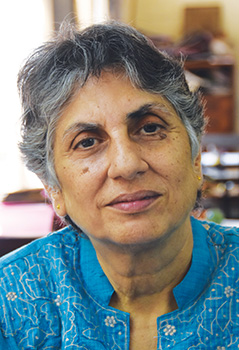 Aban Mukherji is a freelance writer and translator. A student of (and later a teacher at) the New Era School, she completed her Masters in History. She has contributed articles to various publications.
 ◆ ◆ ◆
From the archive