
Observation
The tigers roar once more
Though old bungalows are derelict or being converted into garish hotels, life is returning to the forests around Mahableshwar
Sitting on a bench in a roadside cafe in the hills of Mahableshwar in winter one can truly relish Irish Coffee as a gentle breeze brings the chilled air closer. An occasional cow saunters past, a melancholic donkey trudges by, his eyes deep and moist full of sullenness almost ready to drop a huge tear, and a family of stray dogs stops to see if we are feeling charitable. They were shooed away by the waiter to whom they turned from a distance and gave an indignant bark. The waiter, unmoved by their insult, turned with a shrug and returned to his lonely post. This is life in the very slow lane that we were experiencing on our 20th honeymoon anniversary. Later in the market we happened to hear two locals talking about how they had attended a Parsi marriage at the enchanting Sunset Hall in the elegant premises of the Mahableshwar Parsi Gymkhana (MPG, also referred to as the MPG Club). Once our Parsi eardrum caught the beat, we decided to check out the grand old establishment where surely several thousand liters of rum and colorful words must have flowed.
The sun had just begun its descent. As the slanted rays of the sun and the shadows seemed to begin their daily evening waltz, we drove up the narrow path and seemed to be taken into an old part of a Cornwall village. We could almost visualize an Englishman step off the curbstone from a small wooden gate made of bamboo and teak with an arch upon which grew beautiful bougainvilleas, the deepest and brightest purple and pink. As I pumped my brakes to avoid hitting him, the jolt made me see no one was there and brought me back to reality.
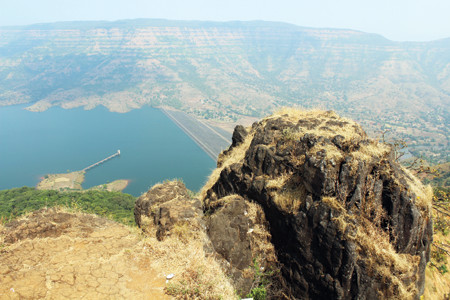

Serene surroundings of Mahableshwar Photo: Jasmine D. Driver
It was so pretty we felt we were driving in an old English poem. Moss covered walls, no more than five feet high and rounded at the top, kept you from entering but not from chatting with the owner of the home. All the bungalows were similar in their design and sadly their dilapidated condition appeared to wistfully hearken for the patter and chatter of happy children who were raised there. It seemed cruel that an era of such elegance and simplicity be crushed out, only to be replaced with the horrid, brightly colored, gaudy hotels and motels, oozing garishness to attract the city dwellers swarming the hill stations in ST (State Transport) buses for cold weather, waterfall picnics of vada pav and strawberry icegolas and undhyu puri (which I too love occasionally).
There were so many dilapidated British-Parsi bungalows each with a broken gate, a hut where the old retainer possibly still lived, a small cobbled path to the main house, large gardens strewn with litter overlooking the lake, hens busy with their chicks and keeping an eye on the marmalade cat with her bushy tail curled up on the first step of the unused door, a very thin dog lying more still than the fallen log next to him, black, hairy pigs scavenging through filth and the thin, bent old man in a torn and tattered banyan, khaki shorts and the half smoked bidi, with his very scanty hair very neatly combed. Every site was identical, almost cloned. Finally my wife Amy convinced me to ask for directions (she being the more practical half whilst I, a romantic, like to get lost). We were taken by a young man to the old Parsi Gymkhana and to our dismay it was not old anymore. The new design on the gate was not inviting, the main structure sporting cosmetic changes on the old structure was akin to adding tomato ketchup to scrambled eggs.
There was construction work going on in all directions, new gaudy structures and gazebos were sprouting all around the once elegantly manicured gardens. The MPG Club, was allegedly being made into a swanky new hotel and resort.
The MPG was founded on May 27, 1910 (as per locals, but I think it must have been much earlier) at the then gargantuan sum of Rs 17,300. The main structure bearing beautiful wrought iron pillars, majestic arches and huge rooms, one could feel the presence of many a pioneering Parsi and Irani sauntering through the foyer, nodding an enlightened greeting to each other, some carrying books, one returning the read book and the other taking it home in anticipation of a great story she will enjoy by her fireplace while her husband has gone down to Poona for the day on his weekly trip. The garden below took our breath away, as it overlooks a lake, with a forest on the opposite bank. Standing at the porch I felt transported back a couple of centuries. In the shadows, now very large, I thought I saw two slanted eyes staring back, maybe the panther we had spotted on the road to Arthur’s Point or a tiger, their populations having grown. For a moment I felt compelled to straighten my back and stand erect, leaving behind my modern slouch. I felt a desire to angle my head in a cocky posture yet there seemed a charming sense to this feeling of drama this old premise gave us. An electrical drill brought us out of character and we remembered the watchman and immediately returned to the gate, thanking him and praying he does not get scolded for our boorish behavior.
Sadly we left the almost hallowed grounds of the once pristine and elegant MPG, a place almost forgotten by the community, its heritage and history nearly lost. Amongst the few with nostalgic memories is the old lady who remembers the Sunset Hall where she was married. It seems the people who pioneered and built this beautiful hill station have left in search of quieter valleys and hills in foreign lands.
Life in the forests is returning, bison and nilgai (bluebull) herds are multiplying, and the tigers are returning to the foothills of the Sahyadris. One can hear them roar and feel the resonance for miles around in the valley. Maybe we should consider returning too.

Urvaksh Hoyvoy is chairman
and managing director of Dairyland Hotels Private Limited.
◆ ◆ ◆
From the archive