
Books
Courtroom chronicle
Courtroom chronicle
The Kesavananda Bharati Case. The untold story for supremacy by Supreme Court and Parliament by T. R. Andhyarujina. Published in 2011 by Universal Law Publishing Company Private Limited, C-FF-1A, Dilkush Industrial Estate (Near Azadpur Metro Station), G. T. Karnal Road, Delhi 110033. Pp: xi+150. Price: Rs 295.
If you believe that any book on some esoteric aspect of the Constitution of India is sure to induce sleep, do read former solicitor general of India, Tehmtan Andhyarujina’s The Kesavananda Bharati Case: The untold story of struggle for supremacy by Supreme Court and Parliament. It is simply unputdownable.
In 1967, the Supreme Court, in the case of Golak Nath, held that fundamental rights (including right to property) could not be amended by Parliament. Three years later, the Supreme Court struck down Indira Gandhi’s bold moves to nationalize banks and abolish privy purses of Indian rulers. Months later, Indira’s Congress won 352 out of the 518 seats in the Lok Sabha on the manifesto of Garibi Hatao (remove poverty). Armed with this mandate, Indira decided to take on a Supreme Court (which, in the words of a then sitting judge, K. S. Hegde, "was three generations behind their times”) by ‘packing’ it with judges considered to be ‘committed’ to the Government’s socialist views. It is against this backdrop that Andhyarujina narrates this gripping story of the famous Kesavananda Bharati or the Fundamental Rights Case, decided by a full bench of 13 judges, and having all the drama of The Last Supper. "The contest in the case was a political one, though cloaked in a legal garb,” observes the author who was then a junior to H. M. Seervai, the foremost authority on the Indian Constitution, and who appeared for the Government. In an all-Parsi cast, the ‘capitalist’ brigade of the petitioners was led by the legendary Nani Palkhivala.
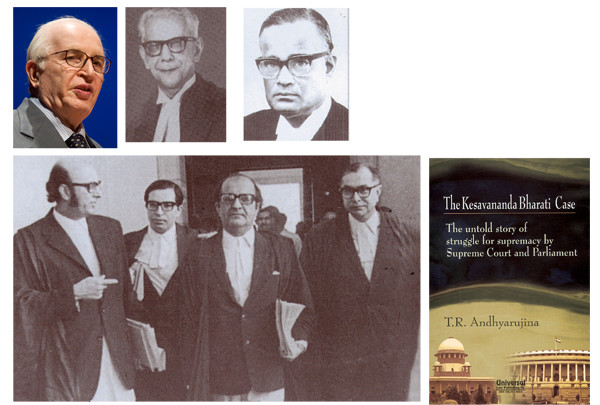
Top: Tehmtan Andhyarujina; Above: H. M. Seervai (left) and Niren De; below (from left): Ravindra Narain, Andhyarujina, Nani Palkhivala and J. B. Dadachanji
The hearings went on for 66 days. The judges’ "minds were closed and views were predetermined,” according to the autobiography of one of the 13 judges, Justice P. Jaganmohan Reddy. Judges sparred with each other in open court, as never before. The author’s firsthand observations, meticulously recorded in his diary and supplemented with archives and interviews, will stun even the legal fraternity keen to know as to what all happened in this momentous case. Brother judges openly traded insults in a supercharged atmosphere. One of the ‘government’ judges, Justice S. N. Dwivedi, a close relative of a central minister, shocked all by asking Palkhivala in court: "Are you prepared to say that the fundamental right to property can be amended? If so, I am prepared to procure from Parliament that all other fundamental rights can be left unamended.”
Other bizzare happenings continued. The texts of the draft judgments came into the hands of the Government before their delivery. One of the pro-Government judges, Justice M. H. Beg, went in and out of hospital for high blood pressure, which resulted in adjournments and which nearly prevented the ‘anti-government’ Chief Justice from delivering the judgment as he was about to retire. The Chief Justice contemplated ‘dropping’ Beg. Much more drama followed. "The petitioners believed that Justice Y. V. Chandrachud had changed his judgment at the instance of the then law minister, H. R. Gokhale,” narrates the author.
The lawyers were no exception. Seervai told the Government that he would appear, only if allowed to argue first and before attorney general Niren De did, who took umbrage and sat next to Seervai "maintaining a stony silence” much to the delight of the petitioners. Andhyarujina records the famous Seervai-Palkhiwala rivalry as follows:
"On the last day of his arguments at the end of the Supreme Court term on December 22, 1972, Palkhivala dramatically ended his arguments by reading out to the Court Seervai’s opposition to the Constitution 4th amendment to the right to property in 1955 from his article in The Times of India to his great embarrassment and to the amusement of the audience in Court. This incident caused an enmity between Palkhivala and Seervai for many years long after the case was over.”
Finally, came the day of judgment. Six judges said there were no limits on Parliament’s power to amend the Constitution. Other six, including the Chief Justice, said there were inherent and implied limitations. The 13th judge, Justice H. R. Khanna said that there were no such limitations but Parliament cannot destroy the "basic structure” or framework of the Constitution. The Chief Justice, a master strategist, hastily conjured up a document, called ‘The View by the Majority’ and made nine out of the 13 judges sign it in open Court. As Palkhivala so succinctly summed up: "Six judges decided the case in favor of the citizen and six in favor of the State. Justice Khanna agreed with none of these 12 judges and decided the case midway between the two conflicting viewpoints. Thus, by a strange quirk of fate the judgment of Justice Khanna with whom none of the other judges agreed has become the ‘law of the land.’”
Immediately after the judgment, Justice A. N. Ray, who had always sided with the Government, was elevated as Chief Justice, superseding the ‘anti-government’ trio of Justices K. S. Hegde, J. M. Shelat and A. N. Grover, all of whom immediately resigned in protest. Indira soon declared Emergency rule. Opposition leaders were jailed and civil liberties muzzled.
Andhyarujina’s analysis is dispassionate and non judgmental. The author is not afraid to call a spade a spade. Andhyarujina is a faithful chronicler, notwithstanding his warm personal relationships with many of the protagonists. The author is one of the finest legal minds that this reviewer has come across and this book is ample testimony. In those troubled times, this narration shows only a few in good light. Both sides forgot judicial detachment. Passions prevailed. Judicial careers were salvaged or destroyed. There could not have been a better person than Andhyarujina to chronicle the happenings for future generations of lawyers, judges and ministers to learn and imbibe. It was a dark period for Indian democracy when its two most powerful institutions, the Parliament and the Supreme Court clashed bitterly.
This little book does not have a dull moment for lawyer and layman alike. Let us hope that Andhyarujina regales us with other such accounts from his long and illustrious legal career spanning over half a century.
BERJIS DESAI
◆ ◆ ◆
From the archive