
Business
The highway man
Beruz Irani’s restaurant Atithi at Charoti offers travelers a choice — a varied menu and assorted services
"What do people look for on a highway? — fast service, good food, varied menu and clean toilets,” shrewdly states Behruz Irani sitting at the galla (till) of his restaurant, Atithi. The menu here caters to a variety of palates — South Indian, Punjabi, tandoori, Chinese, sandwiches, Indian snacks and Parsi fare. The last is the newest addition to the spread as "there was a great demand for a Parsi menu as people kept telling me, you are a Parsi owner and you don’t serve dhansak?” So he obliged with the all time favorites in Parsi cuisine — dhansak (both chicken and mutton); sali boti, patra fish, akoori and Parsi poro to tickle the palate of his regulars. He has thrown in mince patties as well among the Parsi dishes.
Located at Charoti on the border of Maharashtra and Gujarat, but within the precincts of Maharashtra, the restaurant serves alcohol as well. There are some 20 tables in the non-air conditioned section and about another 10 in the air conditioned portion. The food ranges from Rs 30 for idli/sambar to Rs 300 for a preparation of gavti murghi (country free range chicken). An average dish costs within Rs 100.
On the periphery of the compound, shops are sub-let. This owner insists on having a tyrewala operate for the same hours as the restaurant as fixing a puncture is the most common requirement on the highway. In keeping with the Indian custom of having something sweet for good omen on departure or arrival there is also a shop selling Indian sweets — mithais, pedas, and katri etc as mithoo monu. A general store, an outlet selling cold drinks, ice creams, biscuits, etc and a store for kids pre-empts the customers’ needs, making Irani confident that despite competition, he will retain the regulars as he goes that extra mile — literally and metaphorically.
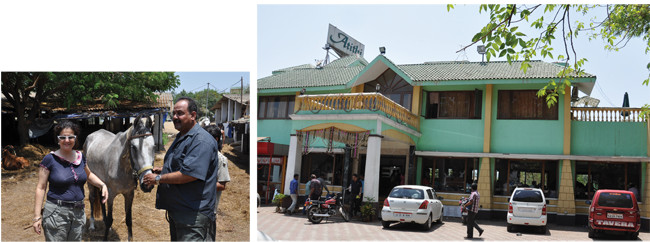
Above: Arzoo and Beruz Irani Alongside: Atithi’s exterior facade
Travelers, both national and international, who commute between the airport in Bombay and Valsad, Surat, Baroda or as far as Ahmedabad in Gujarat are regular diners at Atithi. Given international flight schedules in India, Atithi, which means ‘guest,’ in Sanskrit, keeps late hours. Irani is known for his helpful nature and has assisted guests who have called him at 1 a.m. with problems on the highway, be it an accident or stalling of a vehicle on the national highway. Irani narrates how "this man was lying prone in the middle of the road. One of my travelers told me about him so I put together a team and set off” to help him.
The restaurateur recalls how a foreigner once force-landed in a helicopter in the fields behind the restaurant. "He was scared of leaving his helicopter as he was surrounded by people in a trice.” Irani not only offered him hospitality for five or six days till his organization could evacuate the copter, but also managed to ensure the machine was not vandalized! On one occasion he helped clearing a body lying on the highway and accommodated the dead man’s wife till all the formalities were done. He used his good offices with the authorities to have the body released and offered the newly widowed lady moral support.
Before he ventured on his own, he had his first taste of the hospitality industry while running others’ restaurants. A Bombay boy, Irani ran a farm in the suburb of Dahisar, for a fellow Iranian business concern — Rustomjee. Then came Café Royal in Colaba, made famous by US President Bill Clinton who ate there on his maiden visit to Bombay. He also managed Churchgate Restaurant (now defunct). He states with a sardonic smile that "my stint in Bombay had nothing more to offer...” After 17 years of toiling for others, Irani decided to go on his own. "I am a completely self-made man. I have neither sought nor accepted help from anyone. Nine years ago, in 2002, Irani said he started this restaurant on a plot purchased with a partner. He bought out the partner in the early stages of the business, almost immediately after building the restaurant to their specifications. "Finance was met from my chikoo and mango wadis in Dahanu,” he says, a town where Irani’s roots still lie having been born and schooled there. Atithi was seeded almost out of defiance as he felt belittled by the treatment he received at his last job as manager of a concern located very close to where he is situated today.
During his stay in Bombay, Irani met his heart’s desire — Arzoo, which means desire, and married her. Their only child, daughter Auzar lives in London where she practices dentistry. The father says "she is not coming back even if I capture her.” The doting parents visit her regularly. "Money never stays with Beruz for long and so we do not go to London as often as we would want to,” says Arzoo. They are realistic enough to accept the fact that their daughter may marry a non-Parsi, though Beruz clearly states he will not be happy if that should happen. Arzoo who works in Bombay states with a wink, "In his eyes I do no wrong.” She then smiles and adds, "Thank God he did not hear that,” as her husband is busy chatting up a customer.
Irani is impatient for the almost-built flyovers on the Maharashtra-Gujarat highway to become operational to shorten his driving time between cities. Arzoo is as happy coming over on weekends to be with Beruz as her husband is to commute to Bombay when the impulse overtakes him.
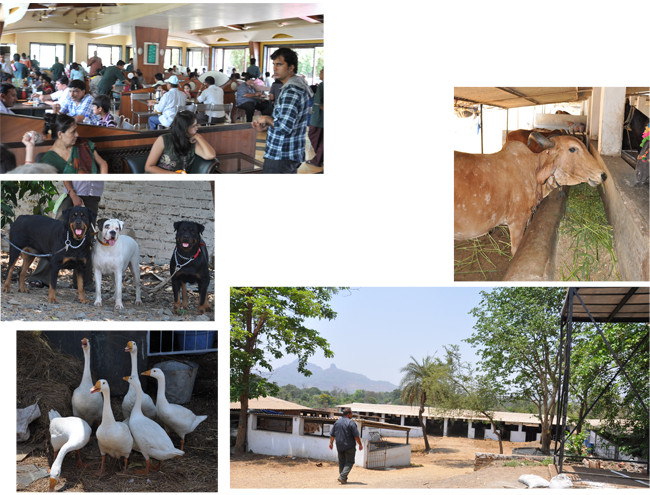
( top left) Interior of the restaurant ; Variety of livestock at farm behind the eatery
Both are sudreh-kusti wearing Zoroastrians. A framed picture of Zarathushtra hangs inside the doorway, which can be seen only as one leaves the restaurant. Beruz takes all his duties — even to the community — seriously. He drove down all the way from Charoti to Khareghat Colony in Bombay for a day to vote for his friend and candidate Muncherji Cama during the June-July Bombay Parsi Punchayet trusteeship elections.
The duo enjoy their animal farm, situated at the rear of the restaurant. Hidden by greenery, the farm houses 200 horses, 25 pedigree dogs — beagles, weimeraners, golden retrievers, boxers and other well known breeds, not to mention the gaggle of geese who saunter all over the backyard, 15 turkeys and about 50 gir gais (red cows) "whose milk is richer than that of normal cows!” Irani proudly proclaims. He adds: "Hu su karu jo mané shauk hoi toh (what can I do if I have a passion)?” Feeding the farm animals requires a separate menu in itself with all its variants. The caretakers walk the horses and dogs, clean the stables, kennels, pens and feed each of the species. Poultry strut everywhere without any fencing, pecking here and there. Irani is affronted at being asked if the poultry is served at the table, his response is an unequivocal "No.” Arzoo states he is "a collector at heart.” He collects knives, bottles of vintage wine and olde whiskey and of course horses. The animals seem to blend into the space at the rear of the restaurant. You do not hear the calls from this veritable zoo as you sit and wonder what to order.
Whilst traveling on the highway one can visit the diner situated on National Highway no 8, Charoti Naka, Dahanu Road, Ahmedabad Expressway, Maharashtra. Tel: 02528-264180/264787.
◆ ◆ ◆
From the archive