
Welfare
Savior of strays
Taronish Bulsara’s non-profit organization World For All works toward a better future for street animals
"As a kid, when all my friends would be playing football, I’d be sitting in a corner, petting and playing with a dog. If everyone had an imaginary friend, my imaginary friend was a dog! I also remember running around every Bakri Eid trying to release all the goats in the society,” recalls 24-year-old Taronish Bulsara. He admits that right from childhood animals have been his greatest love. His passion and profession have merged, and today he is the co-founder, along with friend Ruchi Nadkarni, of World For All (WFA), an organization that strives to provide caring homes for street animals. Bulsara elaborates, "Even as kids, Ruchi and I used to do a lot of voluntary work for animals. We were volunteers with several animal organizations, helped in sterilization programs, rescued injured animals, etc.”
WFA is an organization that deals with adoption for Indian breeds. It star-ted with the adoption of a single puppy named Angel. "When Angel was admitted in the animal hospital, she had no safe place or home to return to. That’s when we realized that while there is a hospital to treat the animals, where does the animal go from there? Back on the street? So we created a group on Facebook, which was the most happening thing at the time and put up a post saying that there is a puppy that needs a home. Before we knew Angel was adopted! We then had more people asking for puppies to adopt.”
A few months ago, WFA organized what they state is India’s first Adoptathon, a camp for adoption of Indian mix-breed pups and kittens. Held at the Bandra Hindu Association Hall in Bombay, the Adoptathon was well-received and resulted in as many as 115 adoptions. It was attended by celebrities from the film world like Raveena Tandon, who adopted two kittens, Tanisha (Kajol’s sister), Sohail Khan and Anaida, to name a few.

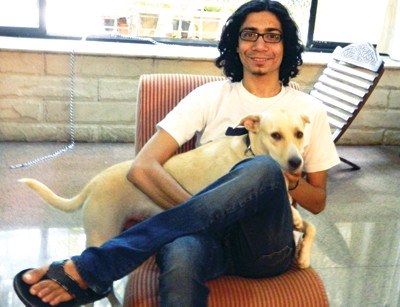
Taronish Bulsara seeks caring homes for street animals
For most people, the word ‘dog’ conjures up images of pedigreed breeds such as Labradors, Dalmatians, etc. What makes WFA different is that they want to provide homes for ‘desi’ Indian street dogs. "Of course, we do not pick the animals off the street and put them in your homes; we have a formal, organized process,” Bulsara says.
WFA conducts a rigorous interview session with every family that wants to adopt an animal to ensure that they will be able to take proper care of it. The organization also undertakes a background check of the families and their homes. People have to fill forms and are given pamphlets on puppy care. WFA’s animal behaviorists maintain contact with these homes and help out if there’s any problem.
"We started with no funds. We had no money, just some experience with animals, and a very strong determination about what we wanted to achieve. While I won’t say that we have achieved it all, we have come a very long way and are still going strong!” Bulsara elaborates. He is happy that events such as Adoptathon have helped change the mindset of people towards street animals. Interestingly, Indian breeds are healthier and more attuned to our climate, which makes them a better choice, he shares. "If you keep them (street dogs) in the house, they are obviously no longer going to look like street dogs. It’s like the difference between you, me and a beggar who doesn’t have access to proper food, clothes and sanitation. The same exists between the dog in my house and the one on the road.”
In the last two years, WFA has facilitated approximately 2,048 adoptions of cats and dogs. While most of these were of Indian breeds, there have been some odd cases of pedigreed animals that had been abandoned. Bulsara notes that several Parsi homes and a few agiaries have also adopted animals from WFA. Other than the animals WFA rescues and adopts, Bulsara personally rescues approximately two every day. And it’s not just limited to dogs and cats. He once brought a donkey home, and has rescued a pig as well. Bulsara himself has two dogs and speaks lovingly of Frisky and Natza.
A BMM (Bachelor of Mass Media) graduate from Jai Hind College, the animal lover also holds a diploma in hotel management. His education, he feels, has played an important role in what he is doing today. "Of course, while advertising doesn’t have much to do with animal welfare, when you’re running an organization, you need to advertise it to manage it. So, in all these ways, my education has helped me a lot.”
While funds for the non-profit organization come in through events, the annual calendar (which is WFA’s main fundraiser) and monthly donors, there is always a need for more as all the money goes towards service for the animals. Though WFA works in tandem with many other organizations and individuals, there is always some cost and expenditure involved. Anyone who is willing to adopt, foster, donate or volunteer is more than welcome, Bulsara states.
Bulsara goes to the agiary at times, but admits that he doesn’t spend hours praying. "I’d rather serve society and animals. I feel that my good thoughts materialize into good deeds by doing something proactively,” he says.
It is Bulsara’s wish that "a day comes when WFA would not have to function in terms of getting animals adopted. Even if every alternate building adopts one dog, there won’t be any stray dogs on the streets.” Stressing the need for sterilization of dogs so that they don’t multiply, Bulsara notes, "While people argue that sterilization is not natural, I feel that when you cannot provide facilities and basics such as vaccines and the safeguarding of puppies, I don’t think it’s right for the species to come into this world and be allowed to suffer. One dog gives birth to six puppies, and then those six, in a year’s time, will give birth to 36, and within two years, there will be as many as 200!”
Bulsara urges, "If you don’t want to help these animals, at least don’t harm them; just co-exist. It’s as simple. While we humans decide our territory on paper, animals decide their territory (in other ways). Harming them is very inhuman and it should not be done.”
For more information about WFA one can contact Bulsara on +91 9820001506, or e-mail him at wfa.adoptions@gmail.com
◆ ◆ ◆
From the archive