
Religion
The flight of the faithful
Ervad Sohrab Mulla was instrumental in shifting the Shroff Adarian fire from Bombay to Jamshedpur by plane in 1960
The Ushahin (late night) gah boi prayers for the sacred fire were performed not in the fire temple but on the aerodrome. This was the first time in the history of the Parsis that a sacred fire was being carried by a specially chartered plane. Entrusted with the responsibility of shifting the Cursetjee Manockjee Shroff Adarian fire from Bombay’s S. K. Thoothi Agiary at Walkeshwar (where it was housed for 17 years alongside the Thoothi Agiary fire) to its new abode at Jamshedpur was the panthaky of the Thoothi Agiary, Ervad Sohrab Fardoonji Mulla.
On the occasion of his birth centenary last year, the late priest’s daughter Mani Mulla shared with Parsiana the 52-year-old meticulously preserved press reports, black and white photographs, as also the blueprint of how and where the holy fire was to be transferred in the Air India aircraft piloted by two Parsis.
On the occasion of his birth centenary last year, the late priest’s daughter Mani Mulla shared with Parsiana the 52-year-old meticulously preserved press reports, black and white photographs, as also the blueprint of how and where the holy fire was to be transferred in the Air India aircraft piloted by two Parsis.
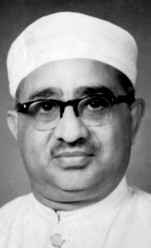
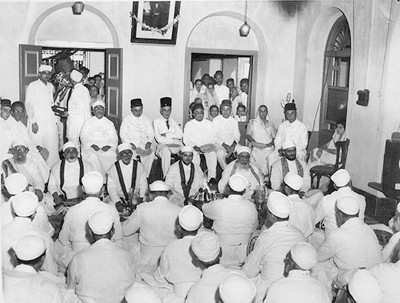
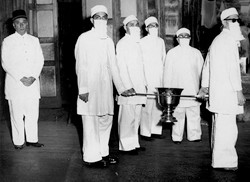
Ervad Sohrab Mulla (from top left); at the Thoothi Agiary centenary jashan with High Priests seated on the floor;(below) and shifting the Shroff fire to Jamshedpur
At the Thoothi Agiary, the final Aiwisruthrem gah jashan was sponsored by the Shroff family on March 1, 1960. [The sacred fire had been consecrated in 1790 for Manockjee Hormusji Shroff at his residence at Chowpatty. In 1816 his son Cursetjee (whose ‘oobha Parsi’ statue is famous at Byculla) had the fire shifted to the newly built Shroff Agiary at Fort which was closed down after the fire was shifted to the Thoothi Agiary in 1943.] The sacred fire was carried in an afarganiu by Mulla and Ervad Pallonji Aibara, followed by 12 other mobeds, on foot to Bandra’s Tata Agiary. Dutifully praying four boi prayers when the fire was in transit at the Tata Agiary, the next night the venerated fire was taken to the aerodrome and after the Ushahin gah boi prayers transported by plane to Jamshedpur on March 3 where it was installed in the agiary that was specially consecrated. After the Havan gah maachi sponsored by Sir Jehangir Ghandy, Mulla led the priests in a jashan that was attended by the enthusiastic Zoroastrians of Jamshedpur.
The year prior Mulla was specially felicitated with a shawl at the hands of Dastur Khurshed Dabu on the occasion of Thoothi Agiary’s centenary when Dabu commended him for his compassion and discretion when interacting with other priests and clients. During the 35 years he was panthaky, the increasing patronage at the Thoothi Agiary was a matter of pride, Dabu was quoted in the Jam-e-Jamshed of May 9, 1959. A week later the Kaiser-E-Hind of May 17 carried a photo of the event.
Prior to joining the Thoothi Agiary Mulla had served as boiwalla at the H. B. Wadia and Anjuman Atash Behrams for 10 years and acknowledged the guidance and training in the performance of religious ceremonies he received from Ervad Pirojsha Garda, as per the 89-year life profile of the respected priest. Having performed over 50 nirangdin ceremonies in Bombay and Poona he was later appointed a polvala, a priest who certifies whether nirangdin ceremonies have been correctly performed. Besides the Jamshedpur agiary he had also participated in the consecration of agiaries in Secunderabad and Kanpur where he even delivered lectures, having made a deep study of the religion.
A founder student of The M. F. Cama Athornan Institute, he had studied Avesta, Pahlavi, Persian and English under principal Ervad Sohrab Bulsara. After his navar-martab initiation, he gained experience performing ceremonies like the yasna, visperad and vendidad. He had assisted in the consecration of the Tower of Silence at Andheri and was also called upon to perform consecration ceremonies for varasiajis. In those days bachelor mobeds were not allowed to serve as boiwallas and it was only after his marriage to Osti Daulat Mobedji (Jijina) in 1938 that he could join the inner league. Their daughter Mani was born the next year and son Hosi, 15 years later.
A lightweight boxing champion during his youth, Mulla’s hobbies were music, photography and traveling. Even after his retirement he continued to perform cere-monies for some clients at the Anjuman Atash Behram.
◆ ◆ ◆
From the archive