
Comment
“The stench that permeates”
The Vendidad narrates the ills that befall and reside in dakhmas
In ecological discussion our Mazda-yasnian socioreligious perspectives are truly noteworthy. Indeed, the respect accorded to and care for the four elements of fire, water, earth, and air are brought to the fore in our Vendidad, an ancient Avestic nask separately dealing with some dozen subjects amongst which the disposal of the dead occupies a prominent place. Loosely speaking, its chapters I-III may be termed "earth chapters;” V-XII furnish material for the treatment of the remains of the deceased. Throughout this nask (the 19th and only "complete” one extant from the original 21-part religious corpus), the highest authority is invoked to give this priestly production the stamp of full authenticity. Thus, Zarathushtra questions Ahura Mazda on a wide range of topics, always addressing Him: "O Ahura Mazda, Thou creator of the physical world” — a point which should not go unremarked, for in our Vendidad we enter the material sphere of existence.
The first chapter strongly condemns, in passing, burial and cremation as Ahrimanic, being unatonable sinful practices. Our text refers disparagingly to these as nasuspaya and nasuspachya: respectively, the "filth underfoot” and the "filth (which is) cooked!”
Chapter III sheds light on the reasons against burial: the early Mazdayasnians were mainly occupied in agriculture and pastoralism; the dearth of arable land and unpolluted water resources for irrigation, and for use by humans with their flocks and herds make it abundantly clear why this evil practice was abhorred throughout the ages. Extreme measures were urged for noting, digging up and removal of buried remains with indications of the intervals after which that part of land again became fit for arable use.
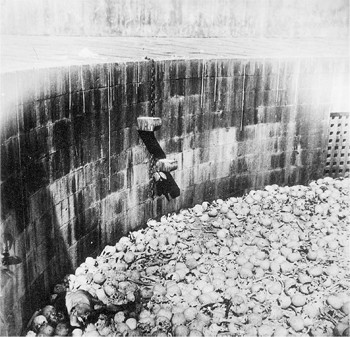
A dakhma with remains: "the third place where earth is most anguished”
Similarly, wood fuel for domestic, religious and other lawful uses, was not to be squandered on cremation. There is a hint about the difficulty in procuring clean wood (Ch V): physical cleanliness in everything informs all the Vendidad’s 22 chapters. How then should human remains be disposed of? Our text retails the evolution of the dakhmas — originating in /dah-, "to burn” (as also for Sanskrit) — from exposure on open ground to the construction of the early funerary enclosures with whose development we are familiar today, and for mortuaries as holding places during inclement weather. Eminent good sense is displayed throughout this exposition, with the greatest stress laid upon the isolation of the corpse: remarkable for its utilitarian vision since hoary antiquity.
Herein lie also the technical terms for exposure under the sun: khvar.daresya/khwarshed nigerishnih. In Iran and south Central Asia predatory birds – nature’s dustmen – were never plentiful, and their intervention was secondary to the process of natural dessication and decomposition. The agents of disposal were anciently termed kerefsh.khvaro suno (corpse-devouring pi-dogs, including also wolves and foxes as belonging to the dog species) when open-ground exposure was practised; thereafter only the vayo kerefsh.khvaro (corpse-rending birds) became responsible for excarnation. So, vanishing vultures apart, why the recurrent anxiety over the future of the dakhma system? Our text on open-ground exposure explains (in paraphrased summary):
Zarathushtra (Z): "Where shall we bring, where shall we deposit the remains?” Ahura Mazda (AM): "On the loftiest heights where do frequent the corpse-devouring dogs and birds. The corpse is to be fastened at the head and feet and weighted down with stones so that these creatures cannot drag the remains to water and plantations.” [The pollution caused in the dakhma by standing rain-water was also noted (VI. 50; V. 15-18, cf also 26)].
It is strongly urged that two persons shall transport the corpse, with the severest chastisement for a solo carrier, for then the risk of infection is greatest (III. 14f). The druj nasu, the corpse demon, attacks the remains in the shape of a fly, spreading its infections afar (Ch VII), especially with reference to water pollution and fire defilement. Various recommendations to a rural populace are made to ensure protection from corpse pollution on wood, water, personal and communal property. Pragmatism was coupled with common sense; the Vendidad’s directives were meant for the Mazdayasni country priests of the times. As guiding principles, however, they are broadly applicable even today.
But what are we to make of this? Z: "Which is the third place where earth is most anguished?” — AM: "It is where most dakhmas remain with corpses of men laid thereon (III.9).” The exchange continues — Z: "Who is the worshipper who most rejoices earth?” — AM: "The one who the most exhumes the remains of dogs and men.”
Z: "Who is the second of your worshippers who most rejoices earth?” — AM: "It is the one who demolishes most dakhmas where remains are laid. (III. 12,13).”
Demolish the dakhmas indeed! Surely the composers, the Pahlavi zandists, and, of course, those meddling mischievous Western scholars have got it all wrong? Hardly so, for we see this injunction repeated at some length in Chapter VII. Z: "How long after human remains have been exposed in a dakhma is the land on which it is built restored?” — AM: "When the dissolution of the remains is complete (Explained as 50 years!). Urge every one in this material world to pull down dakhmas! The one who breaks down the dakhma, however little of it he destroys, will be granted absolution for his sins of thought, word and deed. When his own time comes, his soul shall travel the four stations to be welcomed by Myself, Ahura Mazda! (VII. 49-52).” (The post-mortem four stations are: the Good Thought Star Station; Good Word Moon Station; Good Deed Sun Station; finally, the Endless/Infinite Lights where dwells Ahura Mazda Himself!)
It is noted that VII. 52 is given a greatly expanded treatment in the Pahlavi zand with later (post-Sasanian?) quite gory priestly commentaries; it must be stressed that this zand has no part in the liturgy chanted at present times during the full Vendidad ceremony!
But why pull down the dakhmas if they provide a quasi-scientific safe method of disposal and dispersal of the remains? Our text again — Z: "Where are the daivas? Where are the daivayasnas? In what place do these demonic hordes rush together to kill myriads with their diseases (or, kill with their myriad diseases)?”
AM: "Those dakhmas with corpses laid within that are erected upon earth; that is where the demonic hordes descend, rushing to kill in their myriads… That is where the daivas consume corpses and excrete, and it is the stench of their feeding that you smell there; that is the stench that permeates the dakhmas; thus it is from there that infections arise: sores, high fever, lung diseases, chills, bone disease, trichiasis. It is after sunset that the death-dealing power is at its greatest (VII 53-58).”
There is no mention of the use and power of prayer to destroy those illnesses which emanate from the dakhmas to infect man – on which the most vehement stress is laid. The cleansing of corpse-bearers and morticians is detailed (Ch VIII), but that takes us beyond the scope of this summary. These injunctions are solemnly prayed over by our priests; may they take cognizance of what they pray, and honor the teachings of their ancestors.
Let truth prevail everywhere; may the commonsense aspect of wisdom flourish!
Farrokh Vajifdar is vice president of the Royal Asiatic Society of Great Britain and Ireland. An author and editor, he is an independent researcher into Ancient Indo-Iranian culture, history and religions.
◆ ◆ ◆
From the archive