
Zoroastrians Abroad
From commerce to careers
More than trade and commerce, the present generation in Hong Kong is drawn to the professions
"Over time mercantilism has given way to a community engaged in the professional services or in employment,” observes Jimmy Master, the fourth generation from his family to reside in Hong Kong. The Zoroastrian community in Hong Kong has its roots in families trading in the South China area with "many families here spanning several generations,” he adds. Whilst Master is a professional in the field of finance, his cousin Kawas Pavri is a geotechnical engineer.
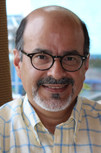
Assets and advisory
"Our competition is every other bank. There are too many banks with marketing wings and arms. We don’t go out to market ourselves,” declares Master of Petrig and Master Asset Management AG who with his Swiss partner Thomas Petrig takes pride in offering their customers "superior service, better performance and customer relations.” Whilst Master and Petrig have had a banking relationship for the last 25 years, "in 1998 we decided to put our respective client bases onto a single operational platform,” says Master referring to the foundation of their asset management and investment advisory firm.
Their Asia based, high net worth clientele constitutes working professionals, active business people, former businessmen and those with ancestral wealth. "It is for us to figure out how to handle everyone differently…When there is one 80-year-old as compared to another who is 45, their capacity for risk will be different as also their investment horizons,” he points out. Master’s role is to "best come up to customer expectations” and build a cordial relationship such that they "are our friends now and we look forward to seeing them. We don’t need painful clients. I am not forced to do this. I want to feel happy when I meet the client,” conveys Master who "has a fair amount of client interface” and is frequently dealing with second generation members from the same family.
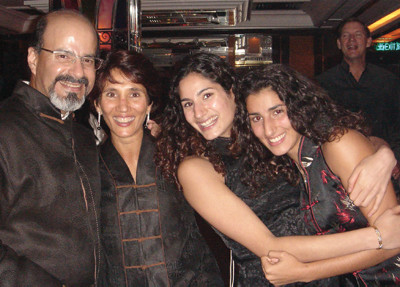
Jimmy Master (top and above) with Niloufer, Farah and Tanya
"This is a very personalized business. There is a limit to the number of clients you can manage and give time to,” says Master. Being a Swiss company regulated by rules and laws applicable to Switzerland, Petrig operates from Zurich, whilst Master manages the representative office in Hong Kong. "We never went looking for business from the Zoroastrian community,” mentions Master. They have many clients with portfolios in Switzerland but with the peripheral information shared by Master and his colleague, they "jointly manage the assets” of their international customers who reside in Hong Kong, Philippines, Korea, Singapore...
Prior to launching this firm Master had spent nearly a decade with Stanrose, one of the Mafatlal Group companies. He had been recruited by them to start an office in Hong Kong but they closed operations when they realized it was impossible to compete with the "Chinese with their thrust on employment and exports. The Chinese were determined to flood the market. They were given export incentives and were heavily subsidized so there was no chance for us. They could crank stuff faster than we could from Bombay.” In the home bedding sector Stanrose offered linen and fabrics but the Chinese could invariably copy the products and cut into the American market.
Qualified as an MBA from UK, Master’s schooling was at Hong Kong’s St Joseph’s College and Island School after which he proceeded to Canada to do his undergraduate studies in economics. Considering Hong Kong his home, he chose to return to the island and worked for two years as a marketing executive with a Government Tourist Agency. Responsible for India, he was required to work with Indian travel agents, commute between India and Hong Kong "and in the process brought a wife back.”
Both his parents, Ruby and the late Minoo were trustees of the Zoroastrian Charity Funds of Hong Kong, Canton and Macao but Jimmy says he only frequents the "Zoo (Zoroastrian) House twice a year on Navroz and New Year,” as he is not interested in playing cards or community gossip, sentiments echoed by his wife Niloufer who worked in the travel trade in Bombay prior to marriage and in Hong Kong thereafter. Jimmy prefers to use his spare time playing golf, and working on the executive committee of the Society for the Prevention of Cruelty to Animals, the largest animal welfare organization in Hong Kong with a staff of 300 members and 40 veterinarians. They have two daughters, Farah who is a journalist in Hong Kong and Tanya who is in the last year of her veterinary medicine degree studies at the University of Edinburgh.
"As a community we educate our daughters and pamper our sons. Then when our daughters find spouses outside the community, we draw upon our worst tribal instincts, beat the war drum and ex-communicate them. Is that any way to improve the gene pool of an already fast diminishing community?” Master asks rhetorically. "To survive, we need to be actively promoting a culture of tolerance and excellence…A schism is developing with the traditionalists holding fast and fighting in their own corner whilst being continuously assailed by an ever growing and shrill community group fighting for their voices to be heard. Perhaps it is best if each side were to develop in their own way, and leave each other alone.” He expects that the traditional definition of "Parsi/Irani Zoroastrian will in time become moribund and within a matter of a few decades, the community will have changed beyond all recognition from where we stand today. This might just be the best thing that happens for us!”
Regretting that "we as a community lack leadership, both from the clergy as well as the laity,” he believes "Zoroastrianism can only flourish if there is freedom of choice…With the best part of our wider community sitting on the other side of the fence, we then bemoan the fact that the community lacks energy, vision and enterprise. We really need to take a hard look at ourselves in the mirror.”
The community in Hong Kong whilst being "closely knit (is) dominated by a handful of traditional families, and change, if any, comes very, very slowly,” declares Master adding, "The community has deliberately shied away from interacting with other diaspora communities, preferring to keep its own company.” The Zoroastrian Charity Funds of Hong Kong, Canton and Macao "is a fount” of many philanthropies "but rather than using its disbursements as an agent for change, it remains a passive giver.” He is enthused though "to see people outside of the traditional Parsi/Irani strongholds in India professing the Zoroastrian faith,” maintaining, "A faith can only be revived and maintained by new blood.”

Engaged in engineering
"It is harder to be a small player now. A lot of small, private developers are being swallowed by the bigger firms,” observes Kawas Pavri, a geotechnical engineer and a partner of Hong Kong based K. P. International Limited. Functioning as a consortium of three firms, although each of them is independent, "we share space, expertise and staff when we need to,” explains the chartered engineer who is a registered professional in Hong Kong.
Specializing in ground problems, foundations and slopes, Pavri’s forte helped in the development of upcoming sites in the new territories of Hong Kong. Since Hong Kong faced major land slips in the 1970s, the government geotechnical and engineering department is very particular about ensuring that all construction work adheres to safety norms. Building on slopes is considered critical and requires accurate cataloguing and assessment of risks, mentions Pavri referring to his college days when he worked as a trainee in Hong Kong to gain experience.
Describing the current scenario as "very buoyant with a lot of public works going on,” among the major projects with which Pavri has been involved are development of the Hong Kong University, the City University in Kowloon, and the new airport where as subconsultants they provided local expertise. Additionally he has been involved with a host of smaller projects in China, Macao and even Malaysia.
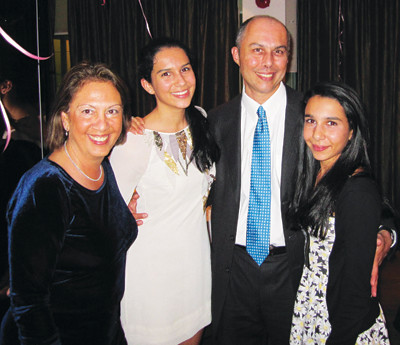
Kawas Pavri (top and above) with Phiroza, Tina and Zoe
Even before he became a trustee of the Zoroastrian Charity Funds of Hong Kong, Canton and Macao, Pavri’s expertise was sought for the maintenance of the association’s cemetery plot that lies on a hillside. "There are many in the community who are in the finance, shipping, trading professions but I can’t think of anyone who has made a career in engineering. That is why I was involved,” he noted. Since the cemetery land is leased to the association they are expected to maintain the walls, stabilize the boulders, renovate the bungli that is used for funerary prayers and additionally generate more burial space. "By creating three to four new platforms, space for 50-75 new graves was created in the 1980s-90s,” states Pavri. Thereafter the association sought his help in the maintenance of other properties like the Macao cemetery (built in 1822) which was conferred world heritage status so there is no fear of the land being developed in future. In fact there is an agreement in place with the Macao government to jointly restore this historical site, he says. He doubts whether any Zoroastrians reside in Macao and assumes that even if some do work there they possibly reside in Hong Kong and commute back and forth, the two destinations being only 45 minutes apart.
Equally involved was he in the construction of Hong Kong’s 23-storey Zoroastrian Building that replaced the original structure on Leighton Road when additional space had to be created for the expanding activities of the members. When he was on the working group that was overseeing the redevelopment of the property, he recalls their original misgivings: community attachment to the old building they were proposing to demolish; and repayment of the mammoth building loan. Meetings would start after 7 p.m. and continue until midnight. "We put in a lot of work for something to be acceptable to the anjuman,” he recalls.
With their building soon completing 20 years, they are planning to get it into shape so that it can continue for another 20 odd years. "We are seeing a bigger attendance at our functions,” observes Pavri, referring to the trustees’ proposals for building expansion and upgrading by renovating the existing floors that the association uses. "We rely on this building for our income and charity work,” sums up Pavri who would rather focus on "properties and charity work” instead of dwelling on religious issues.
Born in Hong Kong to Perin and Noshir, Kawas had studied at the Island School run by the English Schools Foundation, did his graduation in civil engineering from the University of Surrey and his postgraduation in construction from the Loughborough University. Since there was recession in the UK he came back to Hong Kong and worked for a UK consultancy practice until 1994. Once he set up his own company, his wife Phiroza who is a licensed real estate agent doing property management, leasing and sales, started working through his company.
Their daughter Tina, 17, has just started attending university in the UK, reading business and Contemporary Chinese studies whilst 15-year-old Zoe is studying at Hong Kong’s South Island School. The younger one too is expected to do her tertiary education in the UK or US or Australia depending on the destination favored by her classmates. "It is good to go out of home, see something different and be independent,” believes the father who finds both of them being more inclined towards humanities than sciences. The parents also made sure that the girls could read and write Mandarin and had engaged a private tutor to teach them. Kawas can speak Cantonese, but he cannot read and write the language, he regrets as the language was never part of his school curriculum but only picked up from local helpers. With his turning 50 this year, the enterprising Pavri declares that he is considering "doing something different from engineering. Aware that time is passing,” he would rather do it when he has "the energy to start something from scratch.”
Although he may not wear the sudreh-kusti regularly, Pavri is emphatic, "I don’t think I’d like to see reforms pushed too much further in life... We are progressive and tolerant to a number of things,” he spoke on behalf of his like-minded Hong Kong trustees. "Changes should be in small steps,” believes Pavri. "If there are big steps it could create big divides. Whether it is the UK, US or Canada, it is not good if groups go their own way. I don’t subscribe to the view that you must change with the times.” Whilst he expects that small changes are inevitable, he hopes that in its march forward the community will "still maintain its own identity and retain its core principles and practices.”
◆ ◆ ◆
From the archive