
History
The China connection - I
Arriving in the outposts of Canton, Hong Kong and Macao as merchants, over a period of time Parsis and the Chinese people learned to appreciate each other and even intermarried
Though Parsis were of crucial importance in several spheres in the history of modern China this has been neglected by Chinese scholars. Guo Deyan, a PhD in history who is chief of the Preparatory Department of the Palace Museum of the Nanyue Want in Guangzhou and has done research on Chinese foreign relations, has attempted to fill this lacuna in his detailed study paper titled The Study of Parsee Merchants in Canton, Hong Kong and Macao. Parsiana will carry edited excerpts from his study in three parts beginning with this issue. The first part deals with the arrival of Parsi merchants in China and how they gained acceptance in that country by adapting to its culture.
Before the Opium War, the Parsis were active primarily in the cities of Guangzhou and Macao, and they dealt almost exclusively with Chinese merchants. After the Opium War, however, they moved most of their activities to Hong Kong.
Article Three of the Treaty of Nanjing stipulates that "It being obviously necessary and desirable that British subjects should have some port whereat they may ‘maintain’ and refit their ships when required, and keep stores for that purpose, His Majesty the Emperor of China cedes to Her Majesty the Queen of Great Britain, and company, the island of Hong-Kong, to be possessed in perpetuity by Her Britannic Majesty, her heirs and successors, and to be governed by such laws and regulations as Her Majesty the Queen of Great Britain, etc, shall see fit to direct.”
In fact, some Parsis had moved to Hong Kong before the end of the Opium War. When the British military occupied Hong Kong on January 26, 1841, there were already 2,700 Indian soldiers and four Parsi merchants in Hong Kong. The four Parsis were Dhunjibhoy Ruttonjee Bisney, Hirjibhoy Rustomjee, Pestonjee Cawasjee and Framjee Jam-setjee. By 1860, there were a total of 73 foreign factories in Hong Kong, of which 17 were owned by Parsis.
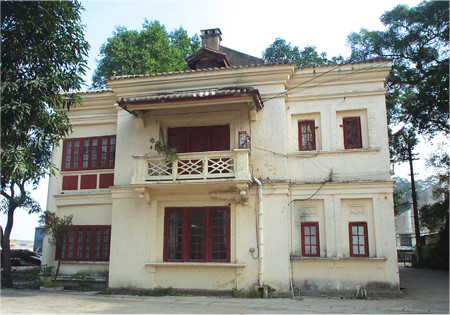
The Parsi rest house in Whampoa, Canton
The following are the names of some important Parsi merchants and businesses in Hong Kong:
Messrs Cawasjee Pallanjee and Company was a long-established and well-known Indian firm in Hong Kong and was the first Indian company to open an office there. It was originally a subsidiary of Cursetjee Bomanjee and Company. Cawasjee Pallanjee first established this company in 1794 in Guangzhou, where it prospered. After the Opium War began, the company was forced to move to Macao. However, the Portuguese in Macao did not welcome competition from other foreign firms, so in 1841 it relocated to Hong Kong. Cawasjee Pallanjee died in 1842 and was buried in Macao, at which point his son Pestonjee Cawasjee inherited the business.
Pestonjee Cawasjee was a talented businessman and the firm reached new heights of prosperity under his leadership. The firm dealt mainly in opium, spices, and silk; later on, it began dealing in yarn and became one of Hong Kong’s most important yarn companies. The firm became so successful that a popular saying arose: "Whatever Cawasjee says, Hong Kong does.” And indeed, Hong Kong soon became a major producer of cotton yarn. In 1874, Sorabjee Dhunjeebhoy inherited the firm from Pestonjee Cawasjee, and as business continued to expand, he opened a branch in Shanghai. Over successive generations, the firm was run by S. C. Khan and D. H. Sethna. But after the First World War, the business went into decline; by the middle of the 20th century, it had been largely forgotten.
F. M. Talati and Company was another Parsi firm that was relocated from Guangzhou to Hong Kong in 1842. The company’s founder, F. M. Talati (or Talatee), had been a businessman in Guangzhou as early as 1827. In 1868, F. M Talati passed away; his son, P. F. Talati, inherited the firm and expanded its business in new directions. F. M. Talati and Company was known throughout Hong Kong and beyond for its fine quality gems, jewelry, silks and oil. In the mid-20th century, the company moved its headquarters to Surat, India. M. P. Talati was the most famous member of the family and was very much respected by Parsis, Indians, Europeans and Chinese alike.
Another famous Parsi firm in Hong Kong was Mody and Paul Chater. One of the co-founders of this firm, H. N. Mody, made a fortune in real estate in Kowloon.
Rustomji Cawasji Banaji was one of the most influential shareholders in the firm of Rustomji, Turner and Company, which owned 27 ships that plied the route between London, Calcutta and the China coast.
Framjee Jamsetjee established a business in Guangzhou in 1830. He was among the first to buy land in Hong Kong in 1841. However, his name is not listed in the Hong Kong registry of names in 1846. It is possible that he remained with his firm in Guangzhou.
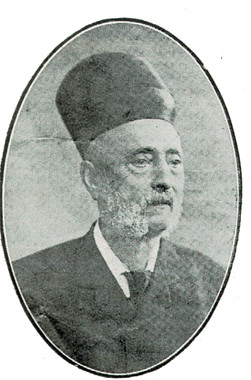
Sir Hormasjee Navrojee Mody: referred to in H. D. Daru-khanawala’s Parsi Lustre on Indian Soil as "the prince of Hongkong”
Other famous Parsi merchants in Hong Kong included Dorabji Naorojee, Dhunjibhoy Bisney and the Ruttonjee family.
The board of directors of the Hong Kong and Shanghai Bank was established in 1864. Of the 13 members of the Board, three were Indians: Pallanjee Framjee of Messrs P and A Camaji and Company; Rustomjee Dhun-jeeshaw of P. F. Cama and Company; and Arthur Sassoon of Messrs D. Sassoon Sons and Company.
Other Parsis based in Shanghai or overseas also engaged in trade in Hong Kong. For example, the Tatas, Ferozeshaw B. Petit, and R. S. Kermani were Parsis from Shanghai who traded in Hong Kong.
Although there were only a few Parsi merchants in Hong Kong, their influence was far greater than their numbers. Along with Messrs Cawasjee Pallanjee and Company, Mody and Chater also had an enormous impact on the development of Hong Kong’s stock market and construction industry.
What is particularly noteworthy is the fact that the historical record is full of references to associations not only between Chinese merchants and Parsi merchants, but also between Chinese literati and Parsi merchants. The literati were either conversant in English themselves or had people around them who were. Men who had received this kind of education were thus quite different from their predecessors, and the barriers of language and culture that had hindered their forebears’ communication with foreigners were less of a problem for them. Thus their writings are often rich and colorful, and provide a more vivid and realistic portrayal of the lives of Parsi merchants in China after the Treaty of Nanjing. For this reason, these accounts are extremely important historical sources.
Zhang Ailing (also known as Eileen Chang) is one of the best known Chinese writers of the modern era. She and her good friend Yan Ying studied at the University of Hong Kong. One day in 1939, an old friend of Yan’s father, a man from India, invited Yan to the cinema. At Yan’s request, Zhang accompanied her to the cinema. The Indian fellow, who did not know in advance that Zhang would also be there, found himself without enough money to pay for an extra ticket. In the end, the Indian gave his ticket to Zhang, and she and Yan watched the movie. Later, on their way out, Yan told Zhang, "he’s a pa xi ren, (or Parsi) — his ancestors were Indian Zoroastrians.”
The present-day Chinese term for Parsi is pa xi ren, when transliterated from the Mandarin characters. But in the post-Opium War period, Qing literati usually used the term ba si which, in the Cantonese pronunciation ba see, was a closer approximation of the word "Parsi.” In 1976, when Zhang Ailing wrote her 2,700-word autobiography Zhang Kan, she describes the Parsis in Hong Kong in the late 1930s. It reveals the changes that the Parsi community had undergone in the late 19th and early 20th centuries.
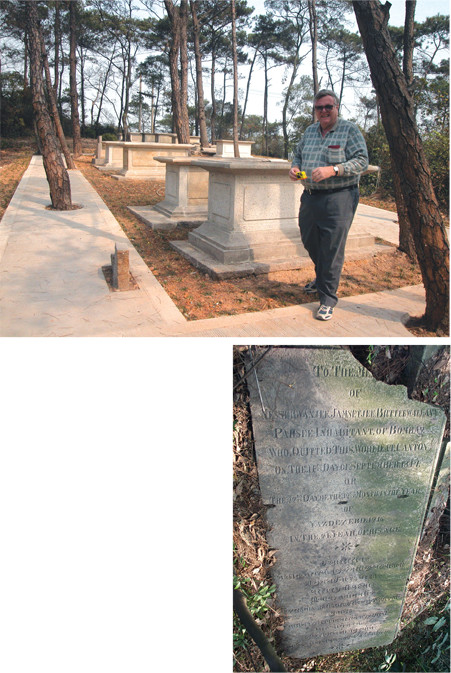
A visitor at the restored Parsi cemetery at Whampoa; below: a broken headstone, pre-restoration
Mutual recognition
It took a long time for Parsis to be accepted by the Chinese community. From the time the first Parsi merchant arrived in China in 1756 until the beginning of the Opium War, Parsis generally dealt only with Chinese merchants, and then only on a relatively superficial level. The Chinese and Parsi communities in Shanghai and Hong Kong started to forge stronger ties with each other only long after the Treaty of Nanjing was signed. A sign of the extent of this mutual acceptance was the growing practice of intermarriage.
In her autobiography, Zhang Ailing provides a good example: the marriage of Mi Ni, a Chinese woman, and a Parsi named Banaji. In China as elsewhere, intermarriage between people of different nationalities is an age-old practice. But in the early 20th century, and even earlier, marriages between Chinese and Parsis were not marriages of convenience; they served no political purpose. They were the result of the two communities getting to know and appreciate each other over a long period of time — a period in which Chinese people came to understand the Parsis, who in turn had to adapt themselves to the dominant Chinese culture.
From the Chinese perspective, both before and after the Opium War, the Parsis were known only as "white-head foreigners;” and since the social rank of any foreigner was below that of any Chinese, they had little to do with each other outside of the business environment. It would have been almost impossible for a Parsi and a Chinese person to become friends, let alone marriage partners. As Zhang Ailing says, in that era, "Chinese people were very conservative — men would never think of marrying a person of mixed blood, not even as a concubine.” However, after the signing of the Treaty of Nanjing, the Parsis’ sphere of activities in China expanded, and they had more opportunities to interact with Chinese people. Language barriers gradually diminished, as more Chinese learned to speak English and more Parsis learned Chinese. For example, Zhang Ailing mentions that Banaji could speak fluent Chinese. Slowly, social conventions changed to the point that Chinese women could have the choice of marrying foreigners. This "choice,” it should be mentioned, referred only to choosing foreigners wealthy enough to match the woman’s social standing — in those days, no one would have thought of marrying a "poor black devil.” But over many years, as understanding and acceptance grew between the Chinese and Parsi communities, marrying a Parsi came to be viewed as an acceptable option for the Chinese.
Zhang Ailing describes the marriage between Mi Ni and Banaji:
"There was a (Chinese) woman called Mrs MacDonald, who had been the foster daughter of a Guangdong family; she had originally lived with an Indian man. The third time she lived with a man it was with a Scot named MacDonald, so she called herself Mrs MacDonald. They had many children. She knew a Parsi man and was always making a big deal about how she would be a matchmaker for him. She insisted that he marry her eldest daughter, Mi Ni. And he liked Mi Ni well enough. But at that time, she was 15 years old and still in school, and she refused to marry him. Her mother beat her and forced her to marry him. By age 22, she had divorced him; they had one child, but she insisted on keeping custody of him, and wouldn’t even let her ex-husband see him.”
Mrs MacDonald’s insistence that her daughter marry Banaji suggests that the Parsis had been accepted by Chinese society — marrying a Parsi was a worthwhile thing to do; at the very least, it would not lose face for the family, because at that time, Parsis on the whole were wealthier than most Chinese. As for Banaji himself, everyone around Mi Ni knew him quite well: Mi Ni’s mother was clearly very fond of him; Yan Ying’s father was "an old friend” of his; and young Yan Ying had the impression that Banaji had been "very successful in business.” It was precisely because Mrs MacDonald’s friends and family knew Banaji as "an old friend” who was "very successful in business” that she wanted her daughter to marry him. The fact that Mi Ni did not want to marry Banaji does not suggest that Chinese people as a whole could not accept Parsis at that time. From this sea change in Chinese attitudes — from "never think of marrying a person of mixed blood, not even as a concubine” to wanting to be the mother-in-law of a Parsi — we can see the process by which Parsis began to be accepted into Chinese society.
As for the Parsi perspective, Zhang Ailing wrote only one line about Banaji’s attitude toward marrying a Chinese woman: "he liked Mi Ni well enough.” We can see from Mrs MacDonald’s high regard for Banaji that he was quite wealthy, and it was his choice whether or not he would accept this offer of marriage. But the laws of Banaji’s homeland would not have allowed him this choice, for Parsis practiced ethnic endogamy. Anyone who married outside the group would be ostracized by society, family and the religious community. In fact, in 1865, the "Parsi Marriage and Divorce Act” was amended to include an "Endogamy Law.” In 1936, precisely when Banaji was in China, the Parsis revised the law in a way that reaffirmed endogamy with the following stipulations: "In the context of this law, ... ‘husband’ means a Parsi husband; ‘marriage’ means a marriage between Parsis, whether contracted before or after the commencement of this Act; a ‘Parsi’ means a Parsi Zoroastrian; and ‘wife’ means a Parsi wife.”
Parsi law did not permit Banaji to marry a woman from a different ethnic group; nor did he personally have any obligation to marry a Chinese woman. Thus the fact that "he liked Mi Ni,” he married her and they had a son, demonstrates that because of his many years of residence in China (and in a way similar to many other Parsis in China and America), bucked what must have been enormous pressure from Parsi society, rebelled against traditional ideas, and dared to marry a woman he liked despite the fact that she was not a Parsi.
Such enormous changes in the traditional attitudes of both Parsis and Chinese are powerful evidence of the extent to which Parsis were accepted into Chinese society. To be continued
◆ ◆ ◆
From the archive