
Zoroastrians Abroad
Hong Kong Zoroastrians
A xerox copy of "A Historical Outline of our Trust, its Activities of its People,” forwarded to Parsiana by Perveez Aggarwal, managing director of the DBS Group of Companies, states:
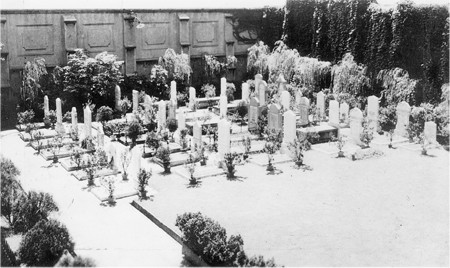
"The beginnings of the present day trust started quite humbly in the year 1822, when a piece of land was purchased on the slopes of Guia Hill in Macao (which until 1844 was administered from Goa) for the establishment of a Parsi cemetery there. The cemetery became operational in 1829. Canton (Guangzhou), however was the hub of China trade in those days with firms such as that of Cowasjee Pallanjee and Company establishing ‘factories’ which were warehouses, residences of ‘factors’ or agents there as far back as 1794. The first Parsi association formed in this area was in Canton in 1834, and was known as the ‘China Canton Anjuman.’ Parsis had begun to settle in Macao in the 1820s and started to settle in Hong Kong in the 1840s after the establishment of the British administration and in Shanghai in the 1850s after it was opened up to foreigners. On September 19, 1845 the Zoroastrian community living in this area met in Canton and created a wider anjuman body, covering Hong Kong, Canton, and Macao for the purpose of establishing and maintaining burial grounds, having places of association and rendering financial assistance to the needy. Zoroastrian cemeteries were established in Hong Kong in 1845, in Whampoa (near Guangzhou) in 1847 and in Shanghai in 1854. A bungalow was built in Whampoa in 1860 and a house purchased in Macao in 1874. The house in Macao was sold in 1939.
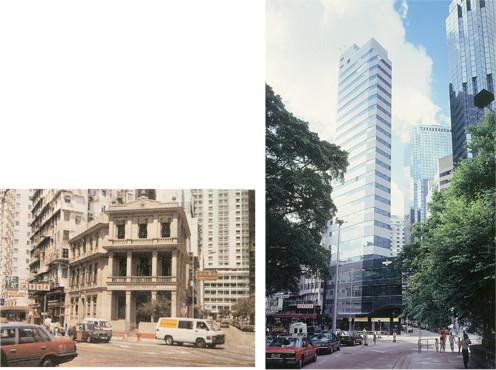
Zoroastrian Building in Hong Kong: the old (left) and the new
"As the resident Parsi community in Hong Kong increased and prospered, the first premises for use of the Zoroastrian community here was rented in 1857, and the first house purchased at 49 Elgin Street in 1861. This house was later sold and a plot was bought at 101 Leighton Road, on which was completed on July 19, 1934, a two-storey building named the ‘Zoroastrian Building’ at a cost of HK $ 48,000 including land. In 1970, a third storey was added to it. This building was demolished in April of 1991 for redevelopment and the anjuman was located temporarily (for two years) at a rented premises at B-6, 17th floor, Fontana Gardens, on Causeway Hill. The new "Zoroastrian Building” a 23 storey centrally air-conditioned concrete and glass commercial tower, was officially inaugurated on Jamshedi Navroz day, March 21, 1993 a day that would be etched in gold in the history of our Trust (see "An affirmation of faith,” Parsiana, August 1993). A time capsule was placed underneath the ground floor lobby’s center marble tiles, and a limited edition of specially crafted sterling silver souvenir medals, with a portrait of Zarathushtra on one side and an etching of the new Zoroastrian Building on the other, were minted and distributed to the members and other VIPs to commemorate the inauguration. Four floors of this building are currently being used by the community, whilst the rest of the floors are rented out as shops and offices. Most of the redevelopment cost of HK $ 33 million was financed by taking out a loan mortgaging the land. The loan was fully paid back in November 1996 and the building now belongs completely to the Trust.
"Parsis have always been noted for their charity and the first remittances of money by our Trust to India started as far back as 1848. Charities for the relief of local destitute Chinese first began in 1854. Substantial donations are now made annually to individuals and institutions in India and Hong Kong. A large number of educational subsidies are also granted to students every year...
"Though the number of Parsis in Hong Kong has rarely exceeded 200 at any time, the contributions of the Parsis to the development of Hong Kong has been considerable. Early 19th century ‘taipans’ such as Sir Jamsetjee Jejeebhoy, the first Indian Knight Bachelor and Baronet, and Pestonjee Cowasjee Sethna, founder of Cowasjee Pallanjee and Co were often known as the princes (among) eastern merchants. Pestonjee Cowasjee, Rustomjee Dhunjishaw and Framjee Talati were present when the British landed in Hong Kong on January 26, 1841. Pestonjee Cowasjee, Dhunjibhoy Bisney (our Trust’s first president), Framjee Jamsetjee and Dadabhoy Rustomjee also made substantial purchases at the first land auction in Hong Kong held in June of that year. In the first 25 years of Hong Kong’s history as many as a quarter of all foreign firms in Hong Kong belonged to Parsis. The latter day Parsis too have not only made tremendous contributions to the growth of Hong Kong’s trade and commerce, but have also helped in the formation and development of financial, educational, medical, social and sports organizations here.
"Sir Hormusjee Nowrojee Mody, president of our Trust in the 1890’s was one of the principal founders of the Hong Kong University and the Kowloon Cricket Club. He helped reclaim Central praya, activate the Hong Kong share and bullion markets and owned and developed large parcels of land in Kowloon. Mody Road is named after the outstanding philanthropist and a true Hong Konger. Bisney Road and Kotewall Road are also named after Parsis. In Macao, our cemetery is located on ‘Estradia Dos Parses’ or ‘Parsi Road’ and in Whampoa too, the hill on which our cemetery stood is still known to locals as ‘Parsi Hill.’
Zoroastrian Building in Hong Kong: the old (left) and the new
"Dorabjee Naorojee Mithaiwala accelerated Sir Hormusjee Mody’s development of Kowloon by starting in 1888 the first regularly scheduled cross-harbor ferry service known as the "Star Ferry.” Both owned famous racing stables as well whilst Dorabjee also owned most of Hong Kong’s top luxury hotels of the time. Jehangir Ruttonjee built and donated the Ruttonjee Sanatorium (now Hospital) and founded Hong Kong’s first brewery, later sold to San Miguel. His son, Dhun Ruttonjee, another Trust past president, was a legislative councillor in the 1960s — one of only two ethnic Indians to have ever become a member. Cowasjee Pallanjee and Company helped start and were the star players on the yarn market in the late 1800s. They, together with the Banaji brothers Framji and Rustomjee, owned and plied scores of ships. Their clippers included some of the fastest and best known of their time. Hormusjee Rustomjee started the ball rolling to build a seamen’s hospital which opened in 1843. Still other Parsis brought banking and insurance from India to Hong Kong and were founding committee members of the Hong Kong and Shanghai Bank in 1865, the Hong Kong General Chamber of Commerce in 1861, and the Indian Chamber of Commerce Hong Kong in 1952. Many of them were also directors of what are now blue-chip companies on the Hong Kong Stock Exchange.
"The Parsis have continuously shown confidence in Hong Kong throughout its history, starting from the first land auction in 1844 right through to the currently redeveloped HK $ 200 million Zoroastrian Building. As our current Trust president Jal Shroff has said, ‘We’ve been in Hong Kong a long time. We’ll be around for a lot longer yet.’”
◆ ◆ ◆
From the archive