
Zoroastrians Abroad
Fortune favors the forerunners
Between the 18th and 20th centuries, Zoroastrians consolidated their position as eminent entrepreneurs in the colony
When the British flag was hoisted in Hong Kong in 1841 among those present to witness the event were three eminent Zoroastrians — Rustomjee Dhunjishaw, Pestonjee Cowasjee Sethna and Framjee M. Talati. By 1860, within two decades of the British taking control, 17 or more than one-fifth of the 73 merchant firms listed in the Hong Kong Directory were owned by Parsis. Nineteenth century taipans (term used to describe a foreign businessman in China in the 19th and early 20th centuries) included illustrious names like Sir Jamsetjee Jejeebhoy, Sethna (founder of Cowasjee Pallanjee and Company) and Dorabjee Nowrojee Mithaiwala who were known as the "Princes of Commerce.”
In fact Parsi presence has been palpable in Hong Kong since the 18th century. The first Parsi who sailed to this region from Bombay in 1756 was Heerjibhoy Jivanji Readymoney, followed by his brother Mancherji and many other Parsis before the turn of the century as the monopoly of the East India Company gradually eased.
Canton (Guangzhou) was the hub of China trade in those days with firms of Readymoneys in 1756 and Cowasjee Pallanjee and Company in 1794 establishing factories which were warehouses/residences of ‘factors’ or agents. The credit for helping start the yarn market goes to Cowasjee Pallanjee and Company. They were also known to ply scores of ships along with the Banaji brothers Framji and Rustomjee.
An account of the lives of these illustrious frontrunners has been gleaned from the Directory of Hong Kong Zoroastrians, an article titled "The Parsee Legacy” that appeared in a Hong Kong magazine Gafencu Men (August 2009), and second generation family members of those firms that are continuing in a new avatar.
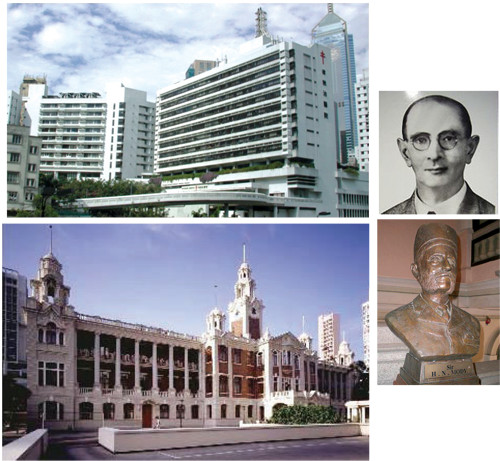
1st row: Jehangir Ruttonjee’s magnanimity led to the establishment of Ruttonjee Hospital;
2nd row: Bust of Sir Hormus-jee Mody at the Hong Kong University
Charting new courses
More than 30 ships were owned by the Banajis and Parsi owned clippers were some of the best owned and fastest in the mid 19th century. A special seamen’s hospital was the initiative of Hormusjee Rustomjee in 1843.
In the field of finance and banking too Parsis had earned credit for being instrumental in bringing banking (including the Oriental Bank in 1845 — Hong Kong’s first note issuing bank) and insurance from India to Hong Kong. Two Parsi traders, Pallonjee Framjee and Rustomjee Dhunjishaw, were on the provisional committee of 14 that formed the Hong Kong and Shanghai Bank in 1865. Both of them were also on the first board of directors of the Bank. Many Parsis served as founder members of the Indian Chamber of Commerce, Hong Kong and of the Hong Kong General Chamber of Commerce, and were directors of blue-chip companies on the Hong Kong and Singapore Stock Exchanges.
Having arrived in Hong Kong as a stowaway aboard a ship, Mithaiwala first accepted employment as a cook, opened a bakery a few years later and within a decade had become partner of Duddell and Company. He expanded the company to establish four hotels: Victoria, King Edward, Kowloon and Peak. He is best known though for establishing in 1880 the first regular cross-harbor ferry service, the Star Ferry by buying over the franchise from Grant Smith who was running an irregular service between Hong Kong and Kowloon. This regular service replaced the ‘walla-wallahs’ that sporadically crossed the harbor.
At the first land auction in Hong Kong in 1841 among the principal buyers were Pestonjee Cowasjee, Cawasjee and Framjee Bisney and Dadabhoy Rustomjee. The year prior though was a difficult one for many Parsis suffered when all their opium was seized at the beginning of the Opium War. Yet another time when many Parsi firms went bankrupt was during the cotton and stock market crash of 1865. This setback prompted many Parsis in Hong Kong to venture into new commercial activities like banking, insurance, transportation, hotels and trading on the shares, bullion and commodities (mainly yarn) markets.
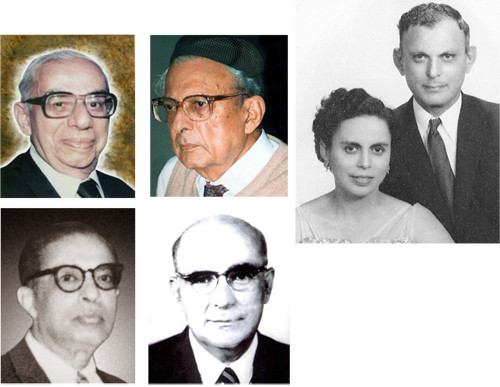
(Clockwise from top left): Pheroz Pavri, Savak Shroff, Bhikha and Soli Shroff, Shapoorji Jokhi and Keki Parekh
Industrious icons
For activating the Hong Kong share and bullion markets, owning and developing large parcels of land in Tsimshatsui, and being the major donor and principal founder of the Hong Kong University and the Kowloon Cricket Club, Sir Hormusjee Nowrojee Mody enjoys the distinction of having Mody Road and Mody Square in Tsimshatsui East named after him. Bisney Road is named after Dhunjibhoy Ruttonjee Bisney, the first president of the Zoroastrian Charity Funds of Hong Kong, Canton and Macau. Kotewall Road is named after Sir Robert Hormusjee Kotewall who was a legislative councilor for 13 years from 1923-36 and an executive council member for the next five years.
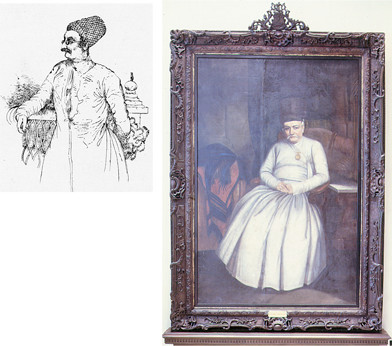
(left) Rustomjee Cawasjee Banajee; (alongside): Sir Jamsetjee Jejee-bhoy’s priceless frame at the Zoroastrian Building in Hong Kong
The only other Parsi and ethnic Indian to have served on the legislative council was Dhun Ruttonjee who was councilor for 15 years from 1953-68. He had additionally served on the Standing Law Committee and the Hong Kong Housing Authority, was chairman of the Trade and Development Council and a steward of the Royal Hong Kong Jockey Club for 10 years. As a longstanding member of the Board of Education he campaigned for free primary education for all and recommended that after the age of 14, children should be given the option of applying to vocational schools, colleges of higher education or universities. For the colony’s youth he advocated the setting up of fully equipped community centers for recreation and learning.
His father was the illustrious philanthropist Jehangir Hormusjee Ruttonjee who had founded Hong Kong’s first brewery in Sham Tseng in the New Territories which was later sold to San Miguel, and held major wines and spirits agencies. He also had the foresight to diversify the family trade into real estate, agencies and other businesses. He is best remembered though for financing Hong Kong’s first anti-tuberculosis sanatorium after his daughter Tehmi succumbed to the disease. His donation of $ 500,000 that led to the setting up of the sanatorium was believed to be the biggest gift by an individual or institution in the history of the colony at that time.
Committed to the cause he had made a further appeal seeking donations saying, "We who live in Hong Kong and prosper from the patronage of this community owe it to our fellow human beings to return to the common welfare an adequate part of whatever surplus we may accumulate. We can, none of us be unmindful of our obligation to our less fortunate fellow men and women. Whatever our race and whatever our religious belief, our common humanity demands our help for the needy and suffering around us.” Subsequently he donated a further sum of $ 250,000 for an extension to the Hospital.
Pheroz Kawasji Pavri came to Canton from Bombay in the early 1920s and set up K. S. Pavri and Sons Limited exporting Chinese products like silk, embroideries, fireworks, etc. Once the Hong Kong port and infrastructure were developed, he relocated to Hong Kong in 1924 and exported items in demand in India. His brothers in the Indian subcontinent from Karachi in the west to Calcutta in the east looked after the operations there. "In old Hong Kong, once a local family established connection with a particular firm, the loyalty to the employer continued with the next generation too,” stated Pheroz’s son Noshir recalling that the proprietor would frequently pay for the education of the employee’s children.
In 1934, Soli Shroff established his company, S. Framjee and Company Limited in Shanghai, which specialized in the manufacture and export of silk pieces mainly to India and the Middle Eastern countries. In 1949, the firm was shifted to Hong Kong where it was mainly manufacturing, importing and exporting silk and cotton textile pieces and garments to the UK, South America and Middle East. Soli’s son Jal’s business empire under the name of Fossil may well be a mammoth undertaking compared to his father’s firm but he ensures that the entrance to his business premises bears the name of "S. Framjee and Company Limited.”
Before Keki Parekh set up K. P. Parekh and Company as an import-export firm in 1937 he had gained four years of experience in Hong Kong, working as a clerk for Gotla and Company initially and joining Ruttonjee and Company thereafter. Like many other trading firms of his time Parekhs imported ghee and spices from India and exported saris, kors and Chinese goods to India. Within two years there was a runaway growth in business but Parekh did not have the requisite money to expand further so he gladly accepted Shapoorji Jokhi’s offer to join the business. Thus was formed the partnership firm of Jokhi, Parekh and Company which continued for the next 13 years until the two entrepreneurs chose to pursue their independent line of business.
Shapoorji Jokhi had the misfortune of being imprisoned by the Japanese during World War II for providing provisions to the British Prisoners of War. Fearing he would be executed, Jokhi told himself "If I come out of this alive, I will do something for my community.” Honoring his pledge he funded many charitable projects until his death in 1990. His business S. F. Jokhi and Company that he launched as an export firm in 1937 commenced with the export of cotton. Over the years the firm traded in dry fruits, ivory that was considered a money spinner, garas and kors. Shapoorji being the fifth of 13 siblings, and he and his wife Manijeh having no issue, he handed over the business reins to his youngest brother Keki. With the business responsibilities came the philanthropic duties too that Keki was expected to fulfil, donating crores in charity in keeping with the wishes of his brother to assist deserving individuals and institutions in India and other parts of the world.
Savak Shroff had come to Shanghai at the age of 18 to join his uncle in the silk trade. After his marriage in Bombay he returned to Hong Kong with his young bride and six-month old son Neville to start a trading firm, Shroff and Company Limited in 1950. Today this firm continues with its manufacturing activities, their garments and household/kitchenware being exported to different regions.
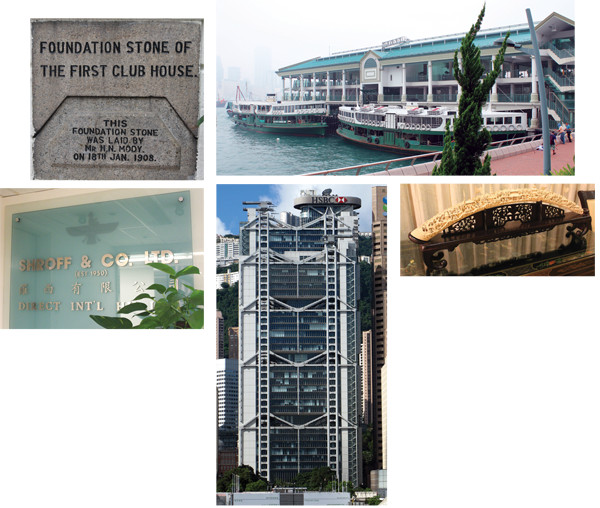
Clockwise from top left: Foundation stone at the Kowloon Cricket Club; Star Ferry wharf; ivory heirloom in the Parekh collection; Hong Kong and Shanghai Banking Corporation; Shroff and Company’s Zoroastrian connection
Photos: Jasmine D. Driver
Chinese chain
Historical references state that Zoroastrians of Pars in Persia had trade ties with the Chinese way back in the sixth century. Small Parsi settlements with fire temples and mobeds were sighted in China in the eighth and ninth centuries (Tang Dynasty) and the oldest extant text in existence of the Ashem Vohu in old Sogdian characters dating to the eighth century was discovered in Dunhuang in western China.
Even after 15 centuries, Zoroastrians who stayed behind in the Special Administrative Region of China, as Hong Kong has come to be designated, are happy to flourish on this island. The trepidation with which they faced the future towards the end of the 20th century when the British returned the island colony to China is now replaced with confidence.
(Future issues of Parsiana will focus on the successful 21st century Zoroastrian entrepreneurs and professionals in Hong Kong.)
◆ ◆ ◆
From the archive