
Zoroastrians Abroad
Profitability with philanthropy
Investment in equities and real estate has enabled Zoroastrian families in Hong Kong to continue with their charitable endeavors
From exports to equities, and from liquor to land, a shift in priorities was inevitable to ensure that profitability and philanthropy were not compromised. Capitalizing on the property boom, some of the long established Zoroastrian families in Hong Kong — Jokhis, Parekhs, Ruttonjees — decided to realign their business resources rationally.
"Trading in commodities is high risk and highly capital intensive. We found that trading in equities and taking care of our own finances was more profitable,” states Roxy Jokhi, daughter-in-law of the largehearted Jokhi family of Hong Kong that has come to be recognized as a synonym for community philanthropy in Bombay and Navsari.
"Dad said ‘focus on equities and investments,’” Roxy’s husband Rustom recalls the counsel of Keki that has stood the family in good stead, permitting them to continue with their magnanimous gestures. When the ivory business was suspended, the custodians of the Jokhi empire realized they needed "to look at other alternatives” and thus concentrated on stocks, shares and property.
Besides ivory their business operations over the years have encompassed cotton when raw cotton from India, Pakistan would be sent to western countries like USA and Germany through markets in Hong Kong and Indonesia. The intervening years saw trading in spices and dry fruits, and later export of garas and kors.
"No one wants to risk private wealth,” remarks Roxy who finds that "entrepreneurship is certainly lacking in the community with most believing that the safest way is to get a good job after education.” While her own father Dara Patel was a ship chandler in Mombassa, Kenya (prior to the Idi Amin crisis in Uganda), Roxy says she would only encourage their sons 17-year-old Farhad and 14-year-old Daryus to venture into a business after they have gained experience working for multinationals. "Competition is very high and risks are substantial,” maintains Keki who at 87 years of age continues to involve himself in the family’s philanthropic activities that have been gaining momentum in the last 40 years, his elder brother Shapoorji having initiated the drive during his lifetime.
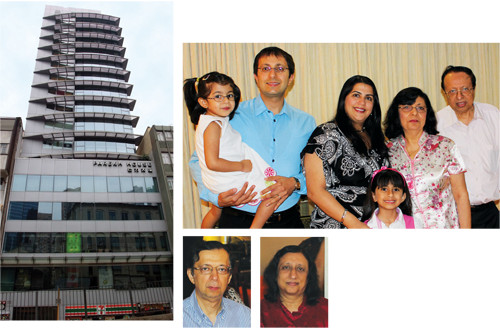
Parekh family (above, from left) Ava, Yazdi, Chermeen, Sanaya, Mahrukh and Viraf; (alongside) Noshir and Freny Photos: Jasmine D. Driver; (far left) Parekh House
Their first phase of philanthropic activities involved construction of Ava Baug in Navsari in the early 1970s, named after benefactor Shapoorji Jokhi’s mother. Within a decade nearly 500 residential tenements had been built for the community. As reported in "Fortune favors the forerunners” (see Parsiana, August 21, 2011) when Shapoorji had been taken as a prisoner by the Japanese during World War II, and was about to be executed, he had promised himself that if he survived the ordeal he would do something for his community. Although Shapoorji got a new lease of life he lost his elder brother Dhunjishaw who succumbed to a burst appendix during the war, with no doctor or medicine to save him. Yet another elder brother Nariman was already in business in Hong Kong when Shapoorji was beckoned there at the age of 17. Keki, the youngest of the 13 siblings, went to Hong Kong after the war when he was 23 years old.
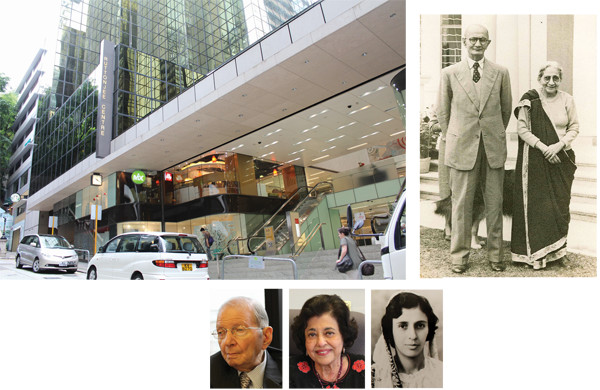
Above: Ruttonjee Centre (Photo: Jasmine D. Driver); Jehangir and Banoo Ruttonjee; (alongside, from left) Rusy, Purviz and Freni Shroff
Ten years before Shapoorji passed away in 1990 at the age of 77 he had handed over the financial reins as also his responsibilities to Keki. Shapoorji and his wife Manijeh had no issue, and it was the betterment of the community for which they sought to use their wealth. After the construction of Ava Baug the family channeled their funds towards the completion of the Shapoorji Fakirji Jokhi Agiary in Godrej Baug and the renovation of the B. D. Petit Parsee General Hospital in Bombay with the creation of the Jokhi Wing, the intensive cardiac care unit, operation theater, x-ray and pathology departments. The reconstruction of Jamshed Baug and R. J. J. School in Navsari where most of the Jokhi brothers studied was also a priority with the family. "Currently dad is involved with the Sir J. J. High School (English medium) under construction in Navsari,” mentions Roxy. They also make an annual contribution to finance the cost of 200 cataract surgeries conducted by Rotarians.
Zoroastrians in the West benefit from the Jokhi largesse too although the family is "more or less partial to India.” Appeals from Zoroastrian associations in Ontario, New Jersey and Pennsylvania have earned a favorable response from the Jokhis. Keki’s second son Burges with his wife Freny, 20-year-old daughter Jessica and 18-year-old son Michael reside in Georgia.
Since they "don’t have the infrastructure” to determine the genuineness of individual applicants, "we generally tend to support organizations,” explains Roxy, clarifying that medical and educational causes as also appeals from Zoroastrians tend to get priority.
"He is very low key. He does not like too much publicity. He is a silent giver who does not expect anything in return. Very thoughtful of the underprivileged, he is humble, ganoo bak bak nai (no futile talk),” Roxy describes her benevolent father-in-law. It is Keki’s wife Javer who is given credit for setting a good religious example to the grandchildren. As Javer realistically mentioned, "I pray every day for at least half an hour. We teach the children. Then when they go abroad, sometimes they follow and sometimes don’t…”
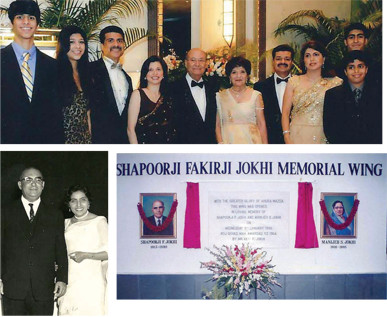
Jokhi family at the 50th wedding anniversary of Keki and Javer (from left) Michael, Jessica, Burges, Freny, Rustom, Roxy, Farhad and Daryus; (Alongside) Shapoorji and Manijeh Jokhi and the plaque at the B. D. Petit Parsee General Hospital
Building anew
Doing business in Hong Kong is "now much tougher,” confirms Viraf Parekh, partner of K. P. Parekh and Sons that will celebrate its platinum jubilee next year. The firm was established by his father Keki Parekh in 1937 to promote a flourishing import/export trade, importing ghee and spices from India and exporting saris, kors and Chinese goods to overseas markets.
Prior to his arrival in Hong Kong in 1933, Keki had worked for a couple of years in Mombassa after which he returned to Navsari to work as a doctor’s compounder there. In Hong Kong he started his career as a clerk with Gotla and Company. Shapoorji Jokhi who was then working with Ruttonjee and Company convinced Keki to join the firm dealing in wines and beer. After serving there for two years Keki Parekh launched out on his own.
Within two years of the firm’s inception the business was leaping ahead and Keki found he did not have the necessary liquidity to expand. Fortunately for him, Shapoorji Jokhi offered to pool in his resources and they formed a partnership, Jokhi, Parekh and Company. The War years proved difficult with uncertainties in transport and procurement of raw materials and essentials. Nevertheless the partnership continued until 1952. By then they were importing dry fruits from India, Pakistan, Afghanistan, Iran, and buying raw ivory at auctions in Africa which they crafted and sold to foreign markets. With a rise in poaching and drastic culling of elephants, when tuskers started becoming extinct, trade in ivory was only permitted to certified traders.
When Viraf joined his father in business in 1963 after his education in Poona the firm was focusing on exports, marketing toys, consumer goods, hardware and kitchen tools, novelties and handbags. Their markets were mainly in the Middle East, Egypt, Dubai, Central and South America. The volume of business started dwindling when "factories that were in Hong Kong shifted to the Chinese side and directly contacted our buyers,” reports Viraf adding, "Now we are more into property development...”
Thus whilst K. P. Parekh and Sons continues with Viraf, his brother Noshir and sister Freny as the three partners, the trio are also directors of Parekh (Hong Kong) Limited, that has ventured into property development. "Nowadays everybody is a competitor,” declares Viraf, candidly revealing that they invest in stocks and shares to augment their income and turnover. He is happy though that unlike India where there is a "lot of paperwork and bureaucracy, in Hong Kong that is kept to a minimum.”
Trustee of the Zoroastrian Charity Funds of Hong Kong, Canton and Macao for the last three decades and its honorary secretary for the last two decades, the self effacing administrator states that he is "thinking about retiring” but the "cohesive and well-knit community appreciates the work you put in…There are differences but there is no split like in other community organizations. Difference of opinion is good.” Describing himself as a "shy person who prefers to work behind the scenes,” Viraf presents us a recent copy of the Directory of Hong Kong Zoroastrians, the joint annual effort of Viraf and his son Yazdi. Support for the association’s social hall committee is obtained from Viraf’s wife Mahrukh, and Yazdi’s wife Chermeen who is busy raising their two little daughters, Sanaya and Ava. Viraf and Mahrukh’s other son Behram resides in California with his wife Rose, sons Sam and Cyrus, and daughter Mehra.
Members of the Parekh family occupy different floors in their 18-storey building, Parekh House, that was rebuilt in 2004. One floor though serves as the common meeting ground for the entire Parekh clan and a convenient set-up to entertain visitors. Taking pride in "the environmentally friendly features” at Parekh House, Viraf elaborates that their design incorporates sun-shading fins, double glazed low-uv glass and insulated aluminum panels.
The spirited shift
Yet another Parsi founded firm that is in the realty business is Ruttonjee Estates Continuation Limited where 94-year-old Rusy Shroff is permanent managing director. Established in 1935, the family business includes ownership of Ruttonjee Centre, comprising the 27-storey Ruttonjee House redeveloped in 1983 and the 22-storey Dina House that was redeveloped in 1986. In 1988, the family decided to close down the wine and spirit business in order to concentrate on the real estate business.
The founder of the Ruttonjee empire was Hormusjee Ruttonjee who came to Hong Kong in 1884 and established B. M. Ruttonjee and Company in 1887, specializing in the trading of wines and spirits. When his son Jehangir took over the reins of the business, he renamed the company H. Ruttonjee and Son Limited. It was Jehangir who was instrumental in founding H. K. Brewers and Distillers Limited, the first company in Hong Kong to be involved in the brewing and production of beer. In 1948, the brewery was sold to San Miguel for the then princely sum of HK $ 6,000,000.
While Jehangir’s son Dhun was the first Indian to serve on the Legislative Council in Hong Kong, it was his son-in-law Rusy Shroff (first married to Jehangir’s daughter Freni who succumbed to cancer) who inherited the business mantle. Rusy along with his siblings Beji and Minnie had been raised and educated by Jehangir and his wife Banoo after their father died tragically in a typhoon when traveling from Shanghai to Hong Kong. Rusy had joined the family business at the age of 17. When he became its managing director the company was one of the leading wine merchants in Hong Kong. After successfully trading for 101 years, the wines and spirits business was closed in 1988.
Both Rusy and his wife Purviz who is also the permanent managing director of Ruttonjee Estates take a keen interest in the management of the 600-bed Ruttonjee Hospital and the 250-bed Freni Care and Attention Home funded by the family for the convenience of Hong Kong residents.
When the British were readying to cede Hong Kong to China before the turn of the last century, one of the journalists had asked Rusy, "If the seat gets very hot in Hong Kong, where would you like to go?” Purviz still recalls the look of surprise on his face and his reply: "Hong Kong is my ship. I’m the captain. I sink or sail with my ship.”
◆ ◆ ◆
From the archive