
ART
The connoisseur collector and his collection
The Jehangir Nicholson Art Gallery showcases prized paintings in his possession collected over 30 years
Works of contemporary Indian artists can now be enjoyed by visitors to the Prince of Wales Museum in Bombay courtesy the recently inaugurated Jehangir Nicholson Art Gallery (JNAG) on its premises. Respecting the wishes of the late art collector who wanted his treasures to be housed in south Bombay, the trustees of Nicholson’s estate — Cyrus Guzder and Kaiwan Kalyaniwalla — have chalked out a path on his 10th death anniversary whereby his collection will be displayed for a 15-year period at the JNAG with a change of exhibits thrice a year. Nicholson’s cache enriches art history in time and culture, believes Guzder who Nicholson referred to as his "god- son.”
"Exhibiting Nicholson’s collection spanning the 1930s to 2000 loaned to the Museum fits in well with the Museum’s own collection of contemporary Indian artists which faded out from the 40s,” specifies Zasha Colah the young curator of JNAG (who is subsequently replaced by Kamini Sawhney). Each of the paintings has been diligently archived and the curator is struck by the single-mindedness of the collector. She has detailed how "Nicholson bought an artist in progression and evolution so that his collection of 800 paintings of 250 artists, 100 sculptures, drawings, prints and boxes of photographs would be enjoyed by several viewers. His collection proclaims 25 works of Shreshtha — the single largest representation of any artist.”
The Progressive Art Group — a breakaway group of artists from Bombay — is well represented in Nicholson’s collection with M. F. Husain, Francis Souza, Prabhakar Barwe, H. A. Gade, Vasudeo Gaitonde, Akbar Padamsee, K. H. Ara, Nalini Malani and the couple Atul and Anju Dodiya.
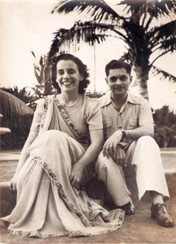
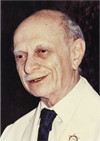
Jehangir Nicholson (top and above) with wife Dina in younger days
His dream gallery occupies 4,500 sq ft, of which 1,000 sq ft is storage and has been designed by architect Ratan Batliboi with diligence and expertise. Guzder sees several advantages in being attached to the Museum: "JNAG has access to the Museum’s mailing list and activity bulletin to thousands of art lovers.” He also traces the exhibits in the Museum from Mohenjodaro to Ashoka to 19th century artefacts to 20th century paintings in the possession of the Museum.
Colah also applauds the Museum’s great contribution in increasing the value of paintings after restoration, which lends the paintings a longer life. They are diligently cleaned, given fungal treatment, placed under ultra violet light to see flaked paint, wax droplets, cupping, etc. Humidity, salt deposits, sunlight damage, dust and dirt are some of the dragons besetting paintings. "After detailed restoration and consolidation, the art works are in mobile storage to international standards of air conditioning, dehumidification, lighting so accessibility is easy due to classification. There is minimal human intervention as ‘accessioning’ is done when procurement is needed. The registry is well documented, complete with photographs,” Colah informs.
Nicholson’s passion for spreading the art word would make travel for the exhibits seem like a natural corollary. Colah was anxious to do this and stated, "We have a good insurance plan so the exhibition can travel. Our website www.jnaf.org.in already has reached out to a vast number and the mailing list has 12,000 listings — both national and international.” She believes that spreading the word was the raison d’être of Nicholson and the gallery should perpetuate this. She reiterates that "if Nicholson learnt from his art collection at his age then others can do so as well.”
"His collection is replete with abstract paintings,” the curator points out. "…Abstract was new in India when he started collecting. It also seemed to confuse him. He grew to like it, as he continued buying abstract — it became the key to the lock till he came into confidence with abstraction.” Nicholson’s bequest also covers several books on abstraction.
A good bargain
Nicholson’s knowledge of contemporary Indian art bloomed with his introduction to the 24-year-old Laxman Shreshtha in 1968 by his friend Kali Pundole. Shresh-tha in turn introduced Nicholson to other artists. The story goes that he disliked being introduced as an art collector as he wanted to meet artists on level ground for discussions which was not possible if he was seen as a potential buyer. This is explained by Guzder who recounts how Nicholson loved a good bargain and was not a spendthrift.
Mint reports information gleaned by Colah: "Nicholson had 150 paintings in 1996, about 300 in 1998 and 800 at his death in 2001 at the age of 86.” The same article says that the collector became more methodical about what he bought. The modern period in his collection starts with Jamini Roy. In fact we learn "that it is Nicholson’s collection of art from the 60s onwards that is focussed.” Anindita Ghose of Mint reports, "…he wanted art that defined each artist’s distinct period.” As an example Ghose quotes how Nicholson bought Raza straight from the 1940s till 2000. Guzder states that "the collector’s works almost represented a new idiom into modern art. If you see the Jamini Roy landscape, it was like pointillism (brush strokes applied in dots till the emergence of an image) but not with the bold strokes of Van Gogh…”
Nicholson the art collector cannot be mentioned without his collection of women artists. He made a concerted effort to buy the works of Nasreen Mohamadi, Anjolie Ela Menon — apart from Malani and Dodiya (Anju) and others who are not widely represented in his collected works. He also financed thematic Marg Publications in the 1980s to showcase modern Indian women artists.
In line with Nicholson’s vision, the Gallery wants to encourage docents (art guides) in museums, who can help novice art lovers and appreciators. One of the Gallery’s initiatives to popularize and make the viewer more sensitive and curious to art is to leave random paper and pencil on art horses (easel benches) so that school groups and viewers can express themselves in any manner to the exhibited stimulus. Students of art from the Sir J. J. School of Art in Bombay use this facility and Colah would like other institutes to do the same. Art students are guided and can refer to any archives, Colah continues. Currently the exhibition sees 600 footfalls a day at the Museum which doubles to an audience of 1,200 over the weekend.
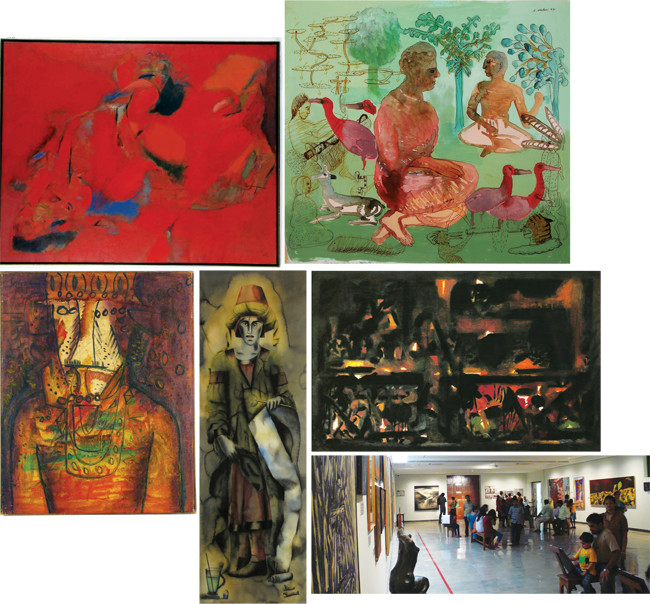
Clockwise from top left: Trussed bull by Tyeb Mehta; Untitled by Nalini Malani; Earth by S. H. Raza; Watercolourist by Anju Dodiya and Mammon by F. N. Souza.
Bottom right: Young and old expressing themselves astride art horses at Jehangir Nicholson Art Gallery
Passion and obsession
Nicholson was a man of many parts — art collector, antique collector, motor car racer, photographer, philanthropist, sheriff. (It is narrated that even after his tenure, he refused to let go of the sheriff’s badge and beacon on the car, till it was practically forced away from him!) Of all the above monikers, the frame of art collector is what he shall be remembered by — his passion and obsession, enshrined at JNAG. In fact his obsession was so great to let the world be exposed to art, that he tried his best to obtain some area or space during his lifetime. "His determination and zest can be understood by the fact that Nicholson studied architecture, display and lighting to be able to put up his dream museum,” Colah states. As an illustration of his obsession, he sometimes awakened his loyal domestic help to rearrange paintings in the wee hours of the morning.
Guzder — himself an amateur photographer — remembers visits to film developers with Nicholson. Whilst Guzder collected 30 odd photos, Nicholson heaved a pile off to the car. Guzder adds that his godfather "had an aesthetic sense — especially his photography. He’d photograph politicians and then send them their snapshots. A lot of our friends claim that the best navjote and wedding pictures were taken by Jehangirji.” He pushed his short frame wherever there was a picture to be taken; embarrassment was not a word he knew.
To shift gears, motor racing was another of Nicholson’s passions. When he was forbidden from racing by his wife, he entered racing competitions under the pseudonym ‘Mr Cotton,’ making wife Dina believe that Jehangir had accepted her ban and quit competitive racing. A well chosen ‘nom de racing’ as his family business was cotton and he was a well known figure at the bourse. Grief stricken at Dina’s demise in 1968, he threw himself into collecting art. He claimed "paintings were his children” as the couple were childless.
Guzder recalls that if he had nowhere to go, there was always the Guzder household. He spent many an evening with them "as he hated eating alone… He also seemed to have several tricks up his sleeve for kids who seem to relate to this impish man.” The godson also reminisces about his good baritone voice and the ability to laugh at himself and his diminutive stature. "He had this mutually reinforcing relationship between artists and himself. He had no hypocritical airs about art,” Guzder brings the man alive.
Born in a wealthy Zoroastrian family, Nicholson was a believer in Bahram roz and regularly attended the sarosh nu patru of friends and even acquaintances. Guzder mentions that he was ardent about wearing his sudreh-kusti and fondly pictures Jehangirji’s kusti often dangling from under his shirt. Some of the co-religionists he patronized and was well acquainted with were sculptor Adi Davierwalla, artist and poet Gieve Patel, artist Homi Patel (in the current exhibition) and Piloo Pochkhanawala the sculptor. He had a long-standing friendship with Kekoo Gandhy of Chemould and was also a frequenter at the Pundole Art Gallery where founder Kali contributed to his growing expertise.
In keeping with the tenets of the faith, Nicholson donated his vast collection of paintings, antiques, books, photographs, objets d’art to posterity. Nicholson’s first art purchase was A Scenery by Sharad Waykool in 1968, way before Indian art went commercial. As a regular at the Taj Art Gallery in the hotel, this canvas caught his eye. Like a shrewd businessman who counted his paisas, he haggled and brought the price down to Rs 500 from the original Rs 600. Guzder gives an insight into the collector’s mind: "His conscience pricked him and in those early days an empathy for struggling artists developed. As his respect and friendships grew… he couldn’t bring himself to bargain with them” as he believed an artist’s soul was different from that of a shopkeeper.
◆ ◆ ◆
From the archive