
Cover Story
Celebrating Sabavala
The Prince of Wales Museum of Western India houses a permanent archive of Jehangir Sabavala’s life and work
"The bequest is more than the mere housing of his last works; it is an archive of his working life and the fruition of his ideas,” Shirin Sabavala told a packed gathering at the auditorium at the Prince of Wales Museum of Western India, now renamed Chhatrapati Shivaji Maharaj Vastu Sangrahalaya, on September 15, 2015. It was the inauguration of the exhibition "Unpacking the Studio: Celebrating the Jehangir Sabavala Bequest” curated by Ranjit Hoskote, an authority on Sabavala. The artist’s wife Shirin not only donated her husband’s paintings but also his drawings, sketchbooks, papers, photographs and many books from his personal library. She did not want the collection to be "dispersed” and wanted it to have a "home” in one single place. As she started going through Sabavala’s papers, she found that she had unearthed a "Pandora’s box from the drawers and cupboards she opened.” She spoke warmly about the special relationship between her husband and Hoskote who, in addition to being the curator of the exhibition, has also written two books on the late artist.
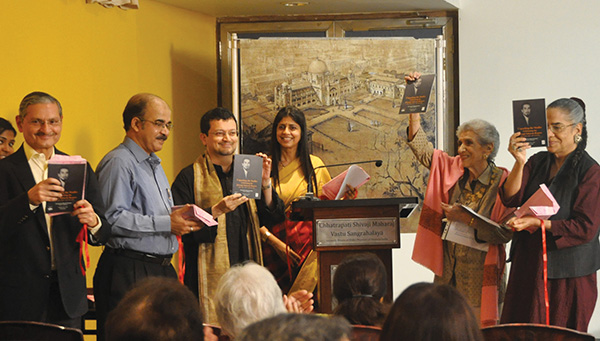
Cyrus Guzder, Sabyasachi Mukherjee, Ranjit Hoskote, Kamini Sawhney, Shirin and Aafreed Sabavala
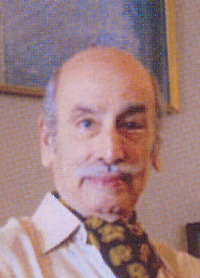
Jehangir Sabavala
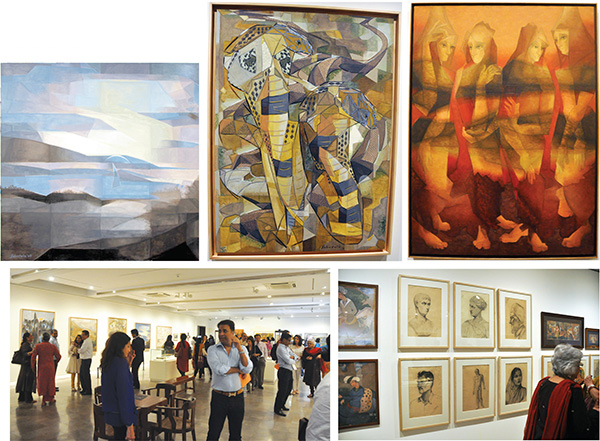
1st and 2nd row: paintings by Jehangir Sabavala and visitors at the exhibition
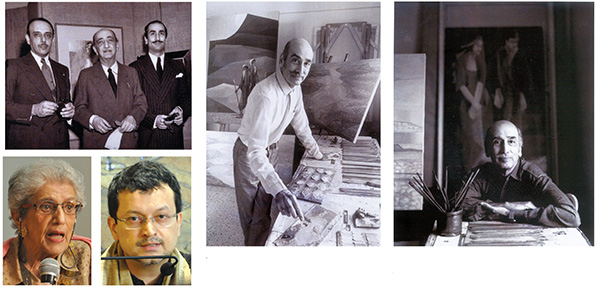
1st row (from left): Karl Khandalavala, Sir Cowasji Jehangir, 2nd Bart, and Sabavala at
his 1st exhibition in 1951; portraits of Sabavala by Girish Dixit and Prabuddha Das Gupta;
2nd row: Shirin Sabavala (left) and Hoskote
Before one enters the exhibition one is informed that Sabavala was a dedicated painter who attended his studio as regularly as others attend their offices. Hence, in the introductory section Hoskote has appropriately placed Sabavala’s work within "the evolving genealogy of the studio for over five centuries.” We witness different studios from 15th century, from German Renaissance artist Albrecht Dürer, Dutch painter Jan Vermeer to American Andy Warhol, a leading figure in pop art. This is not to suggest that Sabavala was confined to a closed room; one sees photographs of him painting in the open air in the Antibes in France and in Droog in New Coonoor.
In "Sketch, Draft, Image” Hoskote has included several of Sabavala’s paintings most of which were painted in 2009-2010: The Eye, The Raven, Brown Seascape. There is a stunningly beautiful and evocative painting of two cobras which seem as if they are about to strike at any moment. Viewers see the care and the meticulous manner in which the artist planned this work. In an incomplete canvas, "An Unfinished Landscape,” the areas which have yet to be painted have notings not only regarding the colors he planned to use but also the various shades of brown from light to dark which have been numbered from one to four. Juxtaposed against his landscapes is Shibata Zeshin’s "Autumn Grasses.” There is also a very interesting display of Sabavala’s easel, palette, paint brushes, palette knives, paints and tubes. Hoskote has included books from Sabavala’s private library on Lyonel Feininger, André Lhote, Giotto di Bondone and Chiam Soutine. Also on display is a book exhibiting one of his watercolors, another with sketches on paper which has carefully been divided into squares and rectangles, and diaries where he has jotted down ideas from various scenes which probably fired his imagination where colors have been listed and where the level of detailing is amazing.
In "Rêverie, Fantasia, Quest,” Hoskote has highlighted some of the sources which inspired Sabavala, particularly his fascination with Japanese art of the 18th and 19th centuries and the sacred and ritual objects of Tibetan Vajrayana Buddhism. Hoskote juxtaposes Sabavala’s painting of The Seers and one of monks against a Tibetan artist, Li Gothami’s Mara Attacking Buddha. A photograph of the artist visiting Japan is exhibited together with his vivid paintings of a Character from a Kabuki play and Benkei, The Warrior Priests.
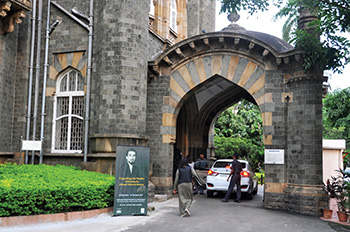
Entrance to the Prince of Wales Museum of Western India
Hoskote then places the artist’s work in the context of the Bombay art background: Sabavala’s education at the J. J. School of Art as well as his relationship with the "Bombay School of Artists.” One sees here several sketches of heads — Roman, male, the Doge — all completed between 1940 and 1942. These are placed in the company of works by other artists of the Bombay School like P. R. Gharpure, Antonio Xavier Trinidade, R. D. Dhopeshwarka and others, not forgetting paintings by Krishnaji Howlaji Ara and Syed Haider Raza.
The last section moves from the private space of the studio to the exhibition of the final work. Sabavala was associated with the Jehangir Art Gallery which was named after his cousin. It was here that several of his exhibitions were on view. On display is an invitation to an exhibition held in 1951 for an exhibition of his paintings and drawings. There is a list of exhibits with prices marked: the lowest is Rs 25 and the most expensive, a "still life in brown” is priced at Rs 300!
The exhibition is a treat not just for art aficionados but anyone who is interested in the painter, the inspiration behind his work and the painstaking planning of a final canvas.
Obtaining the Sabavala collection is yet another outstanding achievement for the Museum which has been constantly re-inventing itself and has come a long way since the first major collection was gifted to it by Sir Ratan Tata and Sir Dorabjee Tata in the early part of the 20th century. Sabyasachi Mukherjee, the director general of the Museum, explained that the Tata collection was so rich, encompassing Western, Oriental, Indian and Himalayan art, Japanese artefacts, Akbar’s armor and shield, and the swords of Shah Jehangir and Alaudin Khilji. "The Museum has had a rich tradition of bequests and close to 40% of its 60,000 artefacts have been contributed by private institutions and individuals who have a huge trust in the Museum’s reputation.” Most prominent among these are Sir Akbar Hydari, Karl Khandalavala, Pheroza Godrej, Pupul Jayakar and, of course, the Jehangir Nicholson collection in whose name a gallery was created in the Museum after his death in 2001.
◆ ◆ ◆
From the archive