
A tripartite treat
Jehangir Nicholson, Kekoo Gandhy and Kali Pundole nurtured the blossoming of modern art in Bombay
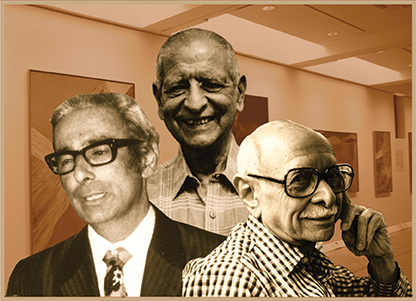
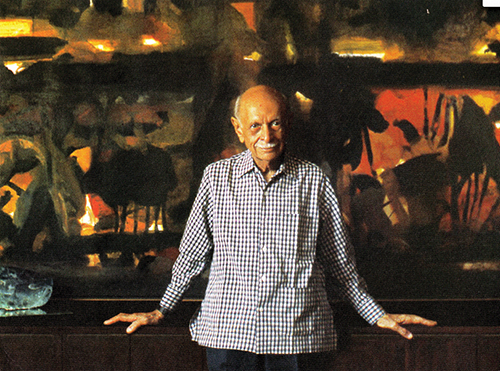
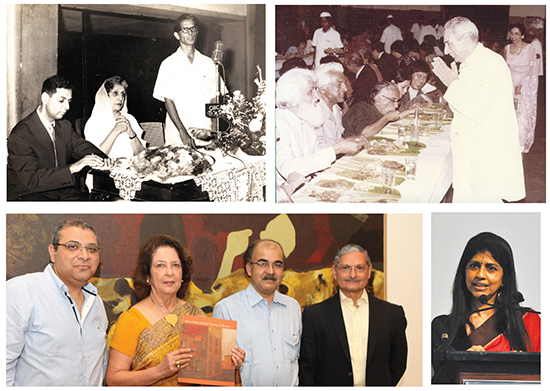
All photos of Nicholson, exhibition and from brochure courtesy Jehangir Nicholson Art Foundation
.JPG)
The exhibition catalog carries a quote by Nicholson, "In those days, Chemould and Pundole were the main, if not the only, commercial ones around. I began meeting artists and sometimes ‘buyers.’ A flame was perhaps lit by (M. F.) Husain, then already 52 years old. Akbar Padamsee, Tyeb Mehta and Gaitonde (Gai as we called him) came next. Then came along Ram Kumar, Krishen Khanna, (S. H.) Raza, later (K. H.) Ara and in the early ’70s Laxman Shreshtha and his wife Sunita. One started recognizing the artists from their works and their style and content, and it gave me joyous satisfaction to know that I was learning.”
Remarking on "the fire in the belly…(of) this small, demure man,” Jeroo Mango, art collector and a contemporary of Nicholson, when inaugurating the exhibition on September 19, 2014 advised the audience, "You don’t have to be educated in art… Buy what you like; train your eyes… Contemplate… Go meet gallery owners… Your eye matures. Even a poor person living with art learns to appreciate it.” "These three great friends left a great legacy,” summed up Sabyasachi Mukherjee, director general of the Musuem.
"This old school gentleman with a modern outlook and vision is someone we all miss,” acknowledged Kali’s son Dadiba who had conceived the exhibition. After purchasing his first painting for Rs 500 in 1968 from Chemould, Nicholson continued to regularly frequent this Gallery as also the Pundole Gallery. "Not only did he religiously visit every exhibition, he also bought regularly. His presence on the art scene certainly contributed to the survival of the two galleries,” attested Dadiba in his introductory article titled "A Goliath in David’s Sandals” in the exhibition catalog.
"He entered the domain of art almost by chance after the death of his wife Dina in 1967,” noted cultural theorist Ranjit Hoskote in his introduction to the collector: "He accepted this devastating loss only gradually; his spirit found consolation in the things of beauty that remained… Having been interested in photography since the age of nine, it was natural that Nicholson should gravitate towards the visual arts… visiting exhibitions at Pundole and Chemould, at first hesitantly, but then with greater confidence… Before he knew it Nicholson had surrendered before his new passion which took its place beside his preoccupation with fast cars and his concern for a sensible taxation policy…”
Nicholson’s eccentricities like flapping his large ears in the midst of an art conversation or propensity to study a painting by rolling up an exhibition catalog as though viewing through a telescope or requesting gallery owners to rotate a painting 180° to permit him to study it from another angle or occasionally even lying down on the floor of the gallery in his pristine whites for a better view were revealed in a conversation between Dadiba, and Shireen Gandhy who after the passing away of her parents is now in charge of Chemould.
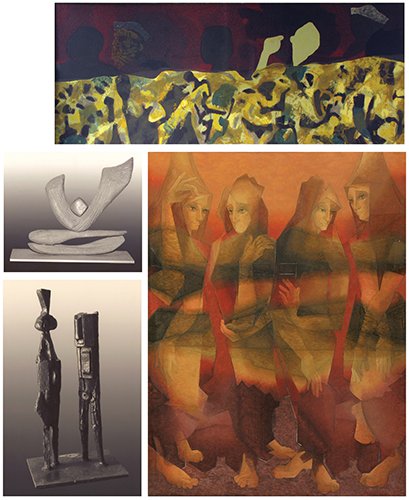
"My father never treated him with any reverence... It was always a bit of fun and games between the two” who were also Rotary friends, revealed Shireen. Dadiba remembered how Nicholson never wanted him to disclose to anyone that he had bought a particular work whilst ever keen to learn who the other buyers were! When Dadiba tried to withhold this information saying he had to likewise respect the confidentiality of other buyers too, Nicholson would retort: "I am different. I am not a normal collector.”
"Every time he saw a work, he would ask if it was worthy of ‘entering the portals of a museum,’” recalled Dadiba who commended trustees Guzder and Kaiwan Kalyaniwalla of JNAF for accomplishing his dream to see his collection housed in a museum. There was a period when seeing the prices of paintings escalating dramatically, Nicholson did not purchase any works. But suddenly in 1986 he bought one Ram Kumar work for Rs 18,000 and thereafter continued to add to his collection. Until the 1980s he trusted his own judgment but in the subsequent period he depended on others’ opinions, observed the second generation gallery owners. Dadiba remembers trying to convince Nicholson in vain to build on his core collection instead of pursuing "his obsession of buying one work of every ‘worthy’ Indian artist” and ofttimes of a female artist!
"You had many sporadic buyers who bought but he was consistent,” remarked Shireen. "For the amount of resources he had, he spent a huge portion of it on art...You have to give this man credit for his vision and dedication,” summed up Dadiba.
Affection for artists
This exhibition brought to mind the early struggles of many leading artists of today and the emotional and financial support they received at Chemould or Pundole. Laxman Shreshtha recalled that in 1963 when he was "struggling for a break... (Kekoo) offered to show my work knowing fully well that I was a newcomer... I have great affection and respect for both Kekoo and (his wife) Khorshed. I’ve learnt a lot from them.” Tyeb Mehta appreciated, "By ensuring a fixed income for me in the early years without pressuring me, Chemould helped me to remain independent and work my own way.” Declared Jehangir Sabavala on the occasion of Chemould’s 30th anniversary in 1993, "My association with the Gandhys has been extremely long, both professionally and as a family. There is no question that they are the pioneers. We have also had the mutual luck to have had sell out shows even in the ’60s and 70s.”
Artists have equally been in praise of Pundole: For Husain, the Pundole Gallery was not "the four walls where paintings are hung and people file past to pay last respects to the departed soul of art and culture... The paintings, when they enter the premises, feel they are wanted and cared for. Not merely a commodity to buy and sell but an identity of an enhanced human endeavor.” Declared Badri Narayan, "Kali genuinely believed that paintings should be acquired for love; unless an emotional chord was struck between the work of art and the viewer-buyer, a sale, whatever the price involved, lost its human credence.” Observed art critic Dnyaneshwar Nadkarni in The Independent in 1990, "Name any leading painter of the past 30 years and there is a greater chance of finding his work in a Pundole show than anywhere else.”
"A sponsoring gallery has a responsibility to the artist as well as to the art collector,” believed Gandhy, adding, "While we are always on the lookout for new talent, we have to be careful in selecting the artist we promote.”
"Is it, or will it be, a good investment? Right or wrong, that has never been my philosophy or interest,” declared Nicholson, adding, "Art for art’s sake; to acquire good art has been my desire, no matter the mistakes I may have made.”
Creative minds
"All three were united in their love for the city (Bombay) and their love for art,” observed Guzder at the first Jehangir Nicholson Memorial Lecture delivered on the collector’s birth centenary by Dr Homi Bhabha at the Coomaraswamy Hall at the Museum on January 19, 2015. Guzder was referring to Nicholson, Bhabha and Sir Howard Hodgkin whose paintings on display from February 20 to April 15 were the joint efforts of the POWM, Tate of UK, JNAF, the British Council and Gagosian Gallery, London.
To accommodate his growing collection in a "museum for the enjoyment of the citizens of Bombay” Nicholson searched fruitlessly for space. On his 10th death anniversary in 2011 Guzder and Kalyaniwalla succeeded with the assistance of then Museum director Dr Kalpana Desai and Mukherjee in creating the JNG in the East Wing of the Museum (see "The connoisseur collector and his collection,” Parsiana, December 7, 2011). With the assigned "storage space being as large as the Gallery,” the JNAF regularly displays his collection in sequence with corresponding programs in the form of talks, workshops for children, music and dance. The highlights of Nicholson’s collection, women artists, abstract art, Mohan Samant’s paintings, drawings of Ara, "Kekoo, Kali and Jehangir: Framing a Collection,” Nicholson’s photographs and the recently concluded Hodgkin show have been the themes of the first eight exhibitions at the JNG that have been possible with the assistance of their board of advisors constituting Dadiba, Hoskote and artist Mehli Gobhai, and curator Kamini Sawhney. Beginning April 24 the Gallery will exhibit the works of Ram Kumar in the Jehangir Nicholson Collection.
Each artwork that Nicholson acquired for his collection and ultimately dedicated to the citizens of Bombay "is a tribute to his taste, choice, generosity, empathy… a testament to his passionate engagement with the most creative minds of the city,” confirmed Bhabha, cultural theorist and pioneer of postcolonial studies who is Anne F. Rothenberg Professor of the Humanities at Harvard University. He vividly remembered the collector as "puckish and amiable... would dart in and out…” Under the joint auspices of JNAF and the POWM, Bhabha spoke "On the Art of Displacement” in the context of works by Zarina Hashmi and Anish Kapoor.
Displacement and relocation can be variously understood as "removal of a thing from its place, putting it at odds… In psychoanalysis it is interpreted as substitution of one idea for another and unintentional transfer of an intenser feeling for something of lesser consequence,” explained Bhabha. In drawing, "displacement is an ongoing process… the denial of destination is complex…There is neither a dead end nor a dead loss… There is freedom to extend the drawn line without reaching a summation or closure… A kind of destination without an end.”
Bhabha analyzed W. H. Auden’s Musée des Beaux Arts where the poet writes: "About suffering they were never wrong,/ The old Masters: how well they understood/ Its human position: how it takes place/ While someone else is eating or opening a window or just walking dully along…” He further pointed out the image of the lone leg in the painting Landscape with the Fall of Icarus and wondered: "In this world of instant connectivity, how far should one extend empathetic antennae. How good must the good Samaritan be?”
T. S. Eliot’s message in "Tradition and the Individual Talent,” was quoted by Bhabha to stress that the import of a work is relative for it is invariably compared to preceding and subsequent creations: "The existing order is complete before the new work arrives; for order to persist after the supervention of novelty, the whole existing order must be, if ever so slightly, altered; and so the relations, proportions, values of each work of art toward the whole are readjusted; and this is conformity between the old and the new.”
"Conformism enforces ignorance,” said Bhabha. "Art and culture are forced to be populist” and dwarfed by political pressure. Occasionally even in the process of religious learning, "art, language and culture are taken hostage.”
Nature of exile is a recurrent theme in Hashmi’s paintings. "Displacement is an integral part of her choice of technique” depicted by artistic materials and methods she employs whilst experimenting within the confines of her studio. Having witnessed primal displacement at the time of partition, seen villages in her native Aligarh burning, smell of rotting flesh and people dead on the street, she found refuge in Delhi. "Hope is inherent; without end but not without destination.”
To symbolize exile, Bhabha showed Hashmi’s depiction of the India-Pakistan border with a barbed wire, "a great dividing line… Border is not on land but is drawn in one’s heart… It is not a geo-political journey but a geo-temporal journey…attached to time,” he believed. He further referred to Husain’s insecurity as an artist when he was banished to a life of exile.
Kapoor’s art as a form of visual culture adopts the technique of montage to depict displacement. It justifies juxtaposition to fill in the blanks, leaving a viewer to frame the story. This is similar to literary craftsmanship where a continual montage creates a panorama.
Bhabha then cited a Harvard University Press publication The Ethics of Memory which raises questions like "Is the moral witness a forward looking creature when his testimony is so much of the past?… We live with our past which refuses to die whilst being confronted with a future which will not wait to be born.” The perils of the present requiring us to maintain a precarious balance, Bhabha concluded, "To survive is in itself an art of displacement.”
The exhibition "Howard Hodgkin: Paintings 1984-2015 A Tribute,” was put up in record time to coincide with the annual visit of 82-year-old Hodgkin to Bombay. This was also the first exhibition put up by the POWM in collaboration with Tate, remarked Mukherjee. Wheelchair bound, Hodgkin who was present at the opening of the exhibition by Tate director Sir Nicholas Serota was presented a shawl by the Museum chairman Eknath Kshirsagar.
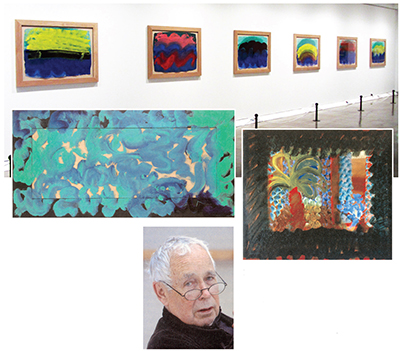
Britannia, Bombay (left), In the Garden of the Bombay Museum and other works by Howard Hodgkin
Hodgkin never belonged to a school or group, states his biography.The abstract works at the exhibition, all connected with India, included the largest painting Come into the garden, Maud, oil on wood, 74”x98”, loaned by Tate. Another imposing work was the black framed Britannia, Bombay in shades of blue, green and turquoise which was painted by Hodgkin on his current visit to Bombay. It is claimed that he has eaten at this Zoroastrian owned restaurant many times. Bombay audiences could also relate to Marine Drive and Marine Drive, Dusk, both gouaches on intaglio impressed Khadi paper (gouache is an artwork done with a special paint made of pigment, a binding agent and occasionally an inert material, used in an opaque manner; intaglio is a painting technique in which an image is created by cutting or carving or engraving into a flat surface). Art enthusiasts were also intrigued with In the Garden of the Bombay Museum, an oil on wood that evokes images of the palm fronds swaying in the breeze as viewed through the arched balconies. The British Council headquarters in Delhi, designed by Charles Correa, bears the front mural façade by Hodgkin, and its director Rob Lynes mentioned how pleased he was to go to work in such a building.
Most of Hodgkin’s work has "been made elsewhere, not India, and as is Hodgkin’s customary practice, from memory,” stated Shanay Jhaveri in the exhibition catalog. A few pictures completed in Bombay earlier this year were on display too. In fact, a few have already been purchased but with the consent of the buyers their delivery has been deferred until the end of the exhibition, revealed Robin Vousden of the Gagosian Gallery.