
Books
Rooted in reality
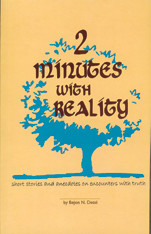
2 minutes with reality: short stories and anecdotes on encounters with truth by Bejon N. Desai. Published in 2011 by Embassy Book Distributors, 120, Great Western Building, Maharashtra Chamber of Commerce Lane, Fort, Bombay 400023; tel: 22819546/32967415; e-mail: info@embassybooks.in Pp: xiii+106. Price: Rs 150.
"To ‘become’ means to embrace ego! To ‘be’ means to embrace reality!” sums up author Bejon N. Desai in the preface to his book 2 minutes with reality. To face life with serenity he recommends the reader to develop "an open heart, a curious mind and a willingness to engage with reality.”
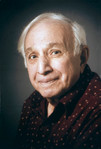
He forewarns the reader, "If we approach life with the expectation that nothing ought to interfere with our own predilections and preferences, we are likely to resist and reject much of what happens to us… We may not have the temperament or the spiritual maturity to greet every challenge with peaceful composure or to delight in whatever is God’s will. It takes trust in our teachings and our Master to welcome each new disruption in our life calmly…” More important than "what life deals out to us… is how we react to it.” Beware of the "murky past” that keeps a record of perceived injustices and insults and the "murky future” that seeks revenge. "Stay in the immediate present that is reality,” the author urges.
The book was launched by the commissioner of police for Nasik Vishnudev Mishra on Desai’s birthday as he entered the 87th year of his life on March 15, 2011 at the Gateway Taj Residency, Nasik, notes a press release. Senior businessman Deokisan Sarda highlighted the author’s life and his values while Vandan Potnis chief editor of Gavkari Press related his experiences with the author and his works. Potnis was among the many devoted students of Desai who was former principal of the Boys’ Town Public School in Nasik for 32 years. Manoj Tibrewala, also his student, was given due credit for getting this work published after glancing through his "guru” Desai’s diary that had recorded these experiences and thoughts.
The book is replete with stories and anecdotes, light in reading but rich in meaning. There is one account of the disciples who, when listening to the master’s teachings in parables, sought something more profound, only to be told "The shortest distance between a human being and truth is a story.”
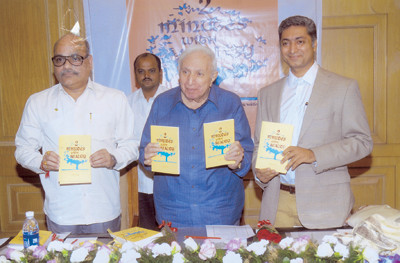
(Above and top): Bejon Desai flanked by Vishnudev Mishra (left) and Sohin Lakhani at book launch
Lessons that can be learnt from the lives of illustrious names like Swami Vivekananda, Swami Ramkrishna Paramhansa, Mahatma Gandhi, Lord Buddha, Moses, Sri Rama are included in the book. Some pages are devoted to the profound messages culled from religious scriptures like the Zoroastrian prayers Kerfeh Mozd and Ashem Vohu. Evolved souls like Sri Aurobindo, J. Krishnamurti, Dada J. P. Vaswani, Kabir, Eckhart Tolle, Khalil Gibran are also quoted.
To the often voiced query, "What is the necessity of offering prayers when every event in a person’s life occurs in a predestined manner by providence?” Desai equates prayers to an umbrella that will protect an individual from rain or sunlight although it will not stop the rain from falling or the heat from descending. He further cites a Persian couplet, "Zindagi barae bandagist, zindagi bin bandagi, sharmindagist (Life is for prayers; life without prayers is sorrow or shame).”
There is one account of Prince Noshirwan who was placed under the tutelage of Iran’s vazir Buzargchameher to make him physically and mentally strong. The young prince was once punished unjustly by this tutor, the reason for which he learnt only at the time of his coronation: to remind him to never dispense injustice to anyone who comes to him for relief.
The significance of different virtues are highlighted in an interesting way. To those in love, the advice was "Let there be space in your togetherness… for the pillars of the temple stand apart.” Stressing on patience the advice was, "The superintendent of a mad house cannot afford to be mad.” For those trying to ward off death the message was: "A person who is trapped in a dilapidated house will have to be brought out, sooner the better.” To those considering leaving their parents in homes for the aged, Desai reminds them to appreciate their unblemished love and sacrifice: "Suppose in your young age, they had admitted you in the orphanage, what could have been your condition?” Whilst comprehending the message imparted on different pages it is best the reader overlooks the grammatical errors and awkward syntax in some sentences.
Author of over 20 books including The Master and Thus Spake the Master, the saintly scholar who has made a comparative study of religions dedicates his latest book to Hazrat Kamu Baba Saheb and Ma Hazur Amina Banoo Saheb.
According to Desai, "Two things harm us a lot. One is our apathy to be in tune with nature and the other is to turn a deaf ear to the voice within and indulge in ignorant babbling like discussing religion and advising others.”
PARINAZ M. GANDHI
◆ ◆ ◆
From the archive