
Books
Solace through silence
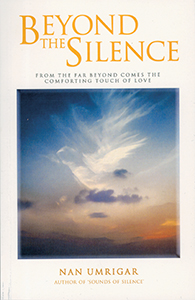
Beyond the Silence by Nan Umrigar. Published in 2013 by Yogi Impressions Books Private Limited, 1711, Centre 1, World Trade Centre, Cuffe Parade, Bombay 400005. Pp: x + 212. Price: Rs 350.
"Mum, I also have a dream… I dream that my Baba’s name go far and wide…that the way He functions be publicized to the farthest corners of the world,” noted a purported message from Karl, who had passed away in a riding accident at the race course over three decades ago. Transmitted through auto writing to his mother Nan Umrigar, this communication is the frontispiece of her new book Beyond the Silence. Whilst attempting to fulfil his dream, in this third book in the "Silence” series the author has made a conscious effort to impart her understanding of suffering and the coping mechanism, constantly drawing on Meher Baba’s life and message.

Nan Umrigar: help to grow
Her trilogy commenced with Sounds of Silence where she related how Meher Baba came into her life after the passing away of Karl and how auto writing helped her to reconnect with him. The second in the series was Listening to the Silence where she expressed her turmoil as also the conflicts encountered and resolved by those who came in contact with Meher Baba.
"Beyond the Silence explains how Baba gives us what He has to give in Silence, without saying a single word. It is in the silence of our perfect surrender that Baba’s Silent Love flows to us,” notes the author in her Introduction. To mitigate the fear of death, give hope to the grieving and peace to those who have crossed over the threshold "this book is filled with episodes of so many people who have been struck by tragedy and difficult life situations, and how they have…been guided and helped to grow in the most amazing ways…”
 In the chapter titled "Baba’s Silence,” the reader learns that for the last 44 years of his life Meher Baba observed silence expressing, "Instead of practicing the compassion He taught, man has waged crusades in His name. Instead of living the humility, purity and truth of His words, man has given way to hatred, greed and violence. Because man has been deaf to the principles and precepts laid down by God in the past, in this present Avataric form, I observe silence.” In what may appear as a contradiction, Meher Baba is later quoted: "I am never silent. I speak eternally. The voice that is heard deep within the soul is my voice — the voice of inspiration, of intuition, of guidance. To those who are receptive to this voice, I speak.”
Umrigar refers to the fall that she had on Meher Baba’s amartithi (death anniversary), January 31, 2007 that left her with a broken femur, a fractured ankle and a series of surgeries. Questioning Baba’s love, she candidly admits that even the knowledge of karma receded in the background when she was flooded with pain. This incident that was mentioned in the Introduction of her second book, is repeated in the first chapter of the current book. According to Umrigar’s explanation, "People suffer for their own karma, Masters suffer for humanity, and the Avatar suffers for each and all in creation.”
Trying circumstances are only opportunities for growth, asserts the author who believes, "The only choice we really have is whether to react to a situation by assuming a victim’s role, or respond to it with understanding and wisdom, recognizing it as a fruit of the seed we have sown in the past, and learn to go beyond.” Sensitized to the needs of differently abled individuals from a young age (Umrigar’s youngest sister Dina was born with Down’s Syndrome and their mother Jai Vakeel had founded The School for Children in Need of Special Care which is today managed by their elder sister Tehmi Shroff), the author is able to establish a rapport with such families and guide many to Meher Baba’s sanctuary.
"To be able to share ‘silence’ is the greatest gift of all. Words speak and actions speak, but when silence speaks, it’s the purest form of communication …for it is in silence that the heart speaks and the heart hears!” This message from Rohan brought relief to his parents who were grieving the loss of their differently abled 11-year-old son who, during his last brief sojourn on earth, could neither hear nor speak, neither read nor write but only communicate through his eyes and touch. Before Rohan’s mother was reportedly able to establish contact with him through auto writing, she was relieved to get a confirmation from Karl, "Rohan took on this very difficult journey for a reason. He chose his parents accordingly, and you have fulfilled every single need that he had…”
As explained by her, "Auto writing is the art of contacting other intelligences through the use of pen and paper, while in an altered or meditative state of consciousness… There are normally three types of contacts or connections you can make — with your higher self, other loving entities or your own spirit guide.” Having practiced auto writing for "almost every single day for 27 years,” Umrigar sees this as an avenue to stay connected with Meher Baba, Karl, her husband Jimmy and bring "thousands of other people into Baba’s fold. I have taken them to the Samadhi, helped them find solutions to their problems and given them a reason to live…”
Knowing that Meher Baba had "certain reservations about His followers connecting with the spirit world and people becoming attached to the occult,” Umrigar cautions, "I do not ever encourage young or emotionally disturbed people to start on (auto writing) as a regular exercise for it sometimes draws one away from reality and keeps one engrossed with the unknown. It makes one dependent on what is going to be instead of what is, and one stops making choices for oneself.”
Baba’s life story narrated in one chapter refers to his birth to Shireen and Sheriar Irani in 1894. As a child he was alert, fast and mischievous with his friends calling him ‘Electricity.’ There were several spiritual masters who recognized his divinity and by age 27, his consciousness was considered totally awakened. He earned the name ‘Meher Baba’ meaning the compassionate father from one of his Mandali members. Although loving, he was also a strict disciplinarian and his motto was "mastery in servitude.” He declared, "I belong to no religion. Every religion belongs to Me… the religion I teach to all is love for God…”
The avatar is known to have personally supervised the construction of his tomb at Meherabad, in Ahmednagar, and to have sat inside its crypt in prayer and meditation to build vibrations that have brought solace to generations of pilgrims who have been visiting his Samadhi for the last 44 years. The words inscribed on his tombstone read: "I have come not to teach but to awaken.”
Among the many individuals who attest to being inspired by Meher Baba’s divinity was Merwan Masters: "He was what we call a ‘mad Parsi’ and a devout follower of Zoroaster, who would visit the agiary almost every day. Therefore Meher Baba had no meaning for him.” The story of his transformation, from being brusque to benign, is sympathetically related. In the chapter on "Baba’s Grace” Shahnaz Jehani narrates how on November 26, 2008 when there were terrorist attacks in Bombay, her husband Farzad and brother-in-law Farhang who own Café Leopold were believed to be saved by Baba’s grace. Unaware of the firing in the restaurant below, they were watching a cricket match on television at the bar above. The book carries a visual of the windscreen of their Prado that was shattered with bullets but bore an image of Meher Baba.
"Her books are like delicious little soufflés,” commends Member of Parliament Maneka Gandhi, adding, "They are sweet and full of fun and grace – as the universe is. The only way they can be judged is by the yearning they awaken in you to find Meher Baba, and the Meher Baba within you.”
◆ ◆ ◆
From the archive