
Seminar
Enigmatic epic - VI
he Shahnameh’s themes, viewed over the centuries, reveal later aspirations and ethics
The shadow of the SN
The Shahnameh’s (SN) many facets were examined by international scholars at the seminar hosted by the K. R. Cama Oriental Institute (KRCOI) on January 8 and 9, 2011. Parsiana presents synopsis of their papers in six installments beginning with a review of the many celebrations of the epic a thousand years after it was composed (August 7, 2011). Subsequent installments dealt with the Parthian influence and the poet’s concept of evil (August 21, 2011), some of the sub-plots in the poem that spans human memory from prehistory to the fall of the Sasanians (September 7, 2011) and conflicting perceptions of Alexander (September 21, 2011). The art and illustrations that the epic spawned were discussed in the October 7, 2011 issue. This concluding instalment deals with the treatment of some of its themes from different perspectives, different cultures and why an epic is an epic.
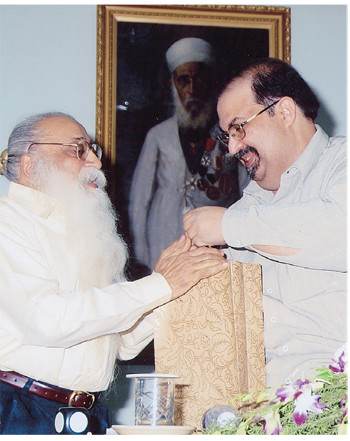
Muncherji Cama (R) presenting token of appreciation to S. A. Upadhayaya
"The stories and narratives of the SN in different forms of literature produced in the later periods, filled Iranians with pride. The Iranians repulsed Arab and Turkish influence in history and always enjoyed ethical and spiritual superiority over them. Interestingly, not a single Persian book on literature, history and culture can be seen without minor or major reference to the SN,” noted Dr Syed Ainul Hasan, professor of Persian at New Delhi’s Jawaharlal Nehru University. He was speaking of the "Rise of the Simurgh in the SN.”
According to Hasan the Avesta speaks of it as a bird with huge wings, its shadow covering the mountain when in flight. Calling it "a model of devotion towards the spiritual master,” it lives at the peak of Mt Albourz. At the base of this mountain was abandoned baby Zaal because his father Saam could not face the ignominy of siring a child who looked like an old man with white hair. Spotting the unprotected infant the giant Simurgh lifts him to her abode, raising the child to "grace and grandeur” along with her own progeny.
Cursed in a dream, advised by the mubads to repent for his ungratefulness to God, Saam and his army go in search of the child and are guided by the benevolent bird to find the beautiful Zaal resting in her nest.
Hasan cites mystic Sufi literature, specifically The Conference of the Birds, an epic allegory of the seeker’s journey to God. "When all the birds of the world convene and determine that they lack a king, one bird offers to take them to a great and mighty monarch.” Initially excited, the birds falter in turn along the way while the leader admonishes them with "well-targeted parables.” Their journey through seven valleys takes its toll of their psyche until only 30 reach the goal but there is no Simurgh to be seen. They wait long enough before they realize that they themselves are the Si(30) Murgh (birds). "The present and future lives of the 30 successful birds become shadows chased by the celestial sun. And they, lost in the sea of his existence, are the Simurgh.” Among the many who followed in Ferdowsi’s footsteps was Avicenna, the great Arab doctor, scientist and litterateur who, "while discussing the journey of the soul to its ultimate destination, considers the pain and anxiety of a bird which is trapped by the hunter who allows the rest of the birds to fly away in search of their king.”
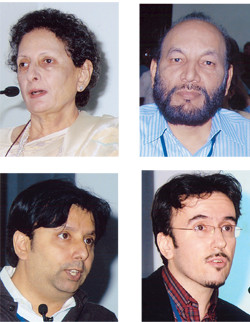
Alongside (clockwise from top left) Drs Nawaz Mody, Syed Ainul Hasan, Evangelos Venetis and Sunil Sharma
The warrior woman
Dr Evangelos Venetis, senior associate at the Department of Arabic, Persian and Turkish at the University of Leiden, sought to establish the connection between the SN literary tradition of Persia and the Digenes Akritas, the Byzantine epic poem which shares various motifs, especially the "protagonist’s profile and the literary motif of warlike women.” The storyline of the poem deals mostly with the Arab-Byzantine conflicts spanning the 7th to 11th centuries and the role of Akritai, the Byzantine frontier guards.
Consisting of two parts, the first relates to the union of Digenes’ Arab emir father and aristocratic Byzantine mother because of which he personifies Arab-Byzantine political antagonism and cultural coexistence, encompassing multiethnic principles and cosmopolitan landscape. The second part deals with the development of the young hero and his superhuman profile — slaying bears and lions bare-handed and killing a dragon on his way to adulthood, says Venetis. Openly compared to Alexander the Great, the deed of killing a dragon however is unusual in Greek literature and very common in Persian literature. The sequence in which Akritas accomplishes his deeds are reminiscent of Rustom’s from the SN, notes Venetis. Of additional interest is that he receives Khosrow’s famous sword as part of his bride’s dowry although it is not known whether this detail comes directly from the SN or via other sources. Also in the end Akritas is laid in a magnificent tomb, "exceeding that of the Persian king and his queen in Pasargadae… The fact that Akritas is compared with the Persian king in terms of valor and… Pasargadae is mentioned (suggesting a reference to the tomb of Cyrus the Great), raises the possibility of it being a remnant from an Iranian story,” perhaps going back to Achemenid times, notes Venetis. This "association with the Persian royal tradition through specific symbols (sword and tomb) reveal an inner connection between the two traditions,” he suggests.
Noting that the warrior woman motif is common to many literatures, Venetis describes it as a love metaphor. Typically the warrior woman is skilful in combat, and personifies the model of a desirable woman: young, beautiful, deceitful, energetic and unchaste. In the Byzantine account the hero meets Maximou, disarms and defeats her quickly and is seduced by her — one of two instances in Akritas’ life when he is unfaithful to his young and beautiful wife. Venetis attributes Maximou’s presence in the narrative to the influence of the ancient Greek tradition of the Amazons who were introduced to Greece by Alexander after his Indian foray. However, such women were also very much a part of the Arab tradition.
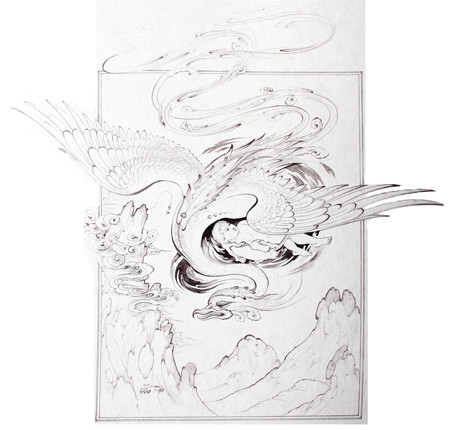
The Simurgh (Courtesy: Tableaux from the Shahnameh, K. R. Cama Oriental Institute)
Mughal manuscripts
While familiarity with the canon of Persian literature was a feature of princely and aristocratic education in all Persianate regimes and would include the standard classics of Anvari, Hafiz, Nizami and Amir Khusrau as of course Ferdowsi, Dr Sunil Sharma notes that while the other works were read, copied and imitated for their literary and artistic value, "the SN is believed to have a symbolic significance in the life of the Persianate courts, connected to establishing legitimacy and inserting oneself into Iranian history.”
The associate professor of Persianate and Comparative Literature at Boston University however points to a disjunct of the Mughal court from its other predecessors, contemporaries and followers. Quoting art historian Som Prakash Verma, he notes that many of these Persian favorites found scant place in the Mughal atelier. "A case in point is that of the SN of which no illustrated manuscript from the Imperial Mughal school is known.”
Nonetheless, "The treasure trove of Timurid books, like crown jewels, were perceived as part of the ruling elites’ imperial charisma: symbols of current role and reminders of a fabled past,” Sharma quotes from Timur and the Princely Vision: Persian Art and Culture in the Fifteenth Century by Thomas Lentz and Glenn Lowry. He goes on to add, that the SN produced for the Timurid prince Muhammad Juki c 1444 was a prized Mughal copy and bears the ownership seals of five emperors including those of Babur (1526-30) who originally brought the manuscript from Herat to India, Shah Jehan (1628-57), whose handwritten note is in it about the manuscript entering the royal library on the day of his accession to the throne, all the way to Alamgir (1658-1707).
There are records of the SN being presented as gifts to Jehangir, Shah Jehan, Prince Murad and Alamgir. The lacuna which art historians have not been able to explain is the lack of any such edition from the art studios in Akbar’s time. One suggested reason for the lack is its loss over the years, a supposition based on the existence of five dispersed paintings which may have belonged to one or more than one manuscript of the time. Three of these five paintings do not have any text on them, while two of them do, one being in prose.
"Mughal sources mention both Akbar’s interest in the SN as a book of stories with entertainment and didactic value and also a work of which a copy was commissioned by him,” notes Sharma, adding "If it is true that Akbar was illiterate, it would explain why he was fond of listening to a broad range of classical Persian texts,” according to a list provided by Abu al-Fazl. However, he argues that the production of an Akbari SN must be seen in the larger context of the late 16th century when the emperor’s interest shifted to Sanskrit classics in his large multicultural empire, when the Mahabharata was translated (1582-84) into Persian and the translation of the Ramayana began in 1584 and was completed in 1588-91.
At the beginning of emperor Jehangir’s reign, with few large projects in the offing, artists from the imperial studio migrated to the courts of governors, generals and others like the merchant class who set out to imitate imperial sponsorship of the arts. Pramod Chandra has coined the term ‘popular Mughal art’ to denote the breadth of its class of patrons, notes Sharma. One manuscript that wound its way from the imperial atelier through several owners to that of the Mughal general Abdul Rahim Khankahnan was refurbished in the latter’s studio and now rests in the British Library. However, with the arrival of the empress Nur Jahan, an Iranian, in Jahangir’s court, tastes reverted to Persian classics including the SN. This led to the creation of pseudo-SNs, contemporary history being couched in the style of Ferdowsi. In Shah Jehan’s time artistic energy was directed towards condensing and abridging the SN and producing epics of which the emperor was the hero, notes Sharma.
"Confronted with the vastness and complexity of their empire and its heterogenous traditions, the Mughals felt a greater need to measure and support their imperial authority with a carefully constructed image of rulership,” Sharma quotes art historian Ebba Koch.
Thus there were all kinds of SN texts in circulation which did not form part of a copy of Ferdowsi’s original. In those times it became an export item, much like the handicrafts of Kashmir today, notes Sharma. For non-Muslims in India it lacked the cultural associations which they had with the Ramayana and the Mahabharata.
Valedictory
Though Jawhar Sircar, secretary to the Government of India’s Ministry of Culture was billed for the valedictory address, he was unable to attend and the last minute breach was ably bridged by veteran scholar S. A. Upadhyaya, director of the Bharatiya Vidya Bhavan and trustee of the KRCOI. Upadhyaya’s discourse concentrated on all that is basic to all epics and asked "Why is a pre-modern text popular in the post-modern period? Why are (such texts) all alive? Why do we read them again and again?” and proceeded to answer his own questions.
"The author of an epic is not only a poet but a rushi, one who can see the future in time as well as the depths of the human psyche,” he noted. "Epics deal with dharma — humanism. What makes a human being a human being. What makes you a virtuous person. It is not something stagnant. Change is the law of life and also the life of law for dharma’s one meaning is law. Search into your heart, look within. Like world religions the epics too teach the same thing: cosmic allegory, the fight between right and wrong at the human level, the weakness, the crisis of confidence… to know what is the truth; but to be unable to practice it.
"Every individual has two viewpoints: the impersonal one that knows what is the right thing to do; and the personal one colored by emotion and greed. These viewpoints are always in conflict which the epics display… Epics show how we go from the substantial to the essential, from diversity to unity. They show the heart and the head. They teach introspection: we are caught up in grief and violence because of our inability to subdue our baser elements…
"Righteousness is basic to Man; the consequences of virtues are often more important than virtues themselves. The epics are full of subtleties and stories of individual moral courage. Study them, not only from the historical and mythological levels, but from life…”
Dr Nawaz Mody’s vote of thanks began with a reference to KRCOI president Muncherji Cama: "Without the kind of support I’ve received from the president, this seminar would not have happened.” She was also lavish in her appreciation of Meher Mirza who designed the beautiful souvenir and the printers, donors, KRCOI staff, Perveez Aggarwal’s display of fabrics that added a decorative touch to the newly renovated Dr Sir J. J. Modi Hall, Kersy Treasuriwala’s handling of the transport and dinners at the Yacht Club as also the well balanced lunch boxes catered by Shirin Adenwala. Concluded
◆ ◆ ◆
From the archive