
Law
“Subject to grave abuse”
Excerpts from the March 11 judgment delivered by Justices (Dr) D. Y. Chandrachud and Anoop V. Mohta defining the power of the Bombay Parsi Punchayet trustees
Having carefully analyzed the deed of trust, we do not find that there is any provision therein that would empower the trustees to prevent a duly ordained Zoroastrian priest from performing the obsequial rites so long as the rites are rendered for a member of the Parsi community professing the Zoroastrian religion and the rites and ceremonies accord with the tenets of the faith. The trustees cannot exert a power to exclude where these conditions are fulfilled.
The Court would not be justified in conferring upon the trustees a power to exclude a duly ordained Zoroastrian priest from performing obsequial ceremonies for a Parsi Zoroastrian in accordance with the religious rites and ceremonies of the faith. Such a power has not been conferred upon them by the deed of trust. Reading any such power into the deed of trust in the absence of explicit provision or, at any rate one which arises by necessary implication, would be impermissible. Worse still it is likely to be subject to grave abuse…
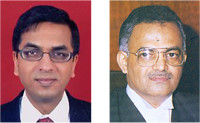
Justices (Dr) D. Y. Chandrachud (left) and Anoop V. Mohta
The cohesiveness of a faith is maintained by dialog, not division. The impassioned plea of the appellants even before this Court for a recourse to reason has only been met with reprisals — reprisals against the appellants, the interveners and their counsel…
The fact that the two priests have chosen not to file proceedings of their own to challenge the ban cannot, by any means, be regarded as precluding the appellants as beneficiaries of the Trust from seeking an interpretation of the deed or a determination of the rights of the beneficiaries. The ban undoubtedly penalizes the two priests by subjecting them to an exclusion from administering religious rites and ceremonies at the Towers of Silence. Implicit in it is a veiled threat to others against the reprisals that may follow, if they were to adopt a course of conduct which the trustees do not countenance. The beneficiaries are aggrieved because the clear consequence of the ban which has been imposed by the trustees, is to deprive them of the choice of a priest in whom they have faith, ostensibly because of the conduct of the priests outside the Towers of Silence. The consequence of allowing the action of the trustees to pass muster would be to confer upon them an arbitrary power to exclude; a power which may well be wielded to exercise control over the beneficiaries themselves. This is more than exemplified by the distressing developments that took place during the pendency of these proceedings.
The appellants (Jamsheed Kanga and Homi Khusrokhan) are citizens of the State and Parsi Zoroastrians with an impeccable record of service…
The appellants have been supported in the appeal by five interveners (the late) Dr Keki Grant, Tehmtan Andhyarujina, Dr Rustom Soonawala, Dilnavaz Variava, Anu Aga. Each of them has a distinguished record of service to the nation in the walks of life that their paths have travelled. The respondents have launched upon an unfortunate tirade against these members of the Parsi Zoroastrian community. Even the counsel appearing on behalf of the appellants and the interveners have not been spared. We record our disapproval to the innuendos leveled against a distinguished former judge of this Court and the Supreme Court. Besides being unfounded, they have been leveled without a sense of responsibility…
Out of a concern for judicial propriety, we have considered it proper not to advert to all the details of the unseemly attacks on the appellants, the interveners and the senior counsel (Iqbal Chagla) in this judgment. Conferring upon the trustees such broad powers of exclusion (even though they have no such power in the deed of trust) would result in a grave affront to basic human rights and individual dignity. Life and death, we believe often lie beyond human choice. The trustees must be left to govern in the secular province that the trust deed has created for them. The trustees cannot arrogate powers to themselves in a mistaken belief that they are custodians of the religion. Religion and faith reside in the hearts of the multitude for whom devotion to the faith is a matter of conscience protected by Article 25 of the Constitution. That sense of faith and commitment to a religion as profound in its philosophy as the Zoroastrian faith cannot be subverted by the trustees. At least the Court cannot be a party to encouraging religious obscurantism…
The judgment appealed against
The learned single judge has in our view, with respect, erred in coming to the conclusion that "the issue would involve interpretation of what are religious ceremonies which are to be performed in the properties of the trust.” With great respect, this was not an issue which fell for determination at all… Similarly, the learned judge, with respect, was in error in holding that the appellants had called upon this Court to indirectly decide upon the cause espoused by them, namely, the cremation of the dead and seeking a declaration that such a practice would not be irreligious. The question as to whether the cremation of a dead body is or is not acceptable to the Zoroastrian faith and the circumstances in which it is acceptable or otherwise does not fall for determination in the Originating Summons. Conscious as we are of the parameters of the jurisdiction of the Court on an Originating Summons, we are of the view that the case of the appellants fell within those parameters and not outside…
We accordingly dispose of the Originating Summons in terms of the following interpretation and determination: (a) Under the deed of trust of 1884, the trustees are not entitled to prevent any duly ordained Parsi Zoroastrian priest from performing Zoroastrian religious rites and ceremonies in the premises of the Towers of Silence (Doongerwadi) and the two agiaries; (b) The trust deed does not empower the trustees to restrain Parsi Zoroastrians in their choice of a duly ordained Parsi Zoroastrian priest to conduct Zoroastrian religious prayers and ceremonies at the Towers of Silence (Doongerwadi) and the two agiaries; (c) The purported ban imposed by the trustees on Framroze Mirza and Khushroo Madon was not within the power and authority of the trustees under the deed of trust; (d) The trustees are accordingly directed to forthwith abstain from taking any action in pursuance of the purported ban or in the implementation thereof and to remove all notices and withdraw all instructions to that effect.
Dr D. Y. Chandrachud, J.
Anoop V. Mohta, J.
I. M. Chagla, senior advocate with F. E. Devitre, senior advocate with Jimmy Avasia and Yugandhara Khanwilkar i/b Rashna Dastur of M/s Dastur, Dadhich and Kalambi appeared for the appellants; R. A. Dada, senior advocate with Percy Ghandy i/b Khushroo Driver, Rati Amrolia and Yasmin Katpitia of M/s KRY Legal appeared for the respondents; E. P. Bharucha, senior advocate with Karl Tamboly i/b Kartikeya and Associates for intervener; N. G. Thakkar, senior advocate with R. G. Seth i/b R. G. Seth and Company for intervener.
◆ ◆ ◆
From the archive