
Books
Sporting chronicles
Cricket and Beyond by Gul-Fraaz Ezekiel. Published in 2011 by Ocean Books Private Limited, 4/19, Asaf Ali Road, New Delhi 110002. Pp: 183. Price: Rs. 250.
A passionate sports fan, a prolific sports writer, Gul-Fraaz Ezekiel’s articles are always thought provoking and well researched. In sports circles he is popularly known as Gulu Ezekiel, always candid in his opinions and renowned for his well-researched sports articles, pithy comments and racy style of writing.

Gul-Fraaz Ezekiel: insightful chronicler
Of mixed parentage, Ezekiel has a Parsi mother from whom he has inherited his intense passion for food, travel, sports, the good things of life and essential compassion, which is evident in all his writings. A versatile journalist he has written on space travel, science fiction, international relations, food, travel, music but his ultimate achievement is sports writing.
Creditably during his over three decade long career as a sports journalist he has meticulously maintained records and published many sports books. Quality sports literature is rare in India and Ezekiel has done his best to fill that void. The current book is his 14th and contains a selection of 40 of his best articles published during his long and illustrious career.
Cricket writing being his forte, the bulk of the articles are understandably on that game. However, he has also done full justice to his other passion, the Olympics, and there are five very thought provoking essays on the greatest sports show on earth. As expected, one of them is on Milkha Singh’s exploits in the 1960 Rome Olympics, when the "Flying Sikh” narrowly missed a bronze medal in the 400 m final, even though he broke the existing Olympic record. Quoting extensively Ezekiel gives a fascinating insight into Singh’s achievements as an athlete and his narrow miss at the Rome Olympics.
The author has also profiled another Olympic hero, the Anglo-Indian Norman Pritchard (winner of silver medals in the 200 m and 200 m hurdles in the 1900 Paris Olympics). Ezekiel aptly brings out the dispute about whether Pritchard’s medals should be credited to India or to England. He also traces the athlete’s remarkable acting career on the New York stage and in several silent Hollywood movies with a changed name, Norman Trevor.
The other three articles on the Olympics deal with contemporary issues, the rise of China, the inability of India despite a vast population to achieve much success in these quadrennial Games, some Olympic scandals and the lifting of the ban on professional sportspersons in the Olympics from 1988 onwards.
There are also chapters on athletics, tennis, hockey (decline of Indian hockey), on Narain Karthikeyan as India’s first global car racing hero, on Gary Kasparov and his abrasive behavior during his reign as the undisputed world champion in chess and a paean to the one of the world’s greatest sporting icons, the incomparable boxer Mohammed Ali. Ezekiel had the good fortune of meeting Ali in Madras in 1988 and the article is his tribute to the all time great boxer on his 50th birthday.
But, back to cricket. On the popular Indian Premier League (IPL), Ezekiel has been very perceptive and not taken a populist view. He has not only traced the origins of limited overs cricket but also warned that such a format can make cricketers mercenaries and lead to early retirement as players may opt to play for their IPL franchises rather than tour with their respective countries. What makes Ezekiel’s essays interesting is that besides being topical they also have a lot of historical research, which shows up the difference in attitude of say Sir Garfield Sobers and Vinoo Mankad (who played as professionals in England) with today’s generation of "freelance cricketers.”
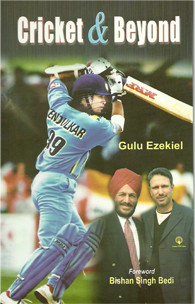
Ezekiel’s articles reflect the changing ethos of the game in the last few decades, the boycott of matches in Colombo during the 1996 Wills World Cup due to a car bombing and attempted terrorist attack on the Sri Lankan team during their tour to Pakistan. He also provides in-depth profiles of the enigmatic but brilliant V. V. S. Laxman (bitterly hurt at being dropped for the 2003 World Cup), the flawed genius Brian Lara and the rise of M. S. Dhoni.
Some of his finest pieces are on Sachin Tendulkar. Ezekiel reveals incidents which show Tendulkar’s gutsy attitude and innate talent even as a teenager on his first tour of Pakistan in 1989, his preparations for the 1998 series against Australia and the pressures he faces every time he bats. Using clever comparisons with other sportspersons, Ezekiel aptly says, "The pressures? Think of David Beckham — and multiply it by at least a hundred. For Indians he is Tiger Woods, Michael Jackson and Barry Bonds rolled into one.”
A professional chronicler, Ezekiel shows Tendulkar’s low points also, like his two unhappy stints as captain of India in the late 1990s. The author also cites instances to show that Tendulkar has often been troubled by left arm spinners like England’s Ashley Giles and Zimbabwe’s Ray Price.
Reasonably priced, the book is a delight for the serious sports lover, the casual fan and the sports historian alike as it provides insights about several sporting legends and changing trends in various sports during the last few decades. Each chapter is further embellished as Ezekiel gives a brief background about the personality he is writing about or events like the enduring myths of India-Pakistan cricket tours.
NOVY KAPADIA
◆ ◆ ◆
One reader wrote
One more great achievement to share,one of the great Indian sons who represented India in 1960 Olympics in Rome,in the field of cycling was a parsi,he was Sam Daruwalla.
From the archive