
Zoroastrians Abroad
Striking silver
Newly on view in the South Asian galleries of the Asian Art Museum of San Francisco is a recently acquired silver bowl featuring a Zoroastrian motif. "Made in a Burmese silver shop for a well-to-do Parsi family, this impressive bowl measures more than a foot in diameter and was meant for use in an annual ceremony honoring deceased relatives,” it was reported on www. asianart.org/blog/index.php/tag/burma/ This antique silver bowl, dating approximately 1875, bears an asho farohar with a recurring Zoroastrian theme. "The events depicted on this bowl are well known in Persian sculptures. Perhaps most notably compare this bowl against the famous relief and inscription of Darius I located at the UNESCO World Heritage site of Behistun,” mentions the blog that was brought to Parsiana’s notice by Mitra Sharafi, assistant professor of law at the UW Law School in Madison, USA.
The blog carries images of both the bowl and the relief of Darius I located on Mount Behistun in the Kermanshah province of western Iran. The bas-relief, described by Wikipedia as being up a limestone cliff from an ancient road connecting the capitals of Babylonia and Media (Babylon and Ecbatana, respectively), shows Darius I holding a bow as a sign of kingship, with his left foot on the chest of a figure lying on his back before him. The supine figure is reputed to be the pretender Gaumata. Darius is attended to the left by two servants, and 10 one-meter figures stand to the right, with hands tied and rope around their necks, representing conquered peoples. One figure is believed to have been added after the others were completed, as was Darius’ beard, which is a separate block of stone attached with iron pins and lead.
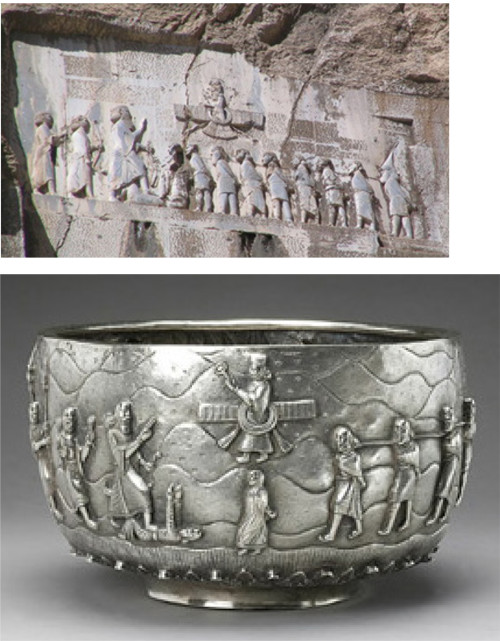
Engraving on the silver bowl (above) and the bas relief of Darius I on Mount Behistun (top)
The accompanying multilingual inscription in Old Persian, Elamite and Babylonian is reported to be authored by Darius the Great sometime between his coronation as king of the Persian Empire in the summer of 522 BC and his death in the autumn of 486 BC. The inscription begins with a brief autobiography of Darius, including his ancestry and lineage. Subsequently narrated is a lengthy sequence of events commencing with the deaths of Cyrus the Great and Cambyses II, followed by the 19 battles fought by Darius in a period of one year to quell multiple rebellions throughout the Persian Empire. Ultimately Darius proclaimed himself victorious, attributing his success to the "grace of Ahura Mazda.”
The acquisition of the priceless silver bowl was "made possible by the Zarthosti Anjuman of Northern California, Rati Forbes, Betty N. Alberts and members of the board of the Society for Asian Art (SAA) in honor of past president Nazneen Spliedt,” states the blog. While Nazneen served as president of SAA from 2006-2008, her husband Ehler is the current president for the year 2010-11.
The dimensions of this bowl are quite different from the one which was in the collection of the Alpaiwalla Museum run by the Bombay Parsi Punchayet (BPP), maintains curator Nivedita Mehta. The bowl from the Alpaiwalla Museum went missing following a break-in over two decades ago.
The Asian Art Museum of San Francisco is "one of the largest museums in the western world devoted exclusively to Asian art. But we are more than just an art museum — we are your ticket to Asia. Here you can travel through 6,000 years of history, trek across seven major regions and sample the cultures of numerous countries,” states its website adding, "Well-known in the scholarly world, the collection contains rare and exceptional objects which are often referenced in journals and textbooks. The collection includes approximately 17,000 objects ranging from tiny jades to monumental sculptures, paintings, porcelains and ceramics, lacquers, textiles, furniture, arms and armor, puppets and basketry.”
◆ ◆ ◆
From the archive