
Events & Personalities
Fracas over farohar
As a result of the public interest petition filed in the Calcutta High Court by Darayas Bapooji, president of the Parsi Zoroastrian Association of Calcutta, YouTube has withdrawn the music video starring Iranian singer Amitis Moghaddam and Calvin Cordozar Boradus Jr, popularly known as Snoop Dogg, which community members felt was blasphemous and showed disrespect for the sacred farohar symbol displayed as a backdrop, reported The Times of India (TOI) in its Calcutta edition on July 15, 2015. Advocate Phiroze Edulji served notice to the website and now he, along with Bapooji and others, want the government of India to ban the video to protect the religious rights of a "microscopic minority.”
"Not only does the video feature stripper poles and skimpily clad women smoking hookah in front of the farohar, but also stars Snoop Dogg sitting on a throne underneath it. The respondents were well aware of the farohar and the religious sentiments that the Parsi Zoroastrians attach with it as Amitis Moghaddam is of Iranian descent. (She) was born in Mashad, Iran but is now based in Atlanta, US. Ironically, (she) has been named after the princess who married…Cyrus the Great… The said video is insensitive towards the religious beliefs of one of the oldest monotheistic religions in the world,” Edulji submitted in the petition, mentions TOI.
"Not only does the video feature stripper poles and skimpily clad women smoking hookah in front of the farohar, but also stars Snoop Dogg sitting on a throne underneath it. The respondents were well aware of the farohar and the religious sentiments that the Parsi Zoroastrians attach with it as Amitis Moghaddam is of Iranian descent. (She) was born in Mashad, Iran but is now based in Atlanta, US. Ironically, (she) has been named after the princess who married…Cyrus the Great… The said video is insensitive towards the religious beliefs of one of the oldest monotheistic religions in the world,” Edulji submitted in the petition, mentions TOI.
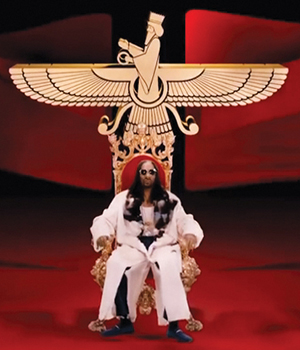
Snoop Dogg seated below farohar symbol
"The wrong use of religious and sacred symbols and iconography hurts, insults and outrages the religious sentiments and beliefs of Parsi Zoroastrians. The lyrics of the song have nothing to do with Zoroastrianism. The farohar should be revered and respected as the Christian cross, the star of David and om, the religious symbols of other religions. All over the world, people respect religious symbols. The farohar, a sacred symbol for the Parsi Zoroastrians, does not belong to this song,” the petitioner stated.
According to Wikipedia, "Though one of the best known symbols of Zoroastrianism… the winged disc has a long history in the art and culture of the ancient Near and Middle East. Historically, the symbol is influenced by the ‘winged sun’ hieroglyph appearing on Bronze Age royal seals. In Neo-Assyrian times, a human bust is added to the disc, the ‘feather-robed archer’ interpreted as symbolizing Ashur (an Egyptian god).” The farohar was first seen in early Mesopotamian and Egyptian reliefs long before it was adopted and adapted by the Persians to represent the Iranian nation.
Regarding the objectionable video, London based independent researcher on Zoroastrianism Farrokh Vajifdar writes: "The beguiling aspect of a delectable young lady draped languorously, cooing words suggestive of a surfeit of worldly luxuries, surrounded by scantily clad handmaidens and fanned by strapping young males…comes to an abrupt halt and a rude awakening by the unwelcome appearance of an uncouth, repulsive individual enthroned beneath a farohar symbol seen amidst billowing wreaths of some exhaled hallucinogen, claiming to be the sought-after king of the singer’s aspirations. It is nothing short of a wholesale, gross perversion of the great King Darius’ pious regard of the Behistun and Naqsh-i Rustam symbols… (Snoop Dogg’s) succession of garbled noises passes for a low grade brand of entertainment. This ghastly travesty of a noble sixth century BCE scenario has to be unreservedly deplored, the more so when it culminates in the young lady (an Iranian, no less!) lavishing her on-screen affections upon this sickening individual as her ‘king!’”
While wholly supporting the outrage expressed by the Zoroastrians of Calcutta at the "despicable misuse” of the symbol, Vajifdar, at Parsiana’s request, explains the significance of the farohar. "It has long been recognized that the Ancient Persians were discerning adapters and adopters of aspects of foreign cultures and depictions. It was the case with the central tableau carved on the orders of Darius/Darayavaush the Great (r. 522-486 BCE). There one notes the monarch right-handedly saluting the figure emerging from the central disc on a wavy-winged avian symbol. That floating symbol, signifying a supernatural being, is placed above a row of personages, in single file, tethered by their necks, and led before the king who is shown with a leg resting on a supine, supplicating figure. Who these are and why is made abundantly clear in the monarch’s own words. The floating figure holds forth a ring with his left hand, acknowledging the king’s salutation with his right. Who is he?
"One is unambiguously informed that the floating figure is the great king’s sole deity Auramazda (Ahura Mazda). The deity holds the ring of sovereignty — the khshathra — intended for the king himself. Accordingly, Darius informs the beholders of this magnificent relief that it is by grace of Auramazda that he was made king; that he was victorious in his military exploits in his quest for imperial expansion; that he vanquished and led before him the string of rebels the most troublesome of whom was the prostrate form of Gaumata, the priest turned politician. In short, the king thanks the deity for all his successes and his election to the kingship. The Behistun relief is, largely speaking, his political testament.
"A similar carving is depicted on the great king’s last resting place on his rock tomb at Naqsh-i Rustam where his moral qualities are presented. There can be no doubt that the so-called farohar symbol is neither the king’s own fravashi or external guardian angel, nor his spiritual double, but the great God Ahura Mazda and none other. The fact that Ahura Mazda is altogether abstract, yet depicted in figural form should not distract one from understanding this basic truth. The wearing of this symbolic shape on bracelets and necklaces by devout ladies does not suggest anything (other than) decorative adornments.”
◆ ◆ ◆
From the archive