
Sports
Achieving at the Asiad
On field and off, Zoroastrian sportsmen give it their all at the Guangzhou Asian Games, with Farokh Tarapore and Asher Noria winning medals for India
It was the biggest sporting event in the world’s largest and most populous continent, home to four billion people, half of whom reside in two countries — China and India! At the XVI Asian Games in Guangzhou, China from November 12-27, 2010, the great will of China produced an assembly line of Chinese champions!
The hosts picked up 199 golds in their tally of 416 medals, double the number of South Korea who came second! Japan was third, but the surprise package was Iran who stood fourth, with 20 golds in a total of 59 medals. India stood sixth with 14 golds in a total of 64, with Kazakhstan pipping them to fifth place with 18 yellow metal orbs. A meticulously organized extravaganza with 45 Asian nations jousting in 42 different sports, the Asian Games and the Asian Para Games cost, as per an official announcement by the mayor of Guangzhou on October 3, 2010, a phenomenal 122.6 billion yen ($ 17 billion)!
In the 600-strong Indian squad was yachtsman Farokh Tarapore, at age 50 taking part in a record eight successive Asian Games! Tarapore won a silver for India (team medal). Teenager Asher Noria once again stood on the podium, with a team bronze in double trap shooting. Swimmer Rehan Poncha posted his best timings of the year. Rohaan Sethna and Kayrus Unwala tackled Asian hunks in the race to get possession of the oval pigskin! Coach Cyrus Pon-cha’s squad whacked the ball in glass courts to earn three bronze medals in squash. Kyoshi Vispy Kapadia guided his karatekas in the silk and steel of the martial art.
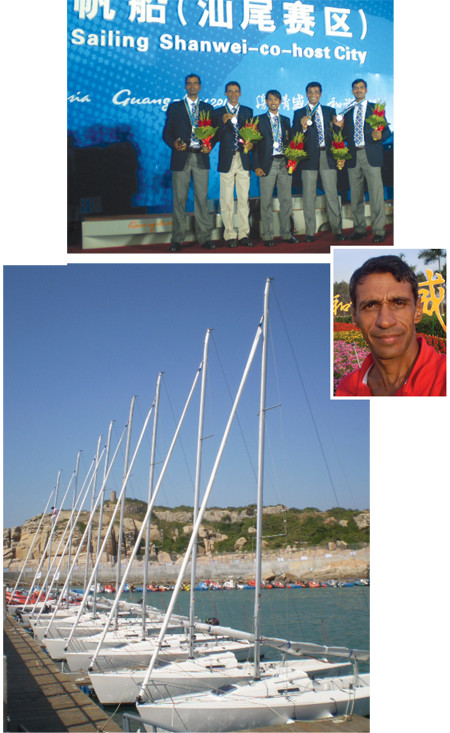
(Above) Yachtsman Farokh Tarapore (2nd from left and inset) and team members display their silvers for match racing; silhouette of sailboats at Shanwei
Tarapore’s tenacity
At 50, he is the grand ‘old’ man of Indian yachting and has participated in three Olympics, a record eight Asian Games and several world championships. At Shanwei, where this Asiad’s yachting events were held, Farokh Tarapore and his team won a silver medal in the open match racing event. "For me, this makes a total of one gold, two silver and two bronze medals at the Asian Games, a feat not achieved by anyone so far,” says the seasoned sailor for whom there has been much sunlight and shade over more than three decades in the sport.
Match racing, Tarapore explains, is like the T-20 of sailing and was introduced at the previous Asiad in Doha, Qatar in 2006. "The umpires are on the water and immediate decisions are taken. The wind conditions were harsh, the waves bigger than expected. There were round robins, the semi final and final. We were the only team without a coach. There was no one to give us a bird’s eye view from the outside,” he narrates. With five members in the team, his main job was to "ensure the team sailed as one unit.” The youngest member was his junior by almost 30 years!
Reading and riding the waves expertly, the team reached the knock-out stage. "Our semi-final was against China, with the final scheduled for the next day. The semi final turned out to be a grueling five-setter. We lost the first and second and were in danger of losing the third when we did a double gybe (a turning maneuver which can be dangerous). We had practiced this thousands of times in the last six months but not used it in competition. We did it once and did it to perfection!” he describes. The tactic took the wind out of the Chinese sails, but three-and-a-half hours of intense racing left the Indian yachtsmen mentally and physically drained.
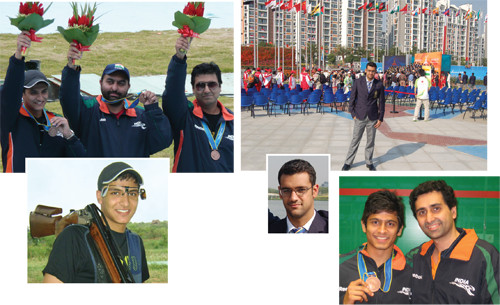
(Left and above far left) Marksman Asher Noria scores bronze; (Above right and inset) Swimmer Rehan Poncha soaking in the Village atmosphere;(right) squash bronze medallist Saurav Ghosal (left) with coach Cyrus Poncha
Unexpectedly, the final against Japan followed immediately thereafter, having been advanced by a day because of rough wind conditions forecast for the next day. The Japanese had finished their semi final one-and-a-half hours earlier and were therefore better rested, Tarapore relates. "So we went just 15 minutes later into the final and had to settle for silver. No, I am not disappointed. All this is part of the sport. The story might have been different the next day. This was the toughest competition I have seen so far. It gets tougher every year and if you go by the same formula for success, you will never win!” Singa-pore had been the gold medalists in Doha, but this time they could not make it even to the semis as they were black flagged (disqualified), he states. In sailing you can take part in only one event, unlike other disciplines like athletics, for example, where you can participate in different distance events, Tarapore informs us. "So you spend maximum time to win that medal, training every day, dreaming the big dream, fighting obstacles,” he asserts.
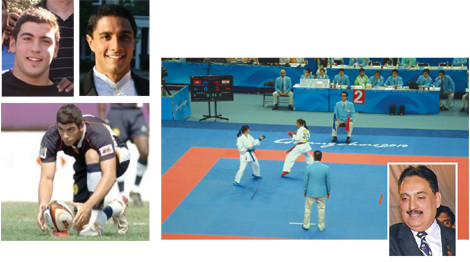
Rugby players Rohaan Sethna (ext left and below left) and Kayrus Unwala Below: Giving a good fight in karate and (inset) chief coach Vispy Kapadia
The 5’10” wiry sailor battles the authorities with the same tenacity he shows while tackling wind and wave! "In a country full of scams we have to fight our way through. Governments do not know how medals are won,” he observes. The Yachting Association of India (YAI) also tied the team in knots! Around 2007, when the planning and preparation started, the yachtsmen had put forward three requirements — a competent coach, two J-80 class boats and good pacers. But they received neither boats nor pacers! The coach appointed for the match racing team was UK’s David Atkinson, who was a level three coach. "He was paid 5,500 pounds sterling a month, a sheer waste of taxpayers’ money. We had suggested to the YAI the names of three or four other foreign coaches who would have come much cheaper,” Tarapore told the Press Trust of India, as reported in Mumbai Newsline, December 14, 2010. Atkinson did not accompany them to China as he was hospitalized (with a diabetes problem) at that time or he might have cost them a medal! Tarapore believes. Soon after returning home from the Asian Games, the YAI disaffiliated the Match Racing Association of India, of which Tarapore is the president. "They gave us a frivolous reason for the decision, saying each of the other associations affiliated to YAI represent one class of boat while we do not,” states the veteran.
"Tarapore has proved that he is undoubtedly the best yachtsman that the country has produced. His feat of representing India in eight consecutive Asian Games is stupendous. Winning the silver medal at these Games with practically no support from any agency shows his determination to succeed against all odds. Hats off to him and may he keep winning more laurels for the country,” commends Captain Homi Motivala, a veteran sailor himself who has been chief national coach for India and has received multiple awards. Tarapore’s sailor-made successes include winning in the Fireball, 420, 470 and Enterprise class of boats, with his first medal coming way back in 1975 in the cadet category! Tarapore also took part in the Los Angeles, Seoul and Barcelona Olympics in 1984, ’88 and ’92 respectively.
Champagne and caviar celebrations are not in the Arjuna awardee’s viewfinder, but the 2014 Asian Games in South Korea are! He does not bear grouses against the mainstream media for not adequately recognizing his rare feat. "If the dream is big enough, facts do not count. There was a dream and then a huge struggle to achieve it. All this would not have been possible without the support of my beautiful wife Anahita who stood beside me in good and bad times. This silver will be one of my most memorable Asian Games medals.”
Going great guns
A month before the Asian Games he had won silver with Ronjan Sodhi in the pairs double trap event at the Commonwealth Games (CWG) in Delhi. In China, 18-year-old Asher Noria once again fired for India, winning a bronze in the team double trap shotgun event on November 21, 2010. Noria was shooting alongside his mentor, 31-year-old Sodhi (ranked No. 3 in the world in men’s double trap) and experienced Vikram Bhatnagar (ranked No. 11, as of June 2010).
"For the Asian Games I did most of my training in China. The range was built on a hill so it took a little getting used to. (The Guangzhou Shotgun Centre was about 200 km away from the Asian Games Village.) We had to take a two-hour bus ride to the range every day so it was a little inconvenient to travel four hours a day,” Noria explains. "In shotgun you will find a similar type of competition no matter where you go. Both the CWG and Asian Games had Olympic level shooters. And the scores were all bunched together — there was no room for error.” India with 403 points finished behind China (414) and Kuwait (407), with Sodhi scoring 139, Noria 134 and Bhatnagar 130.
"It was a great experience to compete in both the games [CWG (where he took part for the first time in the men’s and not the junior category) and the Asiad], especially to be competing in your own country. Exposure to competitions of such magnitude really matures you as a shooter,” he remarks. The Asian Games Village was, he says, "really something else. They did a magnificent job.” The plus point in Delhi, however, was that the venues were built within a 30-minute radius of the Village, whereas in China they were extremely scattered. "The food at the CWG was far better. The shooting ranges in Delhi were better as well,” Noria comments.
Responding to Parsiana’s queries on the e-mail from the Georgia Institute of Technology in Atlanta where he is studying engineering, Noria says: "I am really enjoying it here. They have a very different approach to education which appeals to me. I have taken some of the hardest courses and coupled with my absences because of shooting, it has been a really hard semester.” Noria looks forward to shooting more and more competitions in the senior squad to pave his way into the 2012 Olympics in London. "I will get to train here (in the US) next semester. It is going to be a hectic two years ahead,” the marksman says.
Smoother swim
"The Asian Games for me were good, much more satisfying than my performance at the CWG. All my three swims were my fastest times this year. I clocked 2 min, 03 sec in the 200 m butterfly, 59 sec for the 100 m backstroke and 2 min, 07 sec for the individual medley where I swam the butterfly leg as part of the Indian squad,” says Rehan Poncha. The best team result was a sixth place in the final of the medley relay, he declares. "My best placing in the individual event was ninth in the 200 m butterfly. I just missed making the final in this event, which did hurt a lot, but I clocked over a second better than my CWG time in this so I was pleased about it.”
Poncha believes that he swam better in China because the water temperature was warm and much more comfortable than the Delhi pool which was way cooler. "The overall experience was good too since I was in a happier mood. I enjoyed myself more. We get to meet so many top Indian sportsmen and talk to them about their training as well,” he observes. In December Poncha swam at the World Short Course Championships in Dubai. "It’s a different format swimming in a 25 m pool…Most important also is to get enough rest and recovery and be ready in 2011, which is the qualifying year for the London Olympics.”
Tries and triumphs
"China was amazing. The Village was lovely and Guangzhou itself was quite charming except for the fact that it was like a ghost town — there were barely any people around, yet all the venues were packed during the events,” describes Kayrus Unwala. Ro-haan Sethna and Unwala were part of the rugby sevens squad. "As far as the tournament goes, it was a mixed bag, largely disappointing but with moments of brilliance that are a testament to the growth of Indian rugby,” he notes.
The team ended seventh after beating Thailand in the final game. "I scored two tries in that game to help win it and even though Sethna didn’t score any tries during the tournament he added points by way of conversion kicks. We gifted away two very possible victories against Sri Lanka and Malaysia… We held Japan (gold medalists and historically the best team in Asia) to a 5-5 score line past half-time and gave the Asian giants quite a scare,” he relates. The team has worked hard these past two years and is enjoying a well deserved rest till "we come together in May 2011 to train for the Asian 5 Nations tournament,” he states.
Upward swing
"The squash events were fabulously conducted. In fact, the entire Asian Games were absolutely outstanding. The Chinese gave great attention to detail, from the moment of landing to the moment of departure! We were one hour away from the main city, but the roads were great,” remarks squash coach Cyrus Poncha who was in China with the Indian team. "World No. 25 Saurav Ghosal cruised into the last four with a convincing victory over (fellow Indian) Siddharth Suchde at the Asian Games Town Gymnasium,” reported The Times of India, November 20, 2010, thereby assuring the Indians of at least a bronze in the men’s singles. Ghosal lost to a higher ranked Malaysian and top seed in the semi final and had to settle for bronze, Poncha explains. Joshna Chinappa losing in the quarterfinal was "a heartbreaker,” he adds.
In addition to Ghosal’s individual medal, the men and women picked up a bronze apiece in the team competition, losing to countries like Pakistan and Malaysia which are traditionally strong in squash. "We are not happy with bronzes. Indian squash is headed upwards,” Poncha notes. Our top players compete regularly on the international circuit. "They are young and I am confident they will mature into tough adults,” the mentor declares.
"We’ll pull off medals”
"These Games were better than any Olympics. The housing was very good, the food fabulous. The organization of the competition was phenomenal. The volunteers, stadium, mat areas, scoring system, etc were excellent,” says national coach of the karate team Kyoshi Vispy Kapadia. With four men and four women, this was the first time a full-fledged karate contingent represented India in the Asiad. "Our competitors reached the quarterfinal stage,” says Kapadia. The performance of the players was excellent on the first day. After winning two bouts, "unfortunately one of the girls got hurt and was unable to get up from the mat in the 10 sec time frame and lost to Asian champions China. The team had been given many months training with an Iranian coach in Madras. You can see the improvement. The government has taken a lot of interest,” he commends.
Being a coach is hectic, says Kapadia who was in China for 20 days. "You have to psyche the players, watch their weight as they cannot go even one kilo up and run around for so many things!” He made 12 international trips for karate in the last 12 months, he says, including the World Championships in Serbia, the biggest event with 88 participating countries. "I would say we fared pretty well. Next time, at the Asiad in South Korea, we’ll pull off medals, you’ll see,” he asserts confidently.
Through the delight and despair, the bruising effort, the crests and the troughs, the magic of sport remains.
◆ ◆ ◆
From the archive