
Sports
Uncommon wealth
With dedication and professionalism four youngsters bring home five medals for India at the Commonwealth Youth Games
Going great guns at the Third Commonwealth Youth Games (CYG) 2008 in Poona were shooters Asher Noria, Kynan Chenai and Rushad Damania. Hyderabad’s Noria and Chenai were on target with a gold medal apiece, while Bombay’s Damania maintained his line of fire to pick up a bronze.
For tennis talent Kyra Shroff, the Games were a double delight — she won silver in singles as well as in doubles. The Youth Games were billed as the showpiece precursor to the Commonwealth Games to be held in New Delhi in 2010. The 1,300 athletes below the age of 18 from 71 Commonwealth countries gave the CYG their all in nine forms of sport — athletics, swimming, shooting, tennis, table tennis, badminton, boxing, wrestling and weightlifting — amidst the heat and dust of the Shiv Chhatrapati Sports City at Balewadi from October 12-18, 2008.
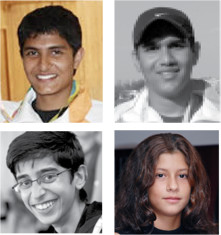
Winners all (clockwise from top left): Asher Noria, Kynan Chenai, Kyra Shroff, Rushad Damania
Gold finger
In the double trap event, 16-year-old Noria shot into the limelight with a score of 180, bettering in the process Athens Olympics silver medallist Rajyavardhan Singh Rathore’s score of 179. "As of now I am ranked fourth in the world in the junior category (under 21),” says Noria. "The competition was not easy as the South African who came second and the British boy who came third are ranked ninth and fifth respectively. In shooting, on the day of competition absolutely anything can happen. There is no Michael Phelps in shooting who can walk into a competition and be certain to win.”
"In double trap, two birds (clay pigeons) are ejected from a trench simultaneously at around 75-80 km/hr and one has to shoot both, hence the name ‘double trap,’” he explains. Shooting flying targets 16 m away 200 times in a competition is no easy task, he notes. "Concentration is combined with controlling one’s emotions and thoughts and holding one’s nerve. You have to be focused, disciplined, committed and determined,” analyses the teenager who won with a comfortable six-point lead, despite a disappointing third round. "I had an excess of adrenalin flowing after my last shot. There were so many emotions and feelings rushing through my mind and I was in a daze. I was just caught up in the moment.”
Watching Asher showing his firepower were his parents Gusti Noria and Mita Banker. "My parents are extremely supportive. My father should get a lot of credit. It is extremely hard to import guns and ammunition, especially in shotgun. Being an international shooter himself, he imports the equipment…” the lad relates. Having made it to the Indian team, government support was forthcoming: "They send us for international competitions for exposure. Before major events, there is a coaching camp with free clays and ammunition. But we do not have a full-time coach. For the CYG, the shotgun camp was for a mere 10 days whereas they had the camp for the rifle shooters from well before.”
Contrary to popular notion, fitness is extremely important and Noria’s preparations for the CYG included running six to seven km daily after practicing at the range for four to five hours. "I train with world champion Ronjan Sodhi who is like my coach. He helps me a lot with my technique and mental makeup,” says Noria who studies at the Hyderabad Public School and practices at the shooting range located in the Hyderabad University campus. "The entire venue (in Poona) was brilliantly done. But the trap and double trap ranges were not up to the mark. There was no shed for the shooters and everything was last minute. The background was all rubble.”
At the World Championship in Cyprus last year, Noria had finished sixth. Sharp shooting at the Singapore Open (a senior event) just prior to the CYG fetched him a prestigious gold. Noria has now set his sights on the nationals in Jaipur in December and on the world championships in Serbia next year.
Eventful trapping
"Kynan holds nerve to trap gold,” stated The Indian Express in a prominent report datelined October 15. With hits and misses in his kitty in the earlier round, Chenai entered the final of the trap event (shooting clay pigeons fired singly at velocity by a mechanical device) just one point ahead of strong contender Ryan Bugeja of Malta. In the 25-target final, Chenai was wayward with a few targets, but steadied to nail the crucial last shots and won the gold with a one-bird advantage.
"It’s the first big international medal for Kynan and I’m happy he could win in the pressure final, more than the score. He’s an emotional shooter. When you win at an early age, you know you belong,” Mansher Singh (Commonwealth gold medallist and experienced Olympian who has mentored the lad)) is quoted in The Indian Express. "Now he should continue working on his physical strength since he has a naturally good build. He should start training more scientifically, but all without changing his natural ability.”
While the indoor shooting range had excellent facilities, the outdoor trap ranges "were completed at the last moment. There was no proper background or shade,” remarks Chenai. The searing Poona heat and the windy conditions made things difficult, but "you have to adjust.” Says his father Darius, himself a national level shooter from Hyderabad who was in Poona to watch his son’s golden moment: "It was a nail biting finish. It was wonderful watching Kynan transform into a competitor who has come into his own.”
"I think a lot of credit for my medal should go to my dad as well as Mansher Singh — he is the one who helped me form my technique,” the Deccan Herald (October 15) quotes 17-year-old Kynan who studies in Standard 12 at Hebron School at Ooty in the Nilgiris and trains in Hyderabad during time off from boarding school. Shooting from the age of 12 under the guidance of his father, Kynan has won at state and national level. Competing with international shooters for the first time at the Asian Clay Championships in Jaipur in March 2008, the lad picked up silver. In August, he shot at the Fifth Grand Prix at Perpetto in Italy and succeeded in entering the final. Preparation for the CYG included a one-month stint under well-known coach Marcello Dradi in Italy. "Kynan’s schedule involved seven hours of shooting and an hour of physical training every day,” states Darius. "Our unconditional support is with him, as we have always done.”
Both Chenai and Noria were singled out by reputed weekly Sportstar (November 1, 2008) as being among the "brigade from India” which "raised its skills to come up with some sterling performances,” showing grit and temperament under trying conditions.
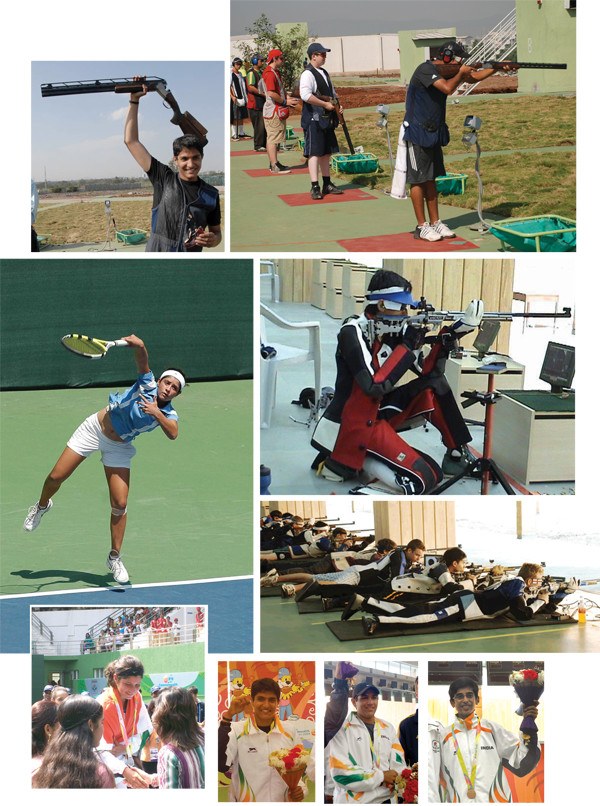
Asher Noria (Top) celebrates his win, Kynan Chenai (in action alongside) on target; Kyra Shroff (middle row, left) on court (Photo courtesy: Press Information Bureau, Government of India), Rushad Damania in kneeling and prone position (at far end of row); medal moments (from left) Kyra Shroff, Asher Noria, Kynan Chenai and Rushad Damania
Shot in the arm
The CYG also proved a happy hunting ground for 17-year-old Rushad Damania. "For the CYG, only one shooter could represent a country in each event. The competition to represent India was itself tough and based on five trials. I was selected to represent India in two events where the .22 rifle is used — the 50 m prone (where he narrowly missed the bronze) and the three-position (standing, kneeling and prone, where he won the bronze). In target shooting, each bull’s-eye scores 10 points, but in the finals the scores are measured with even greater accuracy in decimals, so that a perfect shot fetches you a 10.9,” he explains.
The Commonwealth countries have some of the world’s best shooters, Damania asserts. "All my competitors were world class, with extensive experience and international exposure including the World Cup. They all had their own weapons which had been tested and modified to their own needs,” he remarks. With shooting at this level being very heavy on resources, he adds that not only is the equipment and ammunition expensive but "we travel a lot with loads of extremely heavy luggage and stay outstation at our own expense for prolonged periods of time.” For the CYG, he started training seriously in May. "I never expected to win! It was my first international and the exposure was important,” says the collegian who is in Standard XII (Science) at the Ruia College at Matunga in Bombay.
A bronze in the 50 m prone event would have been a further shot in the arm. In third position at the end of the qualifying rounds, Damania found himself being shuttled from one lane to another in the final (because of a light problem), ending up in the original lane! Focus disturbed, "I shot badly and could not maintain my third position, ending fourth. I feel I should not have let my concentration slip… I cannot blame anyone else if I have shot badly.”
Damania practices at the Maharashtra Rifle Association range at Worli "which has all the basic facilities and I was allowed to use the Association’s weapon. In the last few months I have had to travel extensively for the selection trials and camps held by the National Rifle Association of India — Guwahati, Agra, Indore, Hyderabad and Poona.” Selected as a CYG probable, the Maharashtra government released ammunition for practice and temporarily allotted a government .22 rifle till the competition was over. "No individuals or institutions have financially supported or sponsored me,” he states. Father Kaizad and mother Vinita are both gynecologists and professors who work full-time in a medical college and public hospitals and are very supportive, notes the lad who never liked guns earlier and who as a child never even had a toy gun!
Damania took to shooting when he was 13 when his school (Bombay Scottish) started a Rifle Club. "After I started doing well enough to qualify for the nationals, my parents gave me a German air rifle (which uses pellets) and I broke the school national record at Noida in 2007. By this time I was also interested in .22 shooting (rifles using real bullets),” he narrates.
"The range at Poona is fantastic and is one of the best and largest ranges in the world. It is fully automatic so that both the shooter and the spectators can see their shots and scores live on the monitors and big screens and that makes the game come alive for the spectators,” the marksman describes. "Of course taking part in further international competitions is the dream of every serious shooter.”
Sweet silver
"We as a family are very happy with Kyra’s performances at the CYG. She had a very rough two weeks prior to the Games. She was ill in China (where she had gone for an International Tennis Federation junior tournament) and cried to be shifted from there. She had not eaten a single proper meal for four days and lived only on fruit,” Kyra Shroff’s father Firdaus describes the days prior to the Youth Games. "We had to get a visa for Japan (where she was to play) and so rushed to Hongkong and managed to get it with great difficulty just in time.” Leaving Osaka, Kyra returned to Bombay in the wee hours of the morning of October 12 (the day the CYG began) and drove directly to Poona to allow for some much needed sleep.
Among the shortest of girls on court, her quarter-final against Monica Gorny of South Africa (ranked at No. 50 in world juniors) was a tough three-setter, followed by an equally tough three-set semi-final against Monica Wejnert of Australia (world No. 90). It all depends on how you play on that day, ranking does not really count when you play in front of big crowds, Firdaus assesses. "Kyra was looked after quite well at the CYG but she was made to play all her matches on Court One while other easier matches (of Indian players) were played on Center Court (and televised live for the most part). This did upset her but the crowd really helped pull her through in the quarters and semis,” says Firdaus. Not among the top seed for the tournament, Kyra (who has juvenile diabetes) overcame higher ranked players on her way to the final.
The singles final against Heather Watson of Guernsey (world ranking 83 to Kyra’s 116) was somewhat an anti climax due to the energy-sapping earlier matches in the strong sun as well as the three-set doubles final (which the Indian pair of Shroff and Poojashree Venkatesha lost). "As parents we had to struggle every day to get in, no free passes or tickets were given to us till Thursday (five days into the seven-day competition)!” the father bemoans. The teenager turned sweet 16 a day before the Games ended.
Not waiting for the closing ceremony due to a packed schedule, Kyra had barely 40 minutes in Bombay to pack, say hello to her siblings and go to the agiary before she caught a flight to Bangkok to play in a Grade Two tournament. "By the way, Australian girl Jade Hopper (who won the doubles at the CYG) was her partner in Bangkok, so friendships have been formed and Kyra’s talent observed by other higher ranked players who have agreed to play with her,” Firdaus informs Parsiana.
From Bangkok to Indonesia, a week’s rest followed by exams in November and it’s back to Poona for Kyra for a $ 25,000 WTA (Women’s Tennis Association) event, then a six-week stint in the US, playing and training in Florida!
"The CYG as a whole was a fantastic experience. It was awesome interacting with 1,300 sportsmen from all over the world,” sums up Damania. "I am very proud to be one of the four medal winning Parsis. It was a big event for Poona and India. With India topping the medals tally, it made us all the more proud,” asserts Noria.
◆ ◆ ◆
From the archive