
Sports
A wealth of sport
On the playing field and behind the scenes, Zoroastrians contributed to the success of Delhi’s Commonwealth Games
They have a common connection — they were all at the IX Commonwealth Games (CWG), Delhi 2010. Athletes Asher Noria (shooting), Rehan Poncha (swimming), Rohaan Sethna and Kayrus Unwala (rugby sevens) gave it their all in the amazing race to win medals for India. Cyrus Poncha wore the India blazer as national coach in squash. Shapoorji Pallonji and Company Limited executed the refurbishment and upgradation of the 60,000-seat Jawaharlal Nehru Stadium, fitting it with a new state-of-the-art PTFE (poly tetra fluoro ethylene) roof and equipping it for HD (high definition) television broadcast, with international standard sports lighting and public address system. Viraf Sarkari and Wizcraft showcased India to the world in smooth and spectacular opening and closing ceremonies. Shiamak Davar sang and choreographed, Novy Kapadia graced TV screens, bringing his sports expertise into people’s homes.
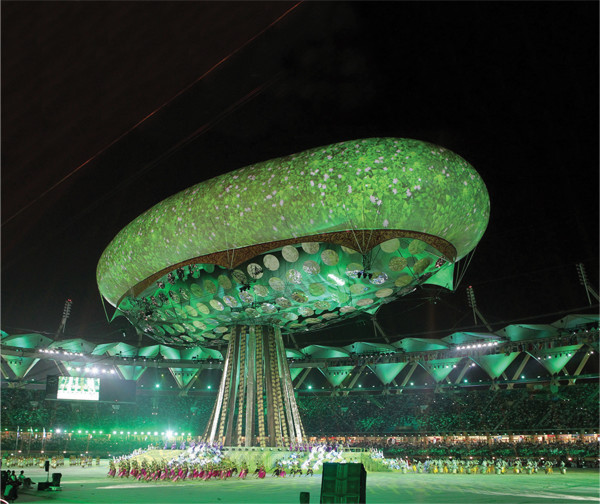
The aerostat bathed in beauty at the opening ceremony
With hosts India almost knocked off the podium by a blitzkrieg of hyperbole, hysteria and negative publicity in the run up to the Games — when the aim of the Games was to wow and win the world — athletes retained single-minded focus from October 3-14, surmounting the tyranny of expectations and gladdening hearts with their feats!
Boy among men
His silver medal was one among the 101 colored discs that took India for the first time to second spot on the medals table at a Commonwealth meet. Calm as a monk with steady hand and heart, marksman Noria — at 18 a boy competing with shooters almost double his age and vastly more experienced — did himself and his country proud by winning a silver medal on October 6 in the pairs double trap event partnering Ronjan Singh Sodhi, a man he considers his mentor. The next day, in the singles double trap, Noria missed out on the bronze by a cross hair!
Having won the gold in junior double trap at the World Shooting Championships in Munich barely two months ago, Noria came to the CWG high on confidence. "Obviously there is some pressure on me because the selection committee has chosen a junior in the senior team for the Commonwealth Games. But I see it the other way. Pressure boosts my confidence and I am in a situation where I know that there are a lot of expectations from me and I have to perform. So I would look to enjoy the pressure,” the Hyderabad teenager told the media. In the double trap final at the Dr Karni Singh Shooting Range on the south Delhi ridges near the historic Tughlakabad Fort, Sodhi and Noria with 188 points lost out on the gold by just one point, with Stevan Walton and Steven Scott of England getting 189 points and establishing a GR (Games Record).
Sharp shooting in the singles double trap event saw Noria qualify for the final round, with the field whittled down to just six shooters. A series of staccato shots later, with bird after bird (clay pigeons) disintegrating in the distance in a burst of powdery pink as the bullets hit, three marksmen — Noria, Sodhi (his partner of the previous day and rival for this event) and Timothy Kneale of the Isle of Man found themselves tied on the same score of 186 points, all in sniffing distance of the silver and bronze! (Stevan Walton won the gold with 190 points.)
Despite the television cameras capturing close up every nuance of expression and relaying them live on large screens at the venue itself and worldwide, Noria kept his cool in the final shoot off among the three, paying careful attention to the placement of his feet, taking deep breaths in round after round before raising the shotgun to his shoulder. One bird missed apiece by Kneale and Noria gave Sodhi the silver. One more bird missed by Noria gave Kneale the bronze, leaving the lad with a fourth place finish!
Italian trainer Marcello Dradi, who has guided Indian shooters on and off over the last decade, believes Noria has the potential to take the top spot. "It takes some time for shooters to mature, but Noria has done it at a young age,” Dradi is quoted on http:// www.prokerala.com/news "He has to just carry it forward.”
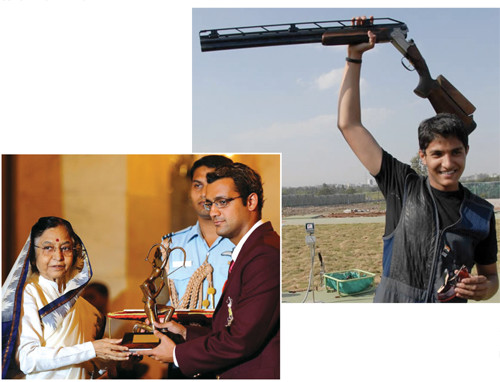
Champion shooter Asher Noria (above); Rehan Poncha (alongside, ext right ) receiving Arjuna Award from President Pratibha Patil
Rehan’s resilience
For Rehan Poncha, his swims did not quite go with the flow in Delhi. "The CWG organizing was great; the rooms were clean and liveable. The swimming pool at the Dr S. P. Mukherjee Aquatics Complex was world class. The water was a little cold and not temperature controlled, but I would still give it a top rating. From a personal point of view, my swims were below par, disappointing and not up to the mark I had set for myself,” he analyzes. In a discipline dominated by powerful Australian, Canadian, South African and English champions who are often body lengths ahead of the others, Poncha did not clock any personal bests, either in the individual events or in the relays. "I had trained really hard in Los Angeles and I didn’t swim to my training. I’m still trying to figure out what went wrong. The best I could manage was a relay seventh finish. Anyway, there are always going to be bad meets so I’m trying to forget and look forward to the Asian Games to repair what I lost here. I know my hard work will pay off sooner or later. I guess I just have to be patient,” declares the 24-year-old from Bangalore who has a host of national records to his name.
Despite India having entered a large swimming contingent, no swimmer, male or female, could achieve substantial success, except for a Paralympic swimmer who made history by winning for the country its first individual swimming medal in Commonwealth Games.
"As far as overall facilities and atmosphere in the Games Village go, I could compare the standard to any international event like the Asian Games or the Olympics. Unfortunately, things were ready only just before the Games started, which ended up giving India a bad name. Nevertheless, as a sportsman, no complaints from my side, only a little disappointment at my own swimming,” he says, adding that he is training for the Asian Games in China this month and will also be swimming at the World Championships in Dubai in December.
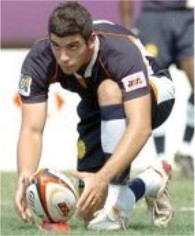
Focus on rugby: Rohaan Sethna (above) and Kayrus Unwala (below)
Tough tackle
It was the very first time an Indian rugby sevens team was playing in the Commonwealth Games — newcomers against the giants (literally!) in a sport where size, speed, strength, stamina and skills show results! And seven of the world’s top teams were in Delhi, so no question of a depleted opposition! "The CWG was a wonderful, unique experience for all of us. We had an opportunity to rub shoulders with the best rugby sevens players in the world. India was pooled with Wales, the sevens World Cup champions, South Africa, a historical rugby powerhouse, and Tonga, widely regarded as one of the most athletically gifted and physical rugby teams around!” explains 20-year-old Kayrus Unwala. These teams are ranked at least 60-65 places above India, "but we were looking to play hard, showcase our talents and prove to the world that rugby in India has come of age.”
Running and tackling as strongly as they could, the team was buoyed by a cheering crowd at the packed Delhi University Stadium, for many of whom terms like mauls, scrums, tries and conversions were Greek and Latin! "We hoped to put up an inspiring performance, get noticed and subsequently be invited to larger tournaments of a level similar to the CWG in order to gain more exposure — a necessity for a growing national side like ours. We also hoped that our efforts will inspire more Indians, raising awareness and participation in the sport,” asserts Unwala who has just completed his first year of undergraduate studies in Chicago and has taken this (his sophomore fall) semester off to play in the CWG and thereafter in Malaysia and in the Asian Games in Guangzhou, China on November 21-22.
For Kayrus, rugby is in the genes! His father Maneck was a committed rugger, playing for Bombay Gymkhana till he was over 40! Maneck is the treasurer of the IRFU (Indian Rugby Football Union) and has accompanied the Indian team as manager on numerous tours up to around three years ago. Kayrus made his international debut for India this year in the A5N (Asian 5 Nations) tournament in Delhi. "Since then I have been a part of the national camp in the Balewadi Sports Complex near Poona and have been in the national team that has toured Turkey, England and Shanghai,” says The Cathedral and John Connon school ex-student who is planning a double major in pre-med (biology) and finance. "I know that I want to continue playing while I study and will keep all my options open — the beauty of an American education!”
"There’s precedence for kickers in the Indian rugby team being the best lookers. Sethna handsomely fills the shoes of former Armenian fly-half and India player Emil Vartazarian. Brown haired and with chocolate eyes to match the mop, Sethna, the quintessential south Bombay boy, is the specialist kicker Indians can rely on — for the game and for the glamor,” writes eye, October 3-9, 2010. "Earlier in the year 22-year-old Sethna had put in extra hours working on his kicking in New Zealand, away from the clattering of teammates, alone in his concentration,” noted Mumbai Newsline, June 3, 2010 in a lengthy article on Sethna. The commerce graduate gave up his center back position in football and opted for the more demanding game of rugby.
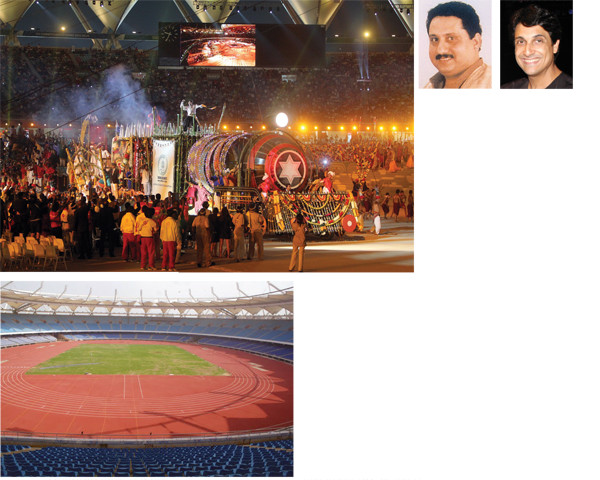
On track with India’s culture at the opening ceremony (Top left);(Right) Viraf Sarkari (left) and Shiamak Davar; showpiece Jawaharlal Nehru Stadium (below)
Playing to potential
"Our playing facilities (for squash) situated at the Siri Fort Sports Complex were truly world class. We had 11 courts, including a four-sided all glass court which could seat 3,000 people,” describes national coach Cyrus Poncha. India had never won a squash medal at the CWG. Speaking to The Times of India (August 27, 2010) before the Games began, Poncha had stated: "CWG is a big event and we just didn’t want to field players who will be out in the first round. This year we are fielding 10 as the scene now is totally different. All our players play in the pro tour and their standards are also much higher than they used to be a couple of years back.”
With top seeded players from powerhouse squash-playing countries like England, Malaysia, Scotland, Australia, Pakistan, etc present in Delhi, it was always going to be a tough task for India’s strongest players like Saurav Ghosal, Joshna Chinappa, Dipika Pallikal and others. The mixed doubles and the women’s doubles were the best bet for India, Poncha believed. "This time we had our first glimmer of hope. Unfortunately it was not to be. Illness of a key player was a setback. However, overall our players gave it their best and I am pleased,” he asserts.
A multisport event is always special. "It’s not often we rub shoulders with sportspersons from different countries and from different sports. The food, the staying and other facilities at the Village were wonderful. Sure, we had our teething problems but by the commencement of the Games, officials and athletes were happy and excited. The ceremonies were outstanding. The criticism was not required. The Press should highlight our country and not bring it down!” he remarks.
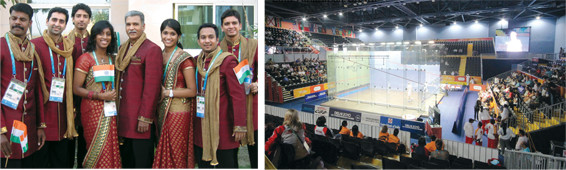
Cyrus Poncha (second from left) with squash team members in ceremonial dress, glass court at squash stadium
Showpiece stadium
"Shapoorji Pallonji’s part of the job in the Jawaharlal Nehru Stadium (JNS) was completed and delivered before time to the Games’ Organising Committee (OC), in March 2010. It is pertinent to note that external work outside the Stadium was not part of Shapoorji Pallonji and Company’s scope of work,” states a press release from Rohit Sinha, head of corporate communications. "We also made and completed the tunnel (below the arena of competition which was used by the athletes and performers at the glitzy opening and closing ceremonies). It was done on a war footing as we were told at the 11th hour,” he adds.
The company was also in no way involved with the work in the adjoining weightlifting venue or the lawn bowling area, he states emphatically. (A small part of the plaster of paris ceiling had collapsed in the weightlifting hall just prior to the start of the Games, leading to screaming headlines in the print and electronic media of "stadiums collapsing!”)
Known for their dynamic work and timely completion, Shapoorji Pallonji incorporated into the project a uniquely designed system of 14 steel ramps around the periphery that ensure that the JNS with a full house of 60,000 people can be evacuated in six minutes in an emergency. The new roof is the world’s largest tensile fabric roof covering a total area of 54,000 sq m and extending up to 70 m into the stands, stated the company’s front page advertisement in The Times of India of October 12, 2010. "The Stadium consists of 88 structural steel columns, up to 45 m above ground level, supporting 600 MT of cables and castings,” the advertisement stated with pride. "The length of wires used is around 2,200 km, the distance between Delhi and Bangalore,” the press release notes. The design for the lights and the public address system are as per Olympic Games and FIFA (International Football Association) standards. The JNS, originally constructed in 1982 for the Asian Games, was one of the stars of the CWG, showcasing to the world the color, choreography and culture of India at the beginning and end of the Games and hosting in addition the gladiatorial contests on track and field (athletics) that are the piece de resistance of any international multisport event.
The wizard of India
"In terms of sheer scale and size, yes it was our most challenging assignment,” says Viraf Sarkari, director, Wizcraft International Entertainment Private Limited, the company which conceived, crafted and presented the grand spectacle of the opening and closing ceremonies. "Initially when all the negativity hit CWG, a lot of my team members were demoralized and there was a feeling that the ceremonies might just get cancelled. I told them to focus and do best what we are good at, that is putting these kind of big shows together. We all did exactly that and we wowed the world,” says Sarkari. Wizcraft had been working on the project for almost two years, from the time they began their pitch creative presentation until final execution. Interacting with a multitude of agencies including those of the government, "it was difficult to follow all the stringent procedures laid down by the OC. Also, Delhi had unprecedented rain this time and that hampered our schedule like crazy!”
The cynosure of the ceremonies was the aerostat, a 80 m x 40 m helium balloon, reportedly costing Rs 38 crores, suspended high above the Jawaharlal Nehru Stadium, its myriad reflectors beaming a multiplicity of ever-changing aesthetic images. With over 6,000 athletes and officials from 71 participating nations and dependencies, thousands of performers in their colorful swirling costumes and props, ranging from small to very large, hundreds of moving lights, stacks of speakers giving rich surround sound and round after round of fireworks shooting into the sky — the logistics and coordination necessitated precise planning! "We had a good number of creative and technical production workshops where all the ideas were brainstormed and the methodology of execution planned and finalized. We had always wanted the laser show at the closing ceremony as the closing was more of a party/celebration theme,” Sarkari elaborates. "It is always fabulous to do a live event as there is nothing in this world that can give you the kind of satisfaction that successfully executing this kind of live event gives you.”
Wizcraft has also recently opened at Gurgaon near Delhi a multimillion entertainment/amusement park called Kingdom of Dreams. A colorful combination of Bollywood, Broadway and Las Vegas style entertainment, its showpiece is a musical entitled "Zangoora — the gypsy prince” which has choreography by Shiamak Davar. "The Kingdom of Dreams is fabulous and Zangoora is the biggest ever Bollywood musical,” Sarkari bubbles with enthusiasm.
Wizcraft has also been appointed the event manager for another global event — the opening ceremony of the ICC (International Cricket Council) World Cup in Dhaka, Bangladesh next year.
Davar on song
On stage at the mega musical party at the closing ceremony was Shiamak Davar, singing alongside India’s top vocalists like Shaan, Shankar Mahadevan, Sunidhi Chauhan, Shubha Mudgal, Kailash Kher and others. I Gotta Feeling, One Love and We Will Rock You had the athletes rocking in the aisles and the spectators in the stands! Davar also choreographed group sequences in the opening and closing ceremonies.
"Being a part of the closing ceremony is indeed a matter of great pride. It was a night of celebrations. The energy at the stadium was something that can’t be described. I thank God for giving me this opportunity of being a part of history,” Davar told Parsiana.
Kapadia’s knowledge
Expert sports commentator Novy Kapadia was a familiar face on television and gave viewers the benefit of his incisive analysis and balanced comments throughout the duration of the Games, the biggest sporting event ever hosted in India.
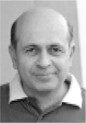
Novy Kapadia: enlightening viewers
As politicians and babus continue to play the blame game after the Games have ended, athletes look to citius, altius, fortius (faster, higher, stronger) future performances! "Eighteen months ago a scheme was devised in preparation for the CWG, in which the players showing top potential were sent abroad for tournaments and training camps and more international sporting events were held in India. This has certainly given an impetus to all sports,” summarizes Cyrus Poncha who is a Dronacharya awardee (for coaching). "I am confident that with such a structure in place, if it is continued we will be a country to reckon with not only at the Commonwealth and Asian Games but also at the Olympics.”
◆ ◆ ◆
From the archive