
Books
Bringing Bhabha to life
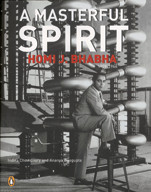
A Masterful Spirit: Homi J. Bhabha, 1909-1966 by Indira Chowdhury and Ananya Dasgupta. Published in 2010 by Penguin Books India Private Limited, 11 Community Centre, Panchsheel Park, New Delhi 110017. Pp: 258. Price: Rs 1,299.
It is surprising that given Homi Bhabha’s stature there is no definitive biography of the man. Bhabha and his Magnificent Obsessions by G. Venkata-raman and Homi Jehangir Bhabha by Chintamani Deshmukh, both slim volumes, have their respective merits but fall far short of doing justice to Bhabha’s multifaceted personality. But this review is an opportunity to laud, rather than lament, for Indira Chowdhury’s and Ananya Dasgupta’s A Masterful Spirit is a very valuable addition to the sparse literature on Bhabha’s life. This book is not a conventional biography but as described in the design note by the author and the designer is "a graphic overture that weaves together letters, and reminiscences, photos, sketches and diary excerpts, quotes from speeches and articles.” They concede that on occasion "linearity has been sacrificed at times in favor of the unexpected and the coincidental.” This book, drawing from a large reserve of archival material, attempts to bring Bhabha to life by recourse to letters, recollections by his contemporaries, manuscripts, photographs, and oral history interviews [the last named being a unique feature of the book and in a sense its USP (unique selling proposition)].
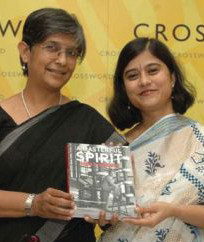
Authors Indira Chowdhury (left) and Ananya Dasgupta
Chowdhury set up the Archives at the Tata Institute of Fundamental Research (TIFR) at Bombay and Dasgupta is currently responsible for the TIFR Oral History Project. The authors’ credentials to write this book are therefore impeccable. And the end result amply reflects their rigorous research and command over their subject. Their attempt is best described in their own words: "In our attempts to share the rich material we had compiled, we tried to move beyond a simple biographical model by setting up a dialogue between the narrative and the historical material previously locked away in archives. This amalgamation we hope will reveal to the reader, the larger historical context that intricately configured Bhabha’s life.”
Bhabha excelled at everything that he did. A theoretical physicist who made important contributions to the theory of cosmic rays (he was nominated for the physics Nobel four times by French mathematician Jaques Hadamard), the architect of India’s nuclear program and an institution builder extraordinaire, he also pioneered electronics in the country. Bhabha was also a connoisseur and patron of the arts. He not only patronized the visual arts but also brought to them outstanding personal artistic ability. He sketched and painted with a facility which would have been the envy of any professional artist. Well acquainted with a large part of symphonic literature from an early age, Bhabha played the violin with a high degree of virtuosity and was also conductor of the Cambridge University Orchestra. He also designed sets and was above all a master gardener. It is therefore hardly surprising that Sir C. V. Raman introduced him as a modern Leonardo da Vinci at the annual meeting of the Indian Academy of Science at Nagpur in 1941. The parallel may have been more apt than Raman realized since M. F. Husain once observed that Bhabha’s style of line drawings closely resembled Leonardo’s. (Bhabha’s sketch of Husain figures in the book as does the one he did of Raman. At Cambridge he showed his sketches to the English artist and art critic Roger Fry who lavished praise on them encouraging him to create works on a large scale. Bhabha was so good that for a while he seriously entertained thoughts of becoming a professional artist.) Prof Rustum Choksi of the Sir Dorab Tata Trust referred to the "Homi Bhabha touch” where everything was conceived and executed in terms of beauty. The aesthetic sense always triumphed. And if you thought that Bhabha’s genius was limited to only things cerebral, he was known to go sprinting at Fenners, the Cambridge University Cricket Ground, and more than three decades later would be remembered and appreciated by Gonville and Caius College as the "cox of the fifth boat.”
There are recollections about Bhabha from people across the world and belonging to different economic and social strata: Jamshed, his younger brother; Gustav Born, son of the famous physicist Max Born; G. V. Vasudevachar, Bhabha’s first lab assistant at Bangalore; N. B. Prasad who became project director for the Canada-India reactor; P. C. Vaidya, a researcher at TIFR; B. V. Sreekantan who was director at TIFR (1975-87); B. M. Udgaonkar, the physicist; Yash Pal who built SAC (Space Application Centre), Ahmeda-bad and ran the SITE (Satellite Instructional Television Experiment) program; and E. C. G. Sudershan who began his career at TIFR and who many think has been unfairly denied a physics Nobel. Others from the scientific establishment include M. G. K. Menon, Dr Homi Sethna, Raja Ramanna, P. K. Iyengar, Obaid Siddiqi, Govind Swarup and M. R. Srinivasan. Among artists and others of the same ilk, there are recollections from Jehangir Sabavala; Husain whose mural Bharata Bhagya Vidhata at TIFR was commissioned by Bhabha; Kri-shen Khanna who made his first sale thanks to Bhabha; Kekoo Gandhy, founder of Gallery Chemould; and dancer Mrinalini Sarabhai.
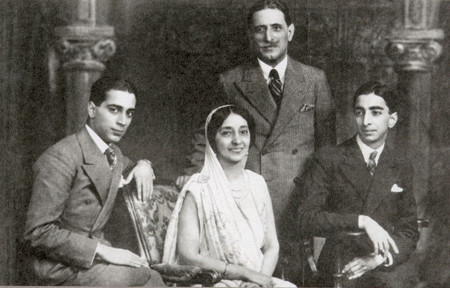
(From left): Homi Bhabha, with mother Meherbai, father Jehangirji and brother Jamshed
As can be expected Bhabha corresponded with a large number of persons and many of those letters, judiciously selected, find their way into the book telling us firsthand about his views on a variety of subjects. There are letters from and to, among others, scientists Paul Dirac, Prasanta Chandra Mahalanobis, Wolfgang Pauli, Birbal Sahni, Subrah-manyan Chandrasekhar, Albert Einstein, Niels Bohr, philosopher Bertrand Rus-sell, Jawaharlal Nehru, J. R. D. Tata and Sir Sorab Saklatvala, chairman of the Sir Dorab Tata Trust. Also included in the book are a number of Bhabha’s sketches and paintings which showcase his phenomenal talent.
The book throws up some wonderful nuggets and provides information not generally known about Bhabha’s interaction with his contemporaries. What would come as a revelation to most is his extensive correspondence with Homi Seervai, the famous jurist, who was a close friend. His letters to Seervai are remarkable for their frankness and insight and reveal their mutual love for philosophy, books and historical figures. In a letter to Seervai dated August 2, 1928 Bhabha wrote about how he wanted to study physics even though he was doing engineering at the time. "I am determined to do physics and astrophysics eventually. Nothing will stop me.” In the same letter he wrote: "I do not care two hoots for anybody. I am going to go my own way against the world if it is in my way.” Prescient words indeed, since Bhabha did pretty much as he pleased for the rest of his life.
Even though Bhabha never married, he had a constant companion in Pipsy Wadia with whom he shared his love for art and music. Mithoo Coorlawalla, now in her 90s, who first met Bhabha at Cambridge, and later became part of his circle of friends in Bombay, narrates an amusing incident about Bhabha and Wadia. When Bhabha was awarded the Fellowship of the Royal Society, the Cambridge Society in Bombay held a dinner in his honor. Sir Cowasji Jehangir was the president and Bishop Lash, an Englishman, the chairman. Wadia was not invited and Bhabha called Coorlawalla to tell her that he would be bringing Wadia along. This proved to be a problem since they were not married and the Bishop had strong scriptural concerns about matrimony. In the end they changed the seating order so that the Bishop sat next to Lady Jehangir, who was of course well-married, and Wadia sat next to Sir Cowasji.
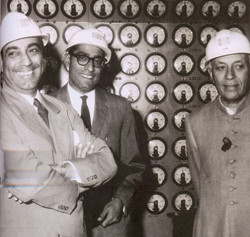
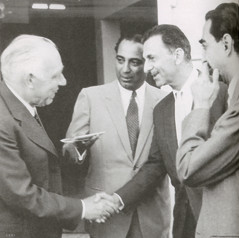
(left): Homi Bhabha, N. B. Prasad and Jawaharlal Nehru; (right): Niels Bohr, Homi Bhabha, J. R. D. Tata and Jamshed Bhabha
When Bhabha died in the plane crash in 1966 all of India was stunned. Jamshed recalled that Homi was not supposed to be on the flight which crashed. He was booked to go to Geneva en route to Vienna by a later flight which went through safely. Fittingly the uthamna ceremony was performed at the TIFR in, as Choksi put it, "that temple he had built for other worship.”
There is much else in the book — the start of TIFR and Trombay, his support of the Progressive Artists’ Group of which he was chief patron and prime supporter, and engaging anecdotes and reflections by those who knew him. Though there is a wealth of material in the book at no time does the reader feel overwhelmed by the detail, a tribute to the economy of expression and the book’s excellent layout.
This wonderfully designed and produced book, which I heartily commend, is a delight to read and to hold. It is evident that the authors and designer have collaborated closely (and as the end result shows, most fruitfully), to produce this gem. Would the fastidious, and at times pernickety, Bhabha have approved of this unique account of his life? I think he would have given it his unconditional approval.
◆ ◆ ◆
From the archive