
Religion
Preserving Iranshah’s sanctity
The proposed development of an residential/industrial complex in the vicinity of the holy Iranshah in Udvada, which caused consternation in the community, has been stymied for now
The proposed industrial development on the 200 acre tract of land located right behind the Iranshah Atash Behram in Udvada has been effectively stalled. To permanently safeguard the holiest of holies a notification will be issued and a development plan prepared to protect the sanctity of the place of pilgrimage for posterity, mentions an e-mail sent to Parsiana by Ahmedabad-based Behram Rustom Mehta, promoter of Aava Natural Mineral Water who facilitated the meeting of a delegation led by Dastur Khurshed K. Dastoor, high priest of Udvada with Gujarat chief minister Narendra Modi’s chief secretary and principal secretary on November 1, 2010.
Reads a press statement issued by Dastoor following the successful meeting: "The administration of Gujarat has taken immediate and effective action to redress the genuine grievances... of a… minority community. The collector has revoked the permission and all development is to be halted. It has been made clear that the status quo granted by the Gujarat Revenue Tribunal will be obeyed in letter and spirit by the developer and will not be construed to mean that the cancellation of the permission by the collector does not stand. If... any attempt is made to change the status quo, so as to jeopardize the very existence and sanctity of the first and most sacred fire temple... of the Zoroastrians of the world, it will be viewed by the state administration with the seriousness that it deserves and the wrong doers and profiteers shall pay the price of these actions.”
A report in The Indian Express (IE) dated November 7, 2010 reveals that the Valsad district collector, Nalin Thaker cancelled permission for transfer of the 200 acres of land for industry after Dastoor along with community members made representations to him that this holy place for Parsis is a heritage spot and that effluents from industries would pollute the ground water which is used for religious ceremonies. Thaker told IE: "A part of the land near the holy place was sold to a Bombay-based company called Nucleus in September while transfer for some other parts was under process. The holy priest moved the Revenue Tribunal, which asked the officials to maintain status quo. We have informed the Nucleus management about the decision.” The Times of India of October 31, 2010 quotes an insider estimate for purchase of the land as being Rs 40 crore.
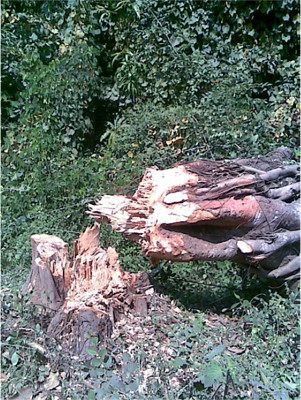
Photograph of one of the several trees allegedly chopped down by new owner. Photograph sent to Parsiana by Ketayun Bamji
As soon as it was clear that the ownership of the land had changed hands and it was allegedly being converted from agricultural to non-agricultural use, Dastoor issued a press release on October 31, 2010 on behalf of the Udvada Samast Anjuman to inform the community about the threat. The appeal garnered overwhelming support worldwide, with many community members signing the online petition as well.
The six High Priests, Dastoor, Dastur (Dr) Peshotan H. Mirza, Dastur (Dr) Kaikhusroo M. JamaspAsa, Dastur (Dr) Firoze M. Kotwal, Dastur Kaikhushroo Navroze Dastur Meherjirana and Dastur Cyrus N. Dastur, had earlier addressed a letter to Modi seeking his intervention in the matter. They mentioned that Udvada has very limited civic infrastructure with a coastline vulnerable to erosion by the sea, that development in the vicinity of the Iranshah would cause further irrevocable damage which would hurt the religious sentiments of Zoroastrians. The letter appealed to the chief minister to proclaim "Udvada a Heritage Village so that our sacred religious tenets, traditions, practices and observances are not affected in any way.”
A move to enlist Udvada as a UNESCO World Heritage site by the Foundation for Development of Udvada (FDU) had been scotched by WAPIZ (World Alliance of Parsi Irani Zarthoshtis) for fear that it would turn the pilgrimage town into a tourist destination and they would have little say in the affairs of the fire temple. They suggested that a two-kilometer radius around the Iranshah be declared a "no development zone,” which they reiterated on the WAPIZ Page of The Free Press Journal on October 29, 2010 as "it will have the same effect as ‘heritage’ but without the pitfalls of heritage in Udvada’s case.” However, on November 4, the WAPIZ Page conceded that "WAPIZ accepts the concept of a conservation heritage village, without it being a stepping stone to a world heritage cultural tourist center,” after four High Priests, Meherjirana, Kotwal, Mirza and Dastur assured them that they have agreed to having Udvada being classified as a Heritage Village only for the purpose of conserving the structures/houses and preventing industrial development around the Iranshah.
According to a report in the Sunday Mid Day of November 14, 2010 the new owners plan to develop the property by constructing 400 row houses and farm houses. Pramod Banka, who claimed to be the director and authorized signatory of Nucleus declined to comment saying, "I cannot give you any details on the phone.” He asked the Sunday Mid Day reporter to contact Adil Kherani, a Vapi-based builder.
Kherani accused the local residents of spreading rumors to jeopardize the project. "We plan to construct row houses and farm houses 250 meters away from the revered fire temple. There is nothing illegal about the project. The commotion is the result of misleading propaganda.” But local hotelier Makek Tadiwala fears that "Once the commercialization of the village begins, the next step could be to revert to the earlier plan to setting up industry.”
In the Jam-e-Jamshed on November 7, Dastoor and Mirza commented on community institutions that have, through the medium of the Press and the electronic media, expressed their views on the routes to be taken to preserve the Iranshah. While appreciating the solidarity expressed, they have cautioned them "to refrain from giving a ‘political’ hue to the matter of safeguarding” the venerated Iranshah. "The responsibility of preserving the sanctity... rests solely with the Udvada Samast Anjuman... (which) has been… taking care of Shreeji Pak Iranshah over the centuries and will continue to do so in future.”
Amidst the consternation and consensus on what should be done to stave off the threat, there is a note of dissent from octogenarian Faramarz Bejonji Sethna of Gandhidham in Kutch, Gujarat, who in an e-mail sent to Parsiana opines: "The fear that Iranshah at Udvada will be at risk is absolutely baseless... On the contrary, such a project will greatly benefit the town... without in any way harming Iranshah.” Light cottage industries that do not cause air, water or soil pollution should be encouraged by creating a Special Economic Zone with tax benefits for export oriented items as at present there are no employment opportunities for Parsi/Irani Zoroastrian youth in Udvada, he feels.
◆ ◆ ◆
From the archive