
Cover Story
The wadi at Udvada
The proposed sale of a 168-acre plantation close to the Iranshah Atash Behram has raised hackle
A lone peacock strode across the road and continued leisurely past the plantation of coconut trees. The peafowl was oblivious to the heated controversy concerning the land he so casually trod upon. For the 168 acres located in Udvada gaam (village), not far from the sacred and much revered Iranshah Atash Behram, is in the midst of a battle of minds, hearts and prices.
"You’re playing with fire,” said Salim Kherani on April 22, 2011 sitting on the front verandah of a spacious bungalow built by the land’s former owner Lallubhai Jogi. He was referring to the storm of controversy following his company Nucleus Developers Private Limited plans to develop the land purchased by them in July 2010. Less than a kilometer from the Iranshah precincts, the directors planned initially to develop a portion of the grounds for a garment factory and a residential complex and later farm houses. The alternative uses arose as objections were raised to each proposal by the local Parsi residents led by one of the two Udvada high priests, Dastur Khurshed Dastoor.
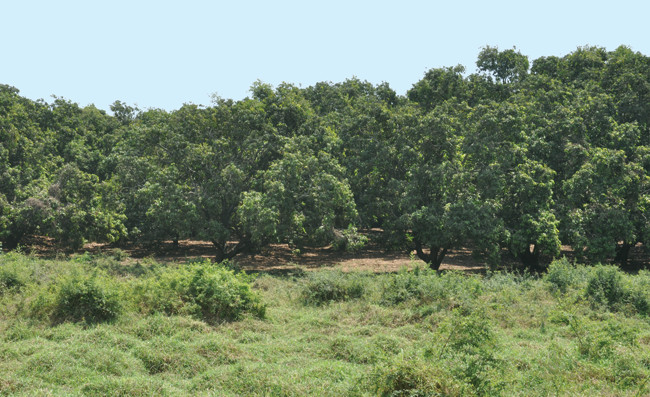
Part of the verdant plot;
Development of the wooded tract would "create an environmental hazard in Udvada,” alleges Dastoor seated at his Cusrow Baug residence on May 3, 2011. The area gets "flooded in the monsoons. Water from the village flows to the sea” via the plantation. With construction of plinths for the proposed homes "the absorption of water will not be there.”
In a press note released in February 2011 on behalf of the Udvada Samast Anjuman (USA) Dastoor had stated "The reason for the USA opposing the development revolves around the fact that Udvada is a small village with a population of just around 7,000 individuals, where civic amenities and facilities available are the very bare minimum. Lack of a proper sewerage system coupled with the ingress of the sea will accelerate the process of salination of the fresh water wells in the Atash Behram complex and thereby bring to a standstill higher liturgical ceremonies such as yashna, vendidad, etc from being performed. Inability to perform religious ceremonies such as yashna or vendidad will be disastrous. Commercial development of the type proposed would therefore have grave consequences for our sacred Shreeji Pak Iranshah.
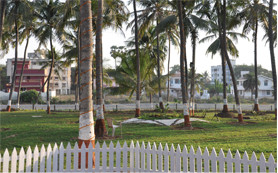
Development nearer to the Iranshah Atash Behram
"Further, commercialization on the massive scale envisaged and the resulting increase in nearly doubling of the population will place enormous strain on other already overstretched civic facilities such as drinking water, power generation, etc...
"The collector of Valsad District understanding that the religious sentiments of the community were outraged and appreciating the danger posed to Shreeji Pak Iranshah overturned the permission given by the local authorities to change the tenure of the property from agriculture to non-agriculture. However, Nucleus Developers Private Limited in an appeal filed before the Gujarat Revenue Tribunal (GRT) had the order of the collector set aside, albeit with a caveat that status quo as on date of order be maintained…
"It is to be clarified that the property in question (approximately 200 acres) has never ever belonged to the USA. Earlier ownership of approximately 38 acres vested with Shree Baug-e-Iranshah Trust, the trustees of which were Dasturji (Dr) Hormazdiar Kayoji Mirza, Sohrab Jehangirji Chiniwalla, Dr Homi Ratansha Bana, Khorshed Kaikhushroo Dubash. The trustees of Shree Baug-e-Iranshah Trust sold the property on April 4, 1966 to Jamnadas Nagardas Modi (then to Jogi), and the same has now been purchased by the said Nucleus Developers Private Limited.”
According to Dastoor the dastava (transfer) of land from Jogi to Nucleus has not been cleared. The land being agricultural, it reportedly has to be sold to an agriculturist.
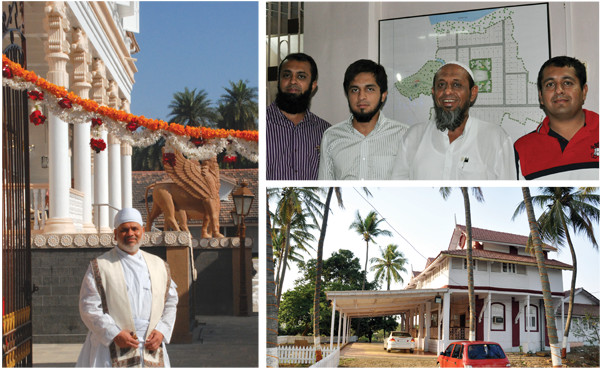
Dastur Khurshed Dastoor of Iranshah; Altaf, Naeen, Salim, Adil Kherani; family bungalow;
"We are ready to purchase the land at a reasonable price…we don’t want to cause any nuksaan (loss)” to the present purchaser "but we will not pay double the price,” Dastoor avers. He claims the sale price from the previous owner Lallubhai Jogi to Nucleus was finalized at Rs 37,50,00,000 (US $ 8,333,333) or around Rs 22,50,000 an acre! But Kherani envisions selling plots to individual buyers at Rs 500 to 600 a sq ft. At 43,560 sq ft to an acre, the price works out to Rs 2,40,00,000 an acre! If construction of homes is to be done Nucleus would charge an additional Rs 600 to Rs 700 a sq ft. Thus the built up cost would work out to around Rs 1,200 per sq ft. The current price for an ownership flat in Udvada is around that amount.
But to sell at that price, Kherani needs the necessary sanction from the local and state government. And of course, sufficient buyers. Farm houses upto 2,500 sq ft or so can however be constructed on one acre of land without converting the land from agriculture to non-agriculture. These can only be sold to Gujarat farmers as per the State regulations.
Nucleus has not approached the Ahmedabad High Court challenging the GRT order though they could, opines Dastoor. Also the development of Udvada has now been entrusted to the Udvada Area Development Authority (UADA) via a notification dated February 28, 2011. The Government of Gujarat, Urban Development and Urban Housing Department notification specifies the "area of Udvada Gram Panchayat” to be within the purview of the order and conservation architects Jamshed Bhiwandiwalla and Pankaj Joshi will assist in delineating the town’s zones, says Dastoor. There will be a core zone around the Iranshah, followed by a buffer area and a periphery zone.
"With the formation of UADA, the Gram Panchayat’s authority to grant no objection certificates will not be there. The UADA will decide,” states Dastoor. Development of non-Parsi property will not be affected, clarifies the priest. "Only Parsi houses in the heritage area” will be impacted by Udvada getting heritage status. Dastoor approximates about 250 to 280 houses belong to Parsis. "Jhupras (shanties) can be torn down and rebuilt. (The restrictions) will not affect the poor non-Parsis.” Referring to the allegations that non-Parsis in the area have opposed the heritage classification and the UADA notification, Dastoor counters "today 90 percent of Udvada is with us.”
As for Kherani’s allegation that much of the construction undertaken by Parsis in Udvada is illegal, Dastoor counters "everything is authorized, everything is legalized.” He notes that existing structures in a dilapidated condition are being reconstructed. "Old buildings are torn down and new buildings have come.” He concedes that near the Ashishwangh Hotel new development has come up but not on such a large scale as Nucleus’ project.
The promoters of Nucleus have met Dastoor. He told them "we are ready to purchase the land at a reasonable rate.” Dastoor claims they offered him a 50 percent partnership in the project but he replied "no, sell the land to my community.” The purchasers also had a lengthy meeting with the trustees of the Bombay Parsi Punchayet (BPP) to work out a compromise but Dastoor cautioned the BPP, "you can’t do anything without our permission.”
Dastoor denies there is any bias against Kherani "because they are Muslims.”
In a letter dated February 15, 2011 on behalf of Nucleus Developers Private Limited addressed to "respected citizens of Udvada” Kherani noted: "Our project is 100 percent legal and no one can stop our project under any of the India laws, under any circumstances, as opined by leading advocates and attorneys from Bombay and Surat. However as we did not want to work under any controversial environment, we decided to leave open, 25 acres of the land, on the side, as common plot where we shall develop beautiful landscape, a garden, children playground, jogging track, English medium school for children and for the people of the village, the Parsi and non-Parsi of the village and the plot holders of our project.
"By leaving aside the above said 25 acres of land our project site is 900 m away from the Pak Iranshah holy fire temple. And instead of passing through the narrow land of Udvada village, for going to our project site, we have developed our main gate and the separate road which is about one kilometer away from the holy fire temple. Hence there will not arise any question of traffic jam or vehicular congestion in the village.
"Our project will develop the area and will create job opportunities for 300 to 400 persons of the village. Our project has been registered under ‘Vibrant Gujarat — 2011’ and we have promised the government creation of about 250 to 300 jobs for the people of Udvada village. As over Rs 200 crores of funds will be invested in our project, our project will develop all the modern and state of the art amenities and facilities.
"Our project had been give an NOC (no objection certificate) by the Udvada Gram Panchayat by passing the necessary resolution. To the Gram Panchayat also we have provided a written undertaking that in our plot we will not undertake any industrial activity.
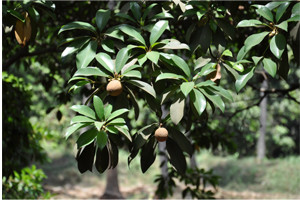
Chikoo trees on the property: An abundance of produce
"Today, in the vicinity of Pak Iranshah fire temple, of about 170 to 180 meters, there are about 36 apartment buildings and with that there are situated about 400 flats with septic tanks, around the said fire temple. Is this out of the sight of Vada Dasturji? Is it because these buildings, bungalows, etc belong to Parsi community?” Kherani claims only around 22 of the town’s 7,000 residents are Parsis. Dastoor disputes this statistic.
"For five years a board has been put up mentioning that this property was for sale,” says the 54-year-old Kherani. "Why did Dastoor not get the community to come together to buy then? Approximately 200 buyers had come to see the place. The earlier owner Modi could not do agriculture because he said it was not practical and so he went to the collector to get permission to sell the land to Jogi, a farmer of Gujarat who has lived in Daman for 40 years. Lallu had two sons, one in America and one here who died suddenly. Jogi was already in his mid-70s and he went to the collector to state that it was not possible to look after the estate alone. Earlier Modi had kept the land for two to three years after buying it from a Parsi trust. So I asked ‘were the Parsis sleeping for the past five years?’”... When he saw the estate Kherani liked it. "Udvada is a very nice gaam. I have my business in Vapi and so I know about Iranshah and I respect it.”
Kherani refers to the development of other religious centers such as Mecca and Shirdi. "If you see Mecca today, at one time 50 lakh people converge. Earlier it was one small structure. Now it has grown and some people stay even a month for Haj.
"If there are only farm houses here people are not going to stay all the time. If they come for a few days in a month or if a company buys a home for their executives, who come for a few days, what is wrong with that?
"Most importantly your head Dasturji does not even stay here. So many Parsis come from Bombay and elsewhere and go off to Daman because there are no good schools in Udvada, no gardens, parks, swimming pools. Let us be honest, nobody prays all day. We thought Parsis would like all this so we came with that idea. Here was a chance for development and when you see Shirdi, Tirupati and our Mecca there is development… Not so for Udvada.
"We have paid the correct price for the land. We have a right to sell or not to sell. There is literally blackmail and we are being told to sell at the price we bought. How is that possible? They are using all tactics possible to pressure us. In and around this area 64 new residential units are coming up by Surat builder Rajubhai. Why are the Parsis not stopping him? He did new boring for wells just now. At the same time many others have also dug borewells. Therefore it is illegal to stop us. Many buildings, hotels, etc here all have carried out illegal work.” Kherani states he derived the information about the alleged illegalities through filing Right to Information applications.
"If there are some Parsis who want to buy the full project we will be very happy to sell,” says Kherani. "Dastur Khurshed met my partner four to five times in Bombay. If Parsis are interested in whole property then we can even make smaller plots to make it affordable for 500 to 600 sq ft without any amenities. Right now we are giving five star amenities in the same rate. But for Parsis we can give a special discount of 10 percent. We will make roads, when each one builds houses. We are also building contractors. The average commercial rate is Rs 700 a sq ft for cost of construction as basic FSI (floor space index) in Gujarat is 1:1. Our byelaws for the land say no sub-divisions, no high rises and no resale without consent of the society.”
Will trees be cut for the construction of houses? "Around five to seven percent will be cut,” says Kherani. The houses will be as far as possible be built between the clusters of trees. And an additional "25 percent more trees will be planted” to compensate for the loss, he says. The plantation has around 7,500 trees of which 6,400 are coconut, 600 chikoo, 500 mango and 200 other, states Kherani. Dastoor claims there are 10,000 plus coconut trees, 1,500 mango, 500 chikoo plus rice and grain plantation. "It’s a fully developed wadi,” says Dastoor and estimates an annual income of around two crore rupees (US $ 4,44,444) from the produce.
The Gram Panchayat will earn around six to seven lakh rupees in grants from the state due to the increase in taxes earned, claims Kherani. "We intend to build an international school also on 10 acres with a hostel, tennis court, etc. From the grant money we can repair and protect the sea wall. We can work with the Udvada town committee. Our family trust can help and give old people food. Our business is in Vapi and Daman and we have 5,000 workers totally, mainly in garment export. For the packing, sealing, labeling if we can move some of the work here, at least 500 ladies can be employed. In the nature of this job there is no pollution, no noise.
"My father Abubaker had a paper and land business and I joined the garment business with my partner. We first started at Daman at Rangarwada then Movai, Balida. A farm house project we started earlier was of 200 crores. We have been in the area since the last 35 years. There have been three Hindu Muslim riots and we live in a Hindu neighborhood. We have faced no problem. We treat all Hindus as our close relatives.”
Despite the posturing on both sides and the war of words (e-mails, pamphlets, articles were and are regularly issued) the crux of the matter boils down to a fair consideration for the land or a structural development acceptable to all. A quick and amicable solution will help to foster the continued harmonious co-existence between the communities of this the most holy pilgrim site of the Parsis.
◆ ◆ ◆
From the archive