
Cover Story
“The problems of Udvada remain”
Dastur Khurshed Dastoor, High Priest of Udvada, speaks of some of the difficulties facing the community there and elsewhere
"My father used to say, ‘Sutharè khursi banavi né bhool kidhi (the making of the chair of office has been an error).’ Personal ego, the yearning to become a trustee, leads to antagonisms. We can solve any problem by sitting across the table with an open mind — not a closed one,” says Dastur Khurshed Dastoor Kaikobad Dastoor.
Community events have left him both sadder and wiser. As High Priest of Iranshah, Udvada, president of the Udvada Samast Anjuman and especially as chairman of the Foundation for Development of Udvada (FDU), Dastoor has seen through the conniving and strategizing of community politicians and revised some of his earlier opinions. The flak the FDU has faced and the allegations it has endured despite documented evidence to the contrary, is a matter of community knowledge. Dastoor referred to some of it in the context of an interview with Parsiana at his Cusrow Baug residence on November 13, 2007.
Crediting Gujarat chief minister Narendra Modi with the establishment of the FDU, Dastoor’s press release dated October 2, 2007 had announced a celebration of the 265th anniversary of the enthronement of the Iranshah fire at Udvada according to the Gregorian calendar on Sunday, October 28, 2007 along with the inauguration of the Zoroastrian Information Centre (ZIC) at Udvada. In that he had recounted how Modi had lauded the pivotal role of Parsis in nation building on the occasion of the foundation stone laying ceremony of the Institute of Hotel Management at Ahmedabad in January 2002 when the Government of India’s minister for tourism and culture, Jagmohan, was also present. To enable the nation to be more cognizant of the role of this micro community, Modi requested renowned hotelier Jehangir Cama of Ahmedabad to showcase Udvada as a symbol of the Parsi community’s traditions of tolerance, harmony and progress.
The Governments of India (GOI) and Gujarat (GOG) eventually allocated a sum of Rs 97.27 lakhs and 24.32 lakhs respectively towards the project. The FDU board of trustees included Jehangir Cama, co chairman; Dinshaw Tamboly, managing trustee; Pravin Laheri, Government nominee Minoo Shroff, Burjor Antia, Homai Modi, Dr Homi Dhalla, Pirojshah Sidhwa and Behram Lakda-wala. The ZIC was GOG’s first priority. Its other recommendations were the establishment of a heritage walk at Udvada, the organizing of an annual festival of Parsis from all over the world and the institution of a tourist circuit of all the places that had housed the sacred fire during its 1,282-year-long odyssey.
The land and building of the ZIC is now a national property held in the name of the President of India, says Dastoor. The artifacts and other contents depicting the history and culture of the community will remain the property of the FDU. The maintenance of the Centre is entirely the responsibility of the FDU, he adds.
In a box titled "FDU’s absurd priorities” in The Free Press Journal (FPJ)’s WAPIZ Page (October 26, 2007) the World Alliance of Parsi Irani Zarthoshtis had accused the FDU of spending one crore five lakh rupees on the museum project and leaving only 16 lakh rupees for electricity, water supply, sewage, roads and a sea wall. "For four years the FDU has done nothing about the infrastructure and only concentrated on this overpriced museum/Information Centre. In fact the FDU trust deed does not even mention infrastructural development,” it states.
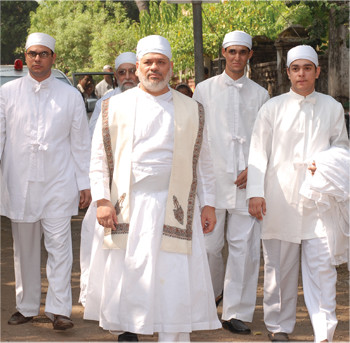
Dastur Khurshed Dastoor flanked by younger mobeds, in Udvada
Rebuts the Dastur, "The money was given (by the government) only for the Centre. The road from the station to Udvada gam would cost at least three lakh rupees. Udvada already has good roads, good electric power supply except for the weekly cut on Saturday. The disposal of garbage is being done in pits dug near the Gymkhana site. The local punchayet has a tractor to collect the solid waste and dump it there. Drinking water supply already exists but the pipelines are corroded. The collector is in charge of changing the pipes in phases. The government has incurred three to four crore rupees of expenditure on all these items, thanks to former Valsad Collector Dilip Rawal who was very pro-Parsi. Other villages are envious of Udvada…We have had meetings with the Collector every month,” notes Dastoor, giving Parsiana a xerox copy of the minutes of March 8, 2006 which had been published in their entirety in Jam-e-Jamshed Weekly of March 26, 2006.
The minutes in Gujarati, signed by the collector of Valsad, detail the presence of 26 individuals representing the government and 14 from the side of the Udvada Anju-man and the FDU including Dastoor and Tamboly as well as two FDU architects Pankaj Joshi and Jamshid Bhiwandiwala. The 13 items discussed include police protection for Udvada, road signs, sewerage, waste disposal, the widening of the road from the station to the town, public toilets to avoid messing of the beach, the creation of a garden, the repair and/or replacement of corroded water pipes, traffic control, the planting of trees along the beach to prevent erosion and the installation of solar lights in 10 spots so that the streets continue to be lit even in case of an electricity crisis. Investing Udvada with the title of ‘Heritage Precinct’ was also discussed. Responsibility for each area of work has been assigned according to the minutes. It may be further noted that at that time the late Lt Gen Adi Sethna was the Zoroastrian member of the National Commission for Minorities.
The publication of the minutes of March 2006 also give the lie to the WAPIZ contention so boldly proclaimed in the FPJ: "FDU hijacks the infrastructure program for Udvada initiated by Dr Mehroo Bengalee.” It further notes, "a couple of months ago ... Bengalee, newly appointed member of the Minorities Commission and the founder member of WAPIZ, along with WAPIZ chairman Areez Khambatta and Ahmedabad Parsi Punchayet president Kersi Shethna and Dr Behram S. Anklesaria met with chief minister Narendra Modi and impressed upon him to urgently begin much needed infrastructural projects in Udvada. She submitted a 10-point program…Not a single member of the FDU was even present at this meeting with the chief minister.” Noting that Dastoor in his article in the Jam-e-Jamshed Weekly of October 7, 2007 and Tamboly in a letter dated October 6, 2007 had quoted the same 10-point program, WAPIZ boldly claimed, "This is a splendid example of what the Parsis call in Gujarati, chaalti gaadi-é chadhee javoon (claim credit for others’ work in pro-gress)!”
Dastoor says that at no stage did anyone in Udvada oppose the idea of the government designating Udvada a Pavitra Yatra Dhaam. "We are trying to get the government to declare it a Pavitra Yatra Dhaam because only then will high rise buildings stop being built. That is the first and foremost aim of the FDU (to preserve the town’s heritage character). Has any member of WAPIZ tried to take over and restore an old community bungalow?” he asks adding, "Almost 30 such buildings have come up with some non-Parsi residents…WAPIZ has misled people. Basically the objection to the designation came from people outside Udvada… It is one of their political gimmicks.”
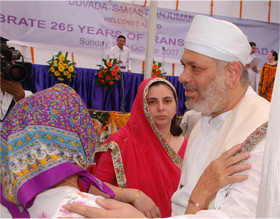
With Mehroo Bengalee (left) and wife Havovy (center)
The High Priest agreed with Parsiana that faith in Iranshah has been increasing in recent years, but he emphasizes that the problems of Udvada remain. "People coming for a few hours and going away are not going to solve them. I am very worried about the local population. There are only 80 Parsi (full-time) residents left. If people come and settle there, things may change…”
Dastoor notes that the facts of the declining Parsi population and the aging of the community in India cannot be wished away. Will we be able to maintain our properties in Bombay and Gujarat? we question this younger generation High Priest. "In Bharuch, for example, there are four agiaries with a population of 150. The agiaries are in bad shape,” he notes. Using the Lonavala agiary, which has accommodated two fires in two separate keblas in a single building, as an example, he feels we could reproduce this arrangement in many more places. The freed real estate could be sold to create funds, the better to look after the fires, the mobeds, the chasniwalas and the remaining structures. "If you want to take care of agiaries let there be one such structure in each baug. Rustom Baug, Panthaky Baug, Jer Baug for instance, have no agiary. It would help the colony as well as the fires in the two separate keblas instead of just doing boi and closing the the agiary for the rest of the time.”
What was it like to grow up as the son of a High Priest? we ask this scion of the late Freny and the late Dastur Kaikobad Dastoor, High Priest of Udvada. "At times I never wanted to take up the job because of the difficulties my father had gone through,” says the alumnus of the Athornan Madressa at Dadar, who lived at the Gamadia Hostel at Tardeo while he pursued his BCom degree at Bombay’s H. R. College. He recalls the family’s predicament "when my father was required to go for knee replacement. The cost was one lakh rupees for each knee. He said we will have to apply to the charities. Only if the money comes…On the other hand when he underwent a by-pass surgery, the R. D. Sethna Trust volunteered to bear the expenses. So I had mixed feelings, but finally I accepted that I have to be a dastur one way or another.”
After graduation he settled in Udvada. Married to Havovy (née Mogul) the couple have two daughters, Parinaz, 10 and Shanaya, six and a son Daraius, a winsome toddler who will be two in January. As a family man Dastoor shares the worries and emotions of his flock, in keeping with the requirement of the religion. He also shares a larger concern, to steer the community in a rapidly changing world, maintain its traditions and standing in the nation, provide an impetus to its aspirations while keeping the ego on a leash…
◆ ◆ ◆
From the archive