
History
Madras musings – I
For over 200 years Zoroastrians have lived and prospered in this southern metropolis
When you only have a tantalizing one-liner that goes "The first Parsis came to Madras in 1795 on a mission from the Rajah of Coorg,” you really don’t know what to make of it. Luckily we can google our way out of mysteries, these days.
First, a brief account of Coorg, Tipu Sultan and the East India Company of the 1790s. While fighting the British during the four Mysore Wars, Tipu was also trying to conquer Coorg. After many battles and skirmishes, the ruling king, Dodda Veera Rajendra appealed to the British for help. A formal treaty was signed between the king and the Company in 1790. However, troubles and conspiracies continued and in 1809 a much anguished and tormented Veera Rajendra passed away. His brother Lingara took charge.
In a detailed and fascinating account of the tumultuous history of Coorg by Hermann Moegling there is mention of one "Parsi Hirji” who was part of a mission from the Rajah of Coorg in 1809 to present to the governor a portrait of the late Veera Rajendra. The governor received the portrait graciously and the delegation was "dismissed.”
What was Madras like in 1800? With Tipu dead, the troublesome wars were at an end. The French invasion was a just a bad dream. The Nawab of Arcot, Muhammad Ali, willingly handed over administration of his territory in return for a pension. Company rule was firmly established, more solidly than in any of the other presidencies. With the ensuing peace, the city began to extend beyond Fort.
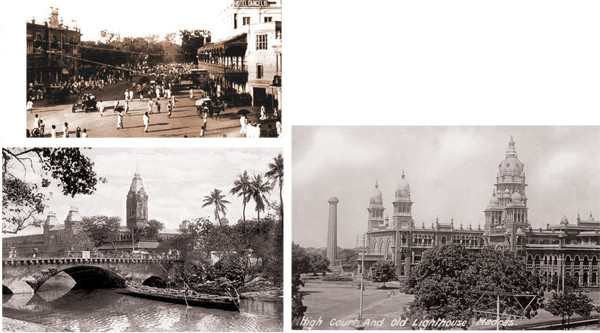
Above: Mount Road, 1908; Alongside: (from left) Central railway station 1925, and High Court and old lighthouse
When Heerjibhai Maneckji Kharas accompanied by five other Parsis and two priests, decided to reside in Madras, it is likely that the move was not pre-planned but taken after arrival. They bought a plot in Royapuram, opposite the Catholic Church.
After the Parsis settled in Madras, a dakhma was built nearby. For years the dakhma remained unused as, according to religious belief, the first body to be placed in it should be that of a child or a very elderly person. When this did not occur, the system of burial was adopted and the dakhma was dismantled.
On January 5, 1799, the partners of the firm Hormusji Edulji Panday obtained a further plot of land from Governor Edward Clive of Fort St. George. In 1814, when the number of Parsi settlers in Madras had increased, additional land was added to the original plot, totalling about 32 grounds and the plot was leased to them by the Company with a proviso that the lease may be renewed for a further period of 99 years on payment of a sum of 100 pagodas! The burial ground was on a portion of this land.
There is hardly any record of the next 60 years. On November 20, 1876, the Parsis formed themselves into an association known as the Parsi Panchayat. Eleven members were present at the meeting and a committee of five members was elected to manage its affairs. In 1893, Cawasji Panday was the first Parsi to be appointed sheriff of Madras.
Interestingly, when the Crown assumed sovereignty in 1858, all lands leased by the Company for a term of 99 years were deemed to be the property of the lessees. In 1895 the collector of Madras transferred ownership of the plot in Royapuram to the president of the Panchayat. In 1900, this body was renamed the Madras Parsi Zarthosti Anjuman. The property was referred to as "Anjuman Bagh” and many residential blocks were constructed over the years.
A century later all the great institutions had been established in Madras — the high court, university buildings, medical college, railway stations, general post office. Many gracious colonial style bungalows dotted the city. First Line Beach had been constructed and there was a proper harbor.
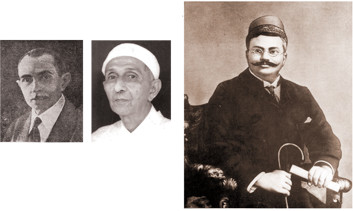
From left: Hormusji Nowroji, Ervad Peshotan Daji and Phiroj Clubwala
The Parsis of 1900 were generally prosperous. From a very fascinating account of the residents of Madras by Madhavrai Gigabhai Joshi in 1928, we learn of their various occupations. They were dealers of motor cars and cycles, perfumes and dyes. They were government and railway officials, managers of banks and shops. Some established soda water and ice factories.
Though two priests accompanied the first mission, there was no official priest in the community for over a hundred years and neither was there a place of worship. The first priest was appointed in 1906. When Jal, the 14-year-old son of the philanthropist Phiroj M. Clubwala died, the grieving family donated a fire temple in his memory in Royapuram. It was designed by Hormusji Nowroji (a road in his name still exists in Chetpet) and consecrated on August 7, 1910.
When Clubwala died in 1927, to honor him the community bought a building down the road called Greenfields as a memorial hall and club. When this was opened in 1930, the community had a meeting place where they could participate in sports and cultural activities, celebrate festivals and marriages.
In 1995, the community celebrated the bicentennial of Parsi residence in Madras. The Anjuman administers the Anjuman Bagh, which serves as a dharamshala for travelers, and more than 15 residential flats which provide subsidized housing for deserving members, especially senior citizens.
The "Parsi Club” having been completely renovated in 1980, continues to be the watering hole of the community (around 250-strong) which meets at least once a month in spite of the fact that most of the members have now settled in far-flung localities.
The first Irani families came to Madras around 1900 and started the famous "Irani” cafes such as National Café on Mount Road and Café Zum Zum on Second Line Beach, serving wholesome food at reasonable rates. One of the most respected Iranis was Rustom F. Mazda who set up (probably) the city’s first ice factory and cold storage, at the end of Pantheon Road where Albert Theatre now stands. The first Star Talkies at Round Tana was started by an Irani family. Later, they built Casino Theatre. The old Elphinstone was built by the well-known Madan "theater” family of Calcuttta. The New Elphinstone was started by the famous Sohrab Modi and managed by Parsis till it closed down in 1968. Wellington Talkies was an enterprise of the Dorabji family and all S. S. Vasan’s films were screened there.
Among the individuals who contributed to the economic, social and cultural fabric of the city were Hormusji Nowroji, president of our Anjuman for almost 45 years, who designed the fire temple in Royapuram. He must have been a well-known personality in the city. Sadly, no records of his achievements exist.
Philanthropist-trader Phiroj M. Clubwala not only donated a fire temple to the Anjuman, the first after a hundred years of residence, he also built a block in the Anjuman Bagh and donated a large tract of land near his house to St. Kevin’s Presentation Convent and School — the best school for girls in North Madras, even today.
Ervad Peshotan Daji, "Pesi” as he was affectionately called, started as an assistant priest at the young age of 12. His grandfather and father managed the fire temple from 1913 to 1965. Daji then took on the mantle and continued to serve the community till 1985, a span of 60 years altogether. His devotion to the holy fire was put to the test when, during World War II, Royapuram was evacuated and the Emden fired a salvo. Daji, as a young priest refused to close down the fire temple and stayed on alone to keep the fire burning.
To be continued
◆ ◆ ◆
From the archive