
Books
Rustamji’s ringside revelations
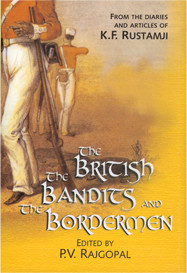
The British, The Bandits and The Bordermen, From the Diaries and Articles of K. F. Rustamji edited by P. V. Rajgopal. Published in 2009 by Wisdom Tree, 4779/23, Ansari Road, Darya Ganj, New Delhi 110002. Pp: xxiii + 388. Price: Rs 495.
Khusro Faramurz Rustamji, the founder director general (DG) of the Border Security Force (BSF) and rightly considered the doyen of Indian police officers is the only policeman to have been awarded the Padma Vibhushan, India’s second highest civilian award. Not only was the National Coast Guard his brainchild but his two articles in The Indian Express on the plight of undertrials in Bihar’s jails proved to be the catalyst and formed the basis for the first public interest litigation filed in India in 1979.
Rustamji lived through some of the most stirring and epoch-making events in Indian history. He had started writing a diary way back in November 1938, something which he continued till December 1970. Apart from his diaries (3,500 pages) Rustamji was equally prolific with his notes and articles which run into about 7,000 pages of printed and typed material. Now as a sequel to I was Nehru’s Shadow, the editor P. V. Rajgopal has compiled this volume from Rustamji’s prolific output and given us another delightful book. Rajgopal, a retired IPS (Indian Police Service) officer of the 1965 batch, came into contact with Rustamji when he (Rajgopal) was director of the National Police Academy at Hyderabad. When Rajgopal expressed a desire to write his biography, Rustamji entrusted his entire oeuvre to him with the proviso that whatever he published should be based only on his diaries and writings and should be in chronological order.
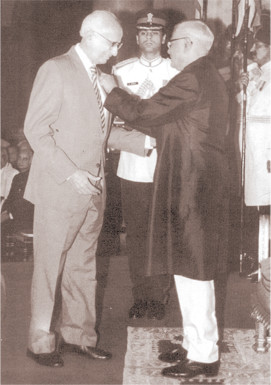
Khusro Rustamji being conferred the Padma Vibhushan at the hands of President R. Venkataraman in 1991
Rajgopal has done a fine job of culling out what is presumably the best of 10,000 pages of Rustamji’s writings, and now presents us with this ‘autobiographical narrative’ of a very successful and interesting life. Why Rustamji did not publish his autobiography during his lifetime remains a mystery since it is certain that his desire for confidential expansion also extended to his writings being published and read as is evidenced in his own words: "My fondest hope is that my diaries will be edited and years hence, when people read them, I hope they will feel for a few minutes the pulse of the times in which I lived, the breath of the men who mattered in my life, and perhaps my age.”
In his long and illustrious career Rustamji was witness to many historical developments in pre and post-independent India. This book presents a first person account, not so much about himself but about some of those tumultuous developments of Indian history recorded by him. As Rajgopal rightly says in his introduction, "Rather than presenting a ringside view of history, the book is more in the nature of an account of a man who was inside the ring itself, as it were, and wrote about the ‘bout’ immediately thereafter.”
Rustamji’s wit and sense of humor are evident throughout the book. Narrating how his mother Banoobai would chastise the children with a frightening scream ("Telling lies, telling lies”) Rustamji narrates that even when he was old and grey he would cross his fingers and say to himself "Mummy, forgive me wherever you are,” whenever he was forced to lie, something which he says is "unavoidable when you are married and also are a policeman.”
The book is full of interesting anecdotes and stories. On Pandit Jawaharlal Nehru’s birthday in 1959 Rustamji gave him a unique ‘gift’ — the news that the Madhya Pradesh police of which he was the head had killed the notorious nose-chopping bandit, Gabbar Singh better known as Gabra. This same Gabra provided the inspiration for Ramesh Sippy’s Gabbar Singh in Sholay, an iconic screen villain now a household name across a generation of Hindi moviegoers.
An interesting and hitherto unknown incident concerns how Rustamji and the BSF saved the plane piloted by Rajiv Gandhi from being hijacked in July 1970. Rustamji had received a tipoff from one of his intelligence officers who had infiltrated a group that wanted to liberate Kashmir by sabotage. The BSF agent was trained in guerilla activities by Pakistan and taught how to hijack a Fokker plane with a hand grenade. When this was reported to Rustamji he found to his horror that the Fokker pilot on the Jammu run was none other than the Prime Minister’s son Rajiv Gandhi, who was then a pilot with Indian Airlines. The day after he received the report Rustamji had an interaction with the Prime Minister and though he does not mention it in his diary he must have briefed the Prime Minister about the hijacking plan.
Still, a hijacking did occur (luckily not when Rajiv Gandhi was the pilot) on January 30, 1971 by two young men, Hashim Qureshi and his cousin, who hijacked an Indian Airlines plane from Srinagar to Jammu. It was taken to Lahore and the two hijackers were treated as national heroes by the then Pakistan foreign minister Zulfiqar Ali Bhutto. The passengers and crew members were allowed to leave for India but when India demanded the return of the aircraft it was set on fire the same evening. India responded by canceling the permission for all Pakistan military aircraft to over fly Indian territory and subsequently extended the ban to commercial flights also. In a subsequent commission of inquiry headed by P. N. Haskar, Rustamji explained all the facts and took the blame on himself. Apparently Qureshi had been promised a job by the BSF, but unknown to them could not withstand pressure from the agency in Pakistan, fearing for the safety of his relatives. Thus, Rustamji’s double agent ploy failed. The Commission concluded that there was a lapse on the part of intelligence but conceded that saving Rajiv Gandhi was a job well done.
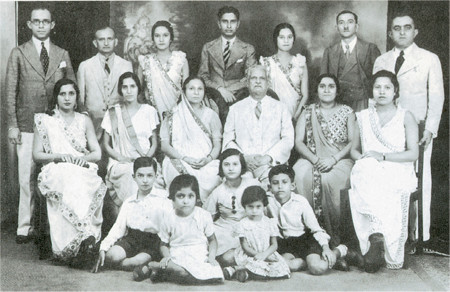
Khusro (standing fourth from left) with his parents (seated center) and family in 1937
It is well known that Rustamji and the then Chief of Army Staff General Sam Manekshaw often clashed through the stormy days of the Bangladesh war. Rustamji narrates how he rang up Manekshaw to congratulate him on his brilliant and early victory in the 1971 conflict. After congratulating him he said, "Chief, do you realize we have not quarreled for 12 days?” Manekshaw laughed and said, "You bloody Parsi.” But there was no doubt that the relationship remained an uneasy one and the author narrates how while addressing some BSF officers, General Manekshaw was asked to remain seated but preferred to keep standing saying, "It would help me to look down upon you.” While this may have been typical of Manekshaw’s wit not all took the remark in that spirit.
Ironically, the founder director general of the BSF was the only one to voice opposition to the creation of the Force when it was first mooted at a high level conference in Delhi. Rustamji was at that time inspector general of police, Madhya Pradesh, and a meeting of the home ministers and chiefs of police from all the states was called by the Union Home Minister Gulzarilal Nanda in May 1965. Prime Minister Lal Bahadur Shastri wanted the international border to be guarded by a separate border force under the aegis of the central government. Rustamji opposed the formation of the new Force citing economic reasons. But the Prime Minister had made up his mind and concluded the meeting by saying, "Gentlemen I am glad we have all agreed, we will go ahead and raise the new central border force.” Raj-gopal says that a possible reason for Rustamji’s objection was that he had been instructed to do so by the then chief minister of Madhya Pradesh Pandit D. P. Mishra. Since Rustamji was attending the conference as a representative of the Madhya Pradesh Government he had no alternative but to comply with the orders of the chief minister. This fact was told to Rajgopal by Vidya Charan Shukla, a former union minister who was present in the room in Madhya Pradesh Bhavan in New Delhi when Rustamji was given these orders.
Stranger still, the man who had opposed the creation of the new Force was selected to be its first DG when he had nine years of service left as inspector general of police. Rustamji notes that he was taken by surprise, was told that he would be promoted to the rank of DG, given an extra star in his badge of rank, and an increase of Rs 250 in pay. Rustamji was made DG, superseding 25 officers senior to him and when L. P. Singh, the then union home secretary, was asked as to how the choice fell on Rustamji he said that raising a new Force was a Herculean task and that he wanted someone who had fire in his belly. Rustamji, he felt, had that fire.
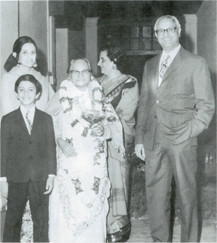
Rustamji (far right) with family (L to R): son Cyrus, daughter Kerman, mother Banoobai and wife Naju
Rustamji notes that after he had accepted or rather was forced to accept his new assignment, he convinced Singh that there should be an ‘S’ between Border and Force because otherwise they would be called BFs. This, says Rustamji, was his first contribution to the BSF. A little known fact is that Rustamji fixed December 1, 1965 as the raising day of the new Force as his mother’s birthday fell on that day.
When Rustamji joined the BSF in July 1965 there was no one above him and there was no one below him. When he left it nine years later, there were 60,000 men, the Force had developed character, and acquired the confidence of a nation. Rustamji narrates a comic incident on his last day with the BSF. His confidential records almirah suddenly started to totter and fall. It almost came down on his secretary and himself. With great effort they managed to get it straight again while Rustamji ran to enlist the help of the peons in the corridor. Rustamji notes with his customary wit, what a glorious obituary the incident would have made. "On the last day of his service the director general, BSF was buried under his own confidential records.” Rustamji was offered the post of special secretary in the Home Ministry after retirement as well as the governorship of the state of Mizoram. He accepted the former because he wanted to continue to stay on in Delhi since he did not want his son Cyrus’ education to be disturbed.
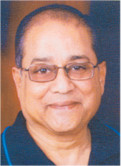
Author P. V. Rajgopal
One can only speculate on what further treasures lie hidden among Rustamji’s diaries and papers. But we must be grateful to Rajgopal for what he has given us. There is little doubt that this compilation from Rustamji’s articles and diaries will continue to be read by policemen and civilians alike with both profit and pleasure.
◆ ◆ ◆
From the archive