
Books
The premier's policeman
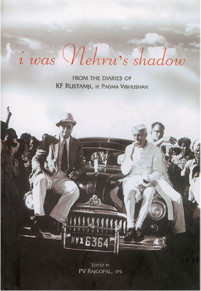
i was Nehru's shadow: From the Diaries of K. F. Rustamji, IP, Padma Vibhushan edited by P. V. Rajgopal. Published in 2006 by Wisdom Tree, 4779/23 Ansari Road, Daryaganj, New Delhi 110002. Pp: 237. Price: Rs 395.
i was Nehru’s shadow: From the Diaries of K. F. Rustamji, IP, Padma Vibhushan edited by P. V. Rajgopal. Published in 2006 by Wisdom Tree, 4779/23 Ansari Road, Daryaganj, New Delhi 110002. Pp: 237. Price: Rs 395.
Khusro Framroze Rustamji, the founder of the Border Security Force was a prolific writer who contributed articles to newspapers and magazines throughout his life. He also found time to record his experiences on tour in the form of detailed memos which he distributed in the form of Tour Notes. And he kept a diary for almost three decades. Rustamji gave away his private papers to the Nehru Memorial Museum and Library, New Delhi in 1993. The diaries were given on the condition that they should not be shown to anyone without his permission. When Rustamji met P. V. Rajgopal at the National Police Academy in Hyderabad in 1999 the latter showed an interest in writing his biography. Rustamji agreed readily, no doubt quite flattered that anyone would want to write on his life. Of the 3,500 pages of diaries about 1,600 pages are devoted to the period when Rustamji was Nehru’s chief security officer. Since the excerpts deal only with Nehru it can also be seen as an attempt at a biographical portrait of Nehru by Rajgopal through the medium of Rustamji’s diaries.
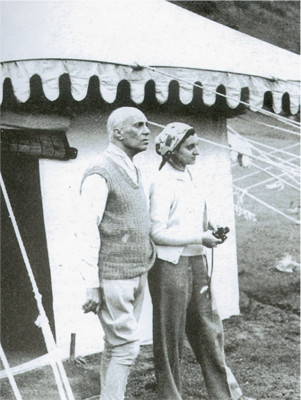
Nehru and Indira Gandhi in Sonamarg, Kashmir, August 1952
The editor, an officer of the 1965 batch of the Indian Police Service (IPS), has divided the book into 12 broad chapters and selected entries relevant to the chapters from the diaries of different days, arranging them to form a seamless narrative. Though this adaptation of diary entries has been competently done, at times one is left wondering as to how much is lost of the original import. To know when Rustamji wrote that particular entry and its context (i.e. the major event or chain of events which inspired that entry) would have added authenticity to the text. Consider for example Rustamji’s rather enigmatic, "I felt, small matters like his instruction about a box of sweets that should not be distributed in the plane so that we could take it home – have had a bigger impact on me than all his speeches and statements.” It would have been nicer if the selected entries had been reproduced in toto with a more liberal use of footnotes and explanatory notes serving to clarify any point when required.
Rajgopal also fails to tell us if Rustamji faithfully wrote an entry a day for the entire period he was with Nehru or only confided in his dairy when there was an event worthy of being written about. Was it a daily diary or an event based one?
The danger with such selective editing is that the editor leaves out what might have seemed to him to be commonplace and trivial, retaining everything which he thought was worth preserving. But without the commonplace and the trivial the best diaries would be bereft of much that makes them compelling and enduringly fascinating. For instance Rustamji says that December 17, 1951 was a big day in his life because he met Nehru for the first time in Aurangabad where he was the DIG. The chapter carries on and one really does not know what other thoughts and observations were recorded in the entry for that day.
The best diaries are those in which the voice of the individual comes through untainted by self-censorship or a desire to please. First and foremost the diarist must write for himself because those who are looking towards publication and public recognition invariably strike a phoney note. Nehru knew that he kept notes but Rustamji never showed him his diaries because "I felt that it would hamper my freedom to write if I wrote in order to show him what I had written.” Rustamji showed his diaries only to Prakash Tandon, the former chairman of Hindustan Lever, whose advice he apparently took on how to improve the quality of his writing.
Like many diarists before him Rustamji’s diary became for him more than a friend. Closer than even his wife Naju he confided in his diary. "The journal became the spokesman of my heart, the purifier of my thoughts, the source of my strength.” On another occasion he writes: "I have shunned every human contact so that I could write my diary, which to me was a companion in which I confide everything.” The British naval administrator Samuel Pepys, the first great diarist who may not have patented the form but was certainly instrumental in its development, wrote it over a long period.
Anecdotes crowd page after page of delightful writing. Rustamji knew Nehru well. This was something that Nehru himself pointed out when he said, "I know Rustamji well, and he also knows me very well.” Some of the minutiae are well known; some, especially those which concern Rustamji and Nehru, are new. The ones which have a personal touch such as when Rustamji’s mother met Nehru in Nagpur and asked him to, "Please look after my Khusro,” make amusing and interesting reading. Nehru disliked waste and once in Riyadh in 1956 actually padded about the palace switching lights off; he thought nothing of wearing darned socks and old shoes; he liked charming women and Rustamji mentions three whose company Nehru especially enjoyed: Lady Mountbatten, Padmaja Naidu and Mridula Sarabhai.
Rustamji paints a warm compassionate sketch of Nehru but also points to his foibles. Nehru was generous to a fault but resented opposition from people he disliked. He could also be "impersonal and even offensive” to the people working close to him. He believed that sickness was caused "invariably by a mind full of bad thoughts” and Rustamji notes how he seemed to think that "I had displayed mental weakness in getting jaundice.” Nehru loved giving speeches but nothing bored him more than listening to others, especially those in Parliament, when he felt that they had nothing to say.
The book also has a number of interesting facsimiles of Nehru’s doodles, notes, chits, and even a menu of the Bengal Nagpur Railway at the back of which Nehru had instructed that a tip of Rs 25 be given to the staff that had waited on him. Nehru was particular about tips and once told Rustamji that he did not require anyone’s permission to give tips.
Rustamji notes that as Nehru grew older he grew more isolated and loyalty to him became the test for selection to his inner circle. He hints at a person "indulging in peculiar form of flattery.” It is obvious that Rustamji was referring to Nehru’s personal secretary M. O. Mathai. Rustamji refers to him as "Mr X whose influence on him (Nehru) was considerable.” It is a little strange that Rustamji should have not mentioned him by name considering that the diary was a confidante and kept away from all prying eyes (and certainly not written for publication). It is typical of the man though, who rarely spoke ill of others and always attempted to see their better and brighter sides.
The book in a sense falls between two stools: it is not a biography of Nehru nor is it an exact reproduction of selected entries from Rustamji’s diaries for that period. But given the fact that Rajgopal never set out to do either, his effort is commendable and in a sense novel. It is an easy and interesting read and highly recommended for anyone with an interest in the life of India’s most charismatic and popular leader (after Mahatma Gandhi) viewed through the lens of India’s most eminent policeman. Rajgopal has a veritable treasure trove at his disposal. It is hoped that in his next selection of diary entries, it is the character and personality of the diarist, a man of undeniable eminence, which is in the foreground, even as he describes the major and minor events of the times that animated him.
Bakhtiar K. Dadabhoy
◆ ◆ ◆
From the archive