
Welfare
The canvas of charity
Devoting a lifetime to charity work, nonagenarian Jerbai Bardi continues with her exquisite embroidery to help those in need
She’s perceptive, she’s spry and she’s 94! Jerbai Bardi sits on the verdant, tranquil terrace of her daughter Dhanoo Khusrokhan’s home. She’s hard at work — specs on nose, embroidery in hand, an accomplished needlewoman filling in with neat and steady stitches pretty patterns on a ring. "I learnt embroidery when I was in school. I love it. It’s a therapy,” she states matter-of-factly. Propped on the wall alongside is her walking stick, her companion subsequent to returning home from hospital after a femur fracture. "The leg still hurts,” she tells us softly, "but I try to walk on my own without the stick when no one is looking!”
In the course of her life, Bardi has embroidered and painted innumerable pictures — be it a bird, a bee or a butterfly, a hill or a dale, a replica of a John Constable painting or a portrait, she imparts to her work great attention to detail and a finesse that have prompted friends and admirers to buy her craft, to frame and hang in homes and offices. All that she has received Bardi has given away over the last 70 years in charity to those in need. "My grandmother’s motto in life is ‘give’ and ‘help.’ She has been involved with charity work since 1933,” says Bardi’s granddaughter Behnaz Khusrokhan.
Bardi’s life has been as colorful as her canvasses. Losing her father Framroze Burjorji Tata even before she had completed her schooling, Bardi’s mother Shirinbai, in tune with the times, saw no need for her daughters to be highly educated. But Jerbai had no intention of remaining a damsel in distress. "I wanted to do my BSc and MSc with chemistry and zoology. I went on a hunger strike, I sulked, I roped in people to persuade my mother,” she chuckles. While in Wilson College, an eligible young man, Khurshedji Bardi who was doing his accountancy and was also her neighbor at Bhiwandiwalla House at Dhobi Talao, would come to the College every Saturday and they would buy a one anna ticket to ride home on a tram. Mama had been unaware of the whispered window conversations, notes being passed on a stick through the week and when someone informed her that he had "seen Jerbai and Khurshedji together in a tram,” all hell broke out at home! "Khurshedji was a very good boy. Mama was not against him. She only wanted me to await my turn till my older sister got married!”
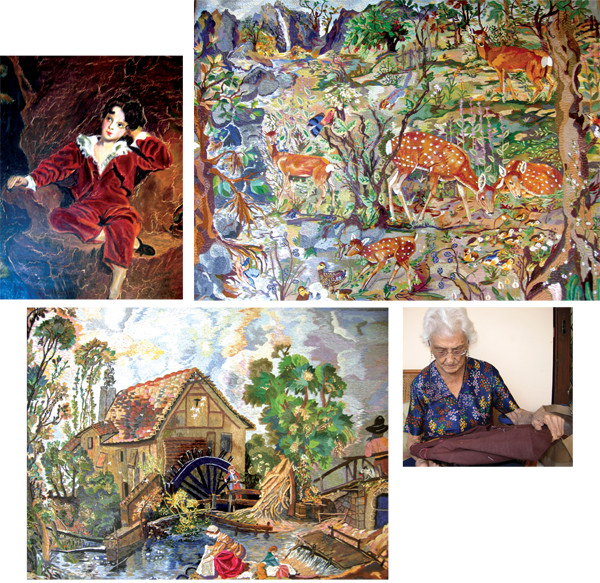
Top (left): Master Lambton (painting), A forest scene and The hay wain (embroideries), Jerbai Bardi at work
Matrimony followed, thanks to Khurshedji’s mother, and an idyllic honeymoon in Kashmir in the early 1930s. Their first child Aspi soon arrived. "He was a premature, three-and-a-half pound baby. I was still doing my MSc so my mother used to look after him,” Jerbai narrates. Second baby Dhanoo came 10 years later. When Jerbai was not yet 40, the doctor pulled out all 32 teeth in four days! "I used to love painting but I would break out in an allergy. The doctor said it was due to pus, so he pulled out all my teeth! But the allergy persisted and it was probably due to the cooking on a sigri (coal fire) we used to do in those days. The allergy disappeared when cooking gas arrived! But in the meantime I had to give up painting,” she regrets.
"While studying at Wilson College, my grandmother started working in a Christian missionary organization that used to help raise money, sell books, collect old clothes and materials to help the poor in Bombay,” relates Behnaz. After Independence, the organization crumbled with all the foreign members leaving India. Bardi then requested the priest in charge to allow her and friend Coomi Munshi to continue the work with Indian members. "He told her that if she was willing to convert to Christianity he would allow her to do so. She felt so insulted that she told herself that she was determined to help people without losing her faith,” continues Behnaz. The Selfless Service Circle was started in 1957 with Bardi and Munshi. Soon she found friends who had the same compelling need to help people and so they met every week and put some personal money aside in a box. On her own Bardi embroidered and painted canvasses that she sold, donating the money to various charities. "She did not believe in giving anything away, even to her children. They were required to purchase her paintings and tapestries,” adds Dhanoo. Currently the Selfless Service Circle has Gul Engineer, Hilloo Damkevala, Pilloo Soonawalla and her daughter Kamal, Minku Subedar, Aloo Khambata, Dhanoo Khusrokhan…, Jerbai recounts the names. "If someone was absent (when they met every week), they would send the money,” she recalls. Each year they would organize a jumble sale by collecting old or unused clothes, shoes, pots and pans and other household articles, selling them at a nominal price. The money collected would be disbursed to the free wards at the B. D. Petit Parsee General, J. J. and Masina hospitals, the Shanti Avedna Ashram, Dadar Parsi Youths Assembly, Cama Athornan Educational Fund, etc and for scholarships for needy boys. "Except when she was in hospital with a broken leg, my mother is always present at the jumble sales. She can’t stand people stealing. She will catch all the chors (thieves),” laughs Dhanoo.
"Jerbai is extremely focused,” remarks Soonawalla. "For her at her age to do things so efficiently is a great achievement. It sums up her personality.” Working with Bardi on the Rayomand Committee (formed to guide and advise on the allotment of flats in seven buildings of Godrej Baug when they were under construction), Soonawalla recalls that Bardi was sharp in her observations and comments, ticking off people in no uncertain terms if they so deserved. "We would visit applicants’ homes at seven in the morning, to take them by surprise and verify facts. The reality often turned out different from what was stated in their applications!” Bardi later resigned from the Committee on a matter of principle. "I have known her for 40 years, since my college days. She is a spirited and determined lady,” says Khambata. Brave enough to go it alone too, without family members when she was in her 80s, on adventure walks in the Canadian Rockies, walking stick in hand, to the utter shock of the youngsters in the group!
Has there been anyone who has greatly influenced you? we ask the nonagenarian. Pat comes the answer: "Who will influence me? I used to influence others! ‘Daredevil’ they used to call me! I wanted to go everywhere and do everything, whether I knew it or not!”
"Granny always taught us that nothing is impossible. As my brother and I were growing up, we witnessed how she put the great quality of ‘giving’ to use and made a difference to several Parsis in India,” remarks Behnaz.
Given the current state of affairs in the community and our dwindling numbers, Bardi does not see much future for the Parsis. "Children of mixed marriages should be brought into the fold, and if the spouse so chooses, he should too, if he learns our prayers and studies our religion,” she asserts, referring to Parsi girls marrying out. Bardi advocates strict selection norms for universal adult franchise for the election of Bombay Parsi Punchayet trustees. Trusteeship candidates should be graduates at least, have a clean background with no past misdemeanors and should follow the tenets of the Zoroastrian religion, she believes.
As far as charity is concerned, "people don’t want to work like before. The utsah (enthusiasm) to do things for others is absent,” says the lady who believes, in the words of her own poetry: "Alas the willing hands are all too few; the providential charity must work through human agency; great is the honor if He chooses you.”
◆ ◆ ◆
From the archive